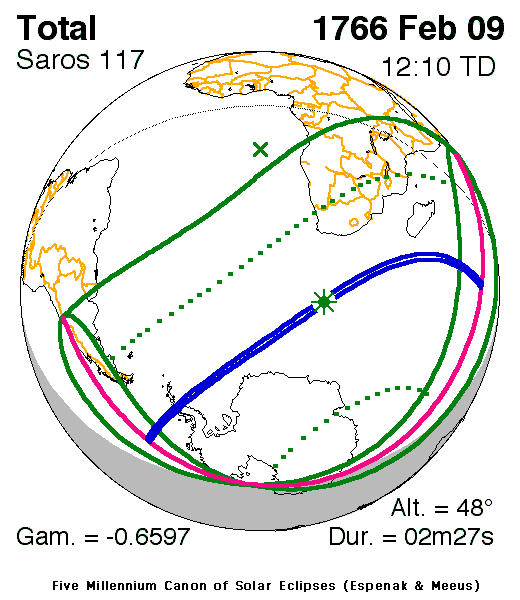
Solar eclipse of February 9, 1766
Jump to navigation
Jump to search
| Total eclipse | |
 Map | |
| Gamma | −0.6598 |
|---|---|
| Magnitude | 1.0352 |
| Maximum eclipse | |
| Duration | 147 s (2 min 27 s) |
| Coordinates | Lua error: callParserFunction: function "#coordinates" was not found. |
| Max. width of band | 156 km (97 mi) |
| Times (UTC) | |
| Greatest eclipse | 12:09:44 |
| References | |
| Saros | 117 (55 of 71) |
| Catalog # (SE5000) | 8954 |
A total solar eclipse occurred on Sunday, February 9, 1766. A solar eclipse occurs when the Moon passes between Earth and the Sun, thereby totally or partly obscuring the image of the Sun for a viewer on Earth. A total solar eclipse occurs when the Moon's apparent diameter is larger than the Sun's, blocking all direct sunlight, turning day into darkness. Totality occurs in a narrow path across Earth's surface, with the partial solar eclipse visible over a surrounding region thousands of kilometres wide.
Observations
[edit | edit source]
Related eclipses
[edit | edit source]It is a part of solar Saros 117.
References
[edit | edit source]Wikimedia Commons has media related to [[commons:Lua error in Module:WikidataIB at line 506: attempt to index field 'wikibase' (a nil value).|Lua error in Module:WikidataIB at line 506: attempt to index field 'wikibase' (a nil value).]].
- Lua error in Module:Citation/CS1/Configuration at line 2172: attempt to index field '?' (a nil value).
- NASA chart graphics
- Googlemap
- NASA Besselian elements
.jpg)