Rabud
Rabud | |
|---|---|
| Arabic transcription(s) | |
| • Arabic | رابود |
| • Latin | Khirbet Rabud (official) |
| Rabud Rabud | |
| Lua error in Module:Location_map at line 411: Malformed coordinates value. | |
| Coordinates: Lua error in Module:Coordinates at line 489: attempt to index field 'wikibase' (a nil value). | |
| Palestine grid | 151/093 |
| State | State of Palestine |
| Governorate | Hebron |
| Government | |
| • Type | Village council (from 1993) |
| • Head of Municipality | Muhammad Huraibat[1] |
| Area | |
• Total | 2.2 km2 (0.85 sq mi) |
| Population (2017)[2] | |
• Total | 2,816 |
| • Density | 1,300/km2 (3,300/sq mi) |

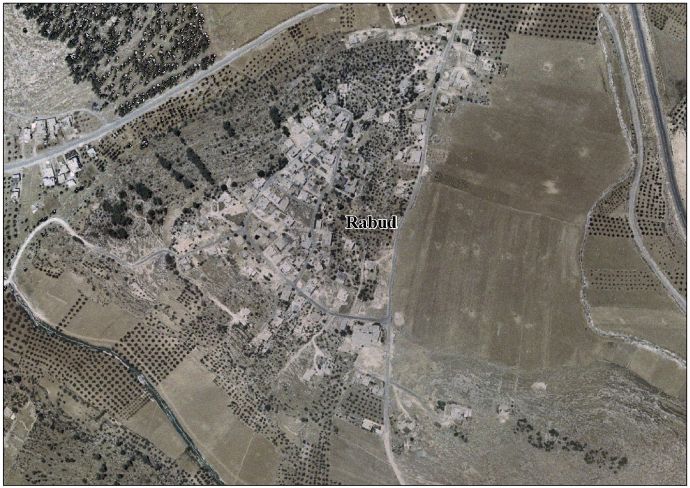
Rabud (Arabic: رابود, also known as Khirbet Rabud) is a Palestinian village in the southern West Bank, in the Hebron Governorate of the State of Palestine. The village was the site of an ancient Canaanite and Judahite city. The village had a population of 2,816 in 2017.[2]
Etymology
[edit | edit source]According to Palmer, the name Khirbet Rabud means "the ruin of the animal's lair".[3]
Demographics
[edit | edit source]Part of the Hebron Governorate of Palestine, it is located 13 kilometers southwest of Hebron and about 5 km northwest of as-Samu. Rabud had a population of 2,262 in the 2007 census by the Palestinian Central Bureau of Statistics (PCBS).[4] According to research by the Applied Research Institute-Jerusalem, Rabud's history dates back to the Canaanite period in Palestine, but the modern inhabitants of the village migrated from the Arabian Peninsula.[5] The principal families are the Huraibat, Quteinah, al-Uqela and Shanan.[5]
History
[edit | edit source]Antiquity
[edit | edit source]Rabud is thought to lie on the site of the ancient Judean Kohanic city of Kiryat Sefer or Debir (Joshua 21:15).[6][7] The archaeologist William G. Dever estimates its population at around 1,500 during the 9th and 8th centuries BCE.[7] One of the stratigraphic levels at the site (B-II) shows evidence of destruction, likely from Sennacherib's campaign in Judah in the late 8th century, and at least one LMLK jar handle has been found there.[7] By the 7th century BCE, the site of Khirbet Rabud had grown to a relatively large town that featured both a fortified city and an unwalled settlement. Both were razed when the First Temple was destroyed (587-6 BCE). It saw limited settlement during the Persian period.[8]
Late Antiquity
[edit | edit source]Ceramics from the Byzantine era have been found here.[9]
Ottoman period
[edit | edit source]In 1863, Victor Guérin found here "caves and cisterns dug into the rock, ...small demolished houses and, on the highest point, the remains of a roughly built tower". North and south-east of this place were two pierced walls, with many caves. Guérin named them Heurkan Beni Hasan.[10][11]
In 1883, the PEF's Survey of Western Palestine found here "walls, cisterns, and rude cave tombs."[11]
British Mandate period
[edit | edit source]The 1931 census of Palestine wrote that "the village in the Hebron sub-district commonly known as Dura is a congeries of neighbouring localities each of which has a distinctive name; and, while Dura is a remarkable example of neighbourly agglutination, the phenomenon is not infrequent in other villages". The total of 70 locations, among them Kh. Rabud, listed in the report had 1538 occupied houses and a population of 7255 Muslims.[12]
Jordanian period
[edit | edit source]In the wake of the 1948 Arab–Israeli War, and after the 1949 Armistice Agreements, Rabud came under Jordanian rule.
In 1961, the population of Rabud was 206.[13]
Post-1967
[edit | edit source]After the Six-Day War in 1967, Rabud has been under Israeli occupation.
A village council was established by the Palestinian National Authority in 1993 to administer Rabud's civil affairs and provide limited municipal services.[5] There is currently one mosque, Salah ad-Din Mosque, which serves the village.
References
[edit | edit source]- ^ Rabud Profile. Jerusalem Media and Communications Center (JMCC).
- ^ a b Lua error in Module:Citation/CS1/Configuration at line 2172: attempt to index field '?' (a nil value).
- ^ Palmer, 1881, p 401
- ^ 2007 PCBS Census. Palestinian Central Bureau of Statistics (PCBS).
- ^ a b c Rabud Village Profile. Applied Research Institute-Jerusalem (ARIJ). 2009.
- ^ Trevor Bryce (2009). The Routledge Handbook of the Peoples and Places of Ancient Western Asia: From the Early Bronze Age to the Fall of the Persian Empire. Taylor & Francis. p. 588. ISBN 978-0-415-39485-7
- ^ a b c Lua error in Module:Citation/CS1/Configuration at line 2172: attempt to index field '?' (a nil value).
- ^ Lua error in Module:Citation/CS1/Configuration at line 2172: attempt to index field '?' (a nil value).
- ^ Dauphin, 1998, p. 967
- ^ Guérin, 1869, p. 370
- ^ a b Conder and Kitchener, 1883, SWP III, p. 360
- ^ Mills, 1932, pp. Preface, 28–32
- ^ Government of Jordan, Department of Statistics, 1964, p. 22
Bibliography
[edit | edit source]- Lua error in Module:Citation/CS1/Configuration at line 2172: attempt to index field '?' (a nil value).
- Lua error in Module:Citation/CS1/Configuration at line 2172: attempt to index field '?' (a nil value).
- Lua error in Module:Citation/CS1/Configuration at line 2172: attempt to index field '?' (a nil value).
- Lua error in Module:Citation/CS1/Configuration at line 2172: attempt to index field '?' (a nil value).
- Lua error in Module:Citation/CS1/Configuration at line 2172: attempt to index field '?' (a nil value).
- Lua error in Module:Citation/CS1/Configuration at line 2172: attempt to index field '?' (a nil value).
External links
[edit | edit source]
- Welcome to Khirbat Rabud
- Rabud, Welcome to Palestine
- Survey of Western Palestine, Map 21: IAA, Wikimedia commons
- Rabud village (fact sheet), Applied Research Institute–Jerusalem (ARIJ)
- Rabud village profile, ARIJ
- Rabud aerial photo, ARIJ
- The priorities and needs for development in Rabud village based on the community and local authorities’ assessment, ARIJ
- Rabud, google-map


Lua error in Module:Authority_control at line 153: attempt to index field 'wikibase' (a nil value).