Fa gao
 | |
| Type | Pastry |
|---|---|
| Place of origin | China |
| Main ingredients | flour (usually rice flour), leavening (traditionally yeast), sugar |
| Similar dishes | Htanthi mont, Bánh bò, Kue mangkok |
| |
| Fa gao | |||||||||||||
|---|---|---|---|---|---|---|---|---|---|---|---|---|---|
| Traditional Chinese | 發糕 | ||||||||||||
| Simplified Chinese | 发糕 | ||||||||||||
| |||||||||||||
| Alternative Chinese name | |||||||||||||
| Traditional Chinese | 發粿 | ||||||||||||
| |||||||||||||
| Second alternative Chinese name | |||||||||||||
| Traditional Chinese | 發粄 | ||||||||||||
| |||||||||||||
Fa gao (traditional Chinese: 發糕; simplified Chinese: 发糕; pinyin: fāgāo; Cantonese Yale: faatgōu; Pe̍h-ōe-jī: hoat-koé), also called fat pan (發粄) by the Hakka,[1] prosperity cake,[2][3] fortune cake,[4] Cantonese sponge cake,[5] is a Chinese steamed, cupcake-like pastry.[6] Because it is often characterized by a split top when cooked, it is often referred as Chinese smiling steamed cake or blooming flowers.[6] It is commonly consumed on the Chinese new year.[7] It is also eaten on other festivals, wedding, and funerals by the Hakka people.[8]
Symbolism
[edit | edit source]The name of cake, fagao, is a homonym for "cake which expands" and "prosperity cake" as "fa" means both "prosperity" and "expand" and "gao" means "cake".[7]
The Hakka call the "top split" of the fa ban "xiao", which means smiling. It is said to be a sign of a coming fortune: the bigger the "top split", the better.[8]
Preparation
[edit | edit source]The cake is made of flour (usually rice flour), leavening (traditionally yeast, but can be chemical leavening),[7] sugar or another sweetener; it is then steamed (instead of baked) on high heat until the top splits into a characteristic "split top" of four segments, or sometimes 3 sections.[6] The batter is typically left to rest for fermentation prior to being steam-cooked.
These cakes, when used to encourage prosperity in the new year, are often dyed bright colours.[citation needed] The most common colours traditionally are white and pink, but it can also be turned brown by adding palm sugar.[6]
Influences in Asia
[edit | edit source]Singapore
[edit | edit source]Chinese Singaporeans use fa gao as offerings during ancestral worship.[5][4]
Thailand
[edit | edit source]In Thailand, this type of cake is called Khanom thuai fu (Thai: ขนมถ้วยฟู, pronounced [kʰā.nǒm tʰûaj fuː˧]), which translates to "fluffy snack in a cup". It is one of nine auspicious Thai desserts, because its name has an auspicious meaning, conveying prosperity or progress.[9]
Influences outside Asia
[edit | edit source]Mauritius
[edit | edit source]In Mauritius, the fa gao is known as "poutou chinois" (lit. 'Chinese puttu') or "poutou rouge" (lit. 'red puttu' in French).[10][11] It is called "pot pan" (發粄/发粄; fa ban) by the Mauritians of Hakka descent.[12] Fa gao in Mauritius is typically pink in colour,[13][14] and it is eaten on Chinese New Year.[10][11] However, it is actually sold and eaten all year long.
Gallery
[edit | edit source]-
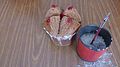 Incense stick and fa gao.
 -
 Mauritian Poutou Chinois.


See also
[edit | edit source]- List of cakes
- List of pastries
- Lua error in mw.title.lua at line 392: bad argument #2 to 'title.new' (unrecognized namespace name 'Portal').
References
[edit | edit source]- ^ Lua error in Module:Citation/CS1/Configuration at line 2172: attempt to index field '?' (a nil value).
- ^ Lua error in Module:Citation/CS1/Configuration at line 2172: attempt to index field '?' (a nil value).
- ^ Lua error in Module:Citation/CS1/Configuration at line 2172: attempt to index field '?' (a nil value).
- ^ a b Lua error in Module:Citation/CS1/Configuration at line 2172: attempt to index field '?' (a nil value).
- ^ a b Lua error in Module:Citation/CS1/Configuration at line 2172: attempt to index field '?' (a nil value).
- ^ a b c d Lua error in Module:Citation/CS1/Configuration at line 2172: attempt to index field '?' (a nil value).
- ^ a b c Lua error in Module:Citation/CS1/Configuration at line 2172: attempt to index field '?' (a nil value).
- ^ a b Lua error in Module:Citation/CS1/Configuration at line 2172: attempt to index field '?' (a nil value).
- ^ Lua error in Module:Citation/CS1/Configuration at line 2172: attempt to index field '?' (a nil value).
- ^ a b Lua error in Module:Citation/CS1/Configuration at line 2172: attempt to index field '?' (a nil value).
- ^ a b Lua error in Module:Citation/CS1/Configuration at line 2172: attempt to index field '?' (a nil value).
- ^ Lua error in Module:Citation/CS1/Configuration at line 2172: attempt to index field '?' (a nil value).
- ^ Lua error in Module:Citation/CS1/Configuration at line 2172: attempt to index field '?' (a nil value).
- ^ Lua error in Module:Citation/CS1/Configuration at line 2172: attempt to index field '?' (a nil value).


Lua error in mw.title.lua at line 392: bad argument #2 to 'title.new' (unrecognized namespace name 'Portal').