
NGC 681
| NGC 681 | |
|---|---|
 legacy surveys image of NGC 681 | |
| Observation data (J2000 epoch) | |
| Constellation | Cetus |
| Right ascension | 01h 49m 10.829s[1] |
| Declination | −10° 25′ 35.13″[1] |
| Redshift | 0.00587 ± 0.00002[1] |
| Heliocentric radial velocity | 1760.4 ± 6.6 km/s[1] |
| Distance | ~66.5 million ly (20.39 ± 1.45 Mpc)[1] |
| Group or cluster | MCG -02-05-053 Group (LGG 33) |
| Apparent magnitude (V) | 12[2] |
| Characteristics | |
| Type | SAB(s)ab |
| Mass | 1.9×10¹⁰[3] M☉ |
| Mass/Light ratio | 3.6[3] M☉/L☉ |
| Size | ~29.07 kpc (diameter)[1] |
| Apparent size (V) | 2.70 × 1.8 arcmin[2][4] |
| Other designations | |
| IRAS 01467-1040, MCG -02-05-052, PGC 6671[5] | |
NGC 681 is an intermediate spiral galaxy in the constellation of Cetus, located approximately 66.5 million light-years from Earth.[1][2][4]
NGC 681 is a member of the MCG -02-05-053 group (also known as LGG 33), which contains four galaxies, including NGC 701 and IC 1738.[6]
Observation history
[edit | edit source]NGC 681 was discovered by the German-born British astronomer William Herschel on 28 November 1785 and was later also observed by William's son, John Herschel.[2] John Louis Emil Dreyer, compiler of the first New General Catalogue of Nebulae and Clusters of Stars, described NGC 681 as being a "pretty faint, considerably large, round, small (faint) star 90 arcsec to [the] west" that becomes "gradually a little brighter [in the] middle".[2]
Physical characteristics
[edit | edit source]NGC 681 shares many structural similarities with the Sombrero Galaxy, M104, although it is smaller, less luminous, and less massive. Its thin, dusty disc is seen almost perfectly edge-on and features a small, very bright nucleus in the center of a very pronounced bulge.[7] Distinctly unlike M104, NGC 681's disc contains many H II regions, where star formation is likely to be occurring.[3][7] The galaxy has a mass of 1.9×10¹⁰ M☉, a mass-to-light ratio of 3.6
, and a spiral pattern which is asymmetrical.[3]
The SIMBAD database lists NGC 681 as a Seyfert II Galaxy, i.e. it has a quasar-like nucleus with very high surface brightnesses whose spectra reveal strong, high-ionisation emission lines, but unlike quasars, the host galaxy is clearly detectable.[8]
Supernova
[edit | edit source]One supernova has been observed in NGC 681. SN 2024abup (type Ib/c, mag. 17.018) was discovered by ATLAS on 22 November 2024.[9]
Image gallery
[edit | edit source]-
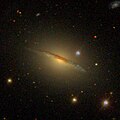 SDSS image of NGC 681

See also
[edit | edit source]References
[edit | edit source]- ^ a b c d e f g Lua error in Module:Citation/CS1/Configuration at line 2172: attempt to index field '?' (a nil value).
- ^ a b c d e Lua error in Module:Citation/CS1/Configuration at line 2172: attempt to index field '?' (a nil value).
- ^ a b c d Lua error in Module:Citation/CS1/Configuration at line 2172: attempt to index field '?' (a nil value).
- ^ a b Lua error in Module:Citation/CS1/Configuration at line 2172: attempt to index field '?' (a nil value).
- ^ Lua error in Module:Citation/CS1/Configuration at line 2172: attempt to index field '?' (a nil value).
- ^ Lua error in Module:Citation/CS1/Configuration at line 2172: attempt to index field '?' (a nil value).
- ^ a b Lua error in Module:Citation/CS1/Configuration at line 2172: attempt to index field '?' (a nil value).
- ^ Lua error in Module:Citation/CS1/Configuration at line 2172: attempt to index field '?' (a nil value).
- ^ Lua error in Module:Citation/CS1/Configuration at line 2172: attempt to index field '?' (a nil value).
External links
[edit | edit source]- Error creating thumbnail: File missing Media related to Lua error in Module:Commons_link at line 62: attempt to index field 'wikibase' (a nil value). at Wikimedia Commons

