Corypha
| Corypha | |
|---|---|
| File:Corypha umbraculifera 1913.jpg | |
| Corypha umbraculifera painting (1913) | |
| Scientific classification Edit this classification | |
| Kingdom: | Plantae |
| Clade: | Tracheophytes |
| Clade: | Angiosperms |
| Clade: | Monocots |
| Clade: | Commelinids |
| Order: | Arecales |
| Family: | Arecaceae |
| Subfamily: | Coryphoideae |
| Tribe: | Corypheae |
| Genus: | Corypha L. |
| Synonyms[1] | |
| |
Corypha or the gebang palm, buri palm or talipot palm is a genus of palms (family Arecaceae), native to India, Malaysia, Indonesia, the Philippines, New Guinea and northeastern Australia (Cape York Peninsula, Queensland). They are fan palms (subfamily Coryphoideae), and the leaves have a long petiole terminating in a rounded fan of numerous leaflets.
All are large palms with leaves ranging from 2–5 metres in length. They reach heights of 20–40 m and with a trunk diameter of up to 1-2.5 m. All the species are monocarpic and die after flowering. The genus is relatively slow growing and can take many years to form a trunk.
Species include:[2]
| Flower | Name | Common name | Distribution |
|---|---|---|---|
| File:Corypha lecomtei.jpg | Corypha lecomtei Becc. ex Lecomte | Thailand, Vietnam, Laos, Cambodia | |
| Corypha microclada Becc. | Philippines | ||
| File:Corypha taliera Md Sharif Hossain Sourav.jpg | Corypha taliera Roxb. | India: West Bengal, Bangladesh, Myanmar | |
| File:Corypha umbraculifera-flowering.JPG | Corypha umbraculifera L. | Talipot palm | Sri Lanka, southern India; naturalized in Thailand, Cambodia, Myanmar, Andaman Islands, Mauritius |
| File:CabbagePalm01.jpg | Corypha utan Lam.(syn. C. elata, C. gebang) | Gebang palm, buri palm or cabbage palm | India: Assam, Andaman Islands, Indochina, Malaysia, Indonesia, Philippines, New Guinea, Australia: Queensland, Northern Territory |
Gallery
[edit | edit source]-
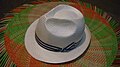 A traditional Filipino buntal hat made from buri palm Corypha (gebang palm, buri palm or talipot palm, genus of palms (fanily Arecaceae)
 -
 Buri palm with fruits
 -
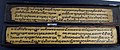 Old Sundanese gebang manuscript, Sanghyang Raga Dewata, from Museum Sri Baduga collection in West Java, Indonesia


Uses
[edit | edit source]In the Philippines, buri trees, like the sago palm, are used as sources of starch made into starch balls called landang. These are traditionally cooked into various desserts and dishes, most notably the binignit.[3]
The leaves are often used for thatching or can be woven into baskets, etc. Three kinds of fibres, namely buri (unopened leaf fibers), raffia (mature leaf fibers), and buntal (leaf petiole fiber), may be obtained from the plant. The midrib of the leaves are also used for weaving hats in the Philippines known as calasiao hats.[4] The Buntal Hat Festival is celebrated in Baliuag, Bulacan yearly every 6th of May.[5][6]
References
[edit | edit source]- ^ Lua error in Module:Citation/CS1/Configuration at line 2172: attempt to index field '?' (a nil value).
- ^ Lua error in Module:Citation/CS1/Configuration at line 2172: attempt to index field '?' (a nil value).
- ^ Lua error in Module:Citation/CS1/Configuration at line 2172: attempt to index field '?' (a nil value).
- ^ Lua error in Module:Citation/CS1/Configuration at line 2172: attempt to index field '?' (a nil value).
- ^ Philippine Travel Blog: Buntal Hat festival launched in Baliuag Bulacan Archived 2012-12-26 at the Wayback Machine
- ^ The Philippine Star: Baliuag celebrates buntal weaving
- PACSOA: Corypha index
- PACSOA: Corypha utan in Australia
- Kunth, Karl Sigismund Corypha miraguama, Nov. Gen., 1816, 1, p. 298. Accessed 2012-8-4.
- The Old Market Gardens and Nurseries of London — No. 10, (52 MB file from archive.org) Journal of Horticulture, Cottage Gardner v. 57, 29 March 1877, p. 238. Accessed 2012-7-31. The Journal records John Fraser as bringing Corypha miraguama back from Cuba in 1807. See also Kunth, 1816, same location.
External links
[edit | edit source]

Lua error in Module:Taxonbar at line 165: attempt to index field 'wikibase' (a nil value).