Rantis
Rantis | |
|---|---|
| Arabic transcription(s) | |
| • Arabic | رنتيس |
| • Latin | Rantes (official) |
| Rantis Rantis | |
| Lua error in Module:Location_map at line 411: Malformed coordinates value. | |
| Coordinates: Lua error in Module:Coordinates at line 489: attempt to index field 'wikibase' (a nil value). | |
| Palestine grid | 151/159 |
| State | State of Palestine |
| Governorate | Ramallah and al-Bireh |
| Government | |
| • Type | Village council |
| Area | |
• Total | 11.0 km2 (4.2 sq mi) |
| Population (2017)[1] | |
• Total | 3,179 |
| • Density | 289/km2 (749/sq mi) |
| Name meaning | Rentis, personal name[2] |
| Time zone | UTC+03:00 |

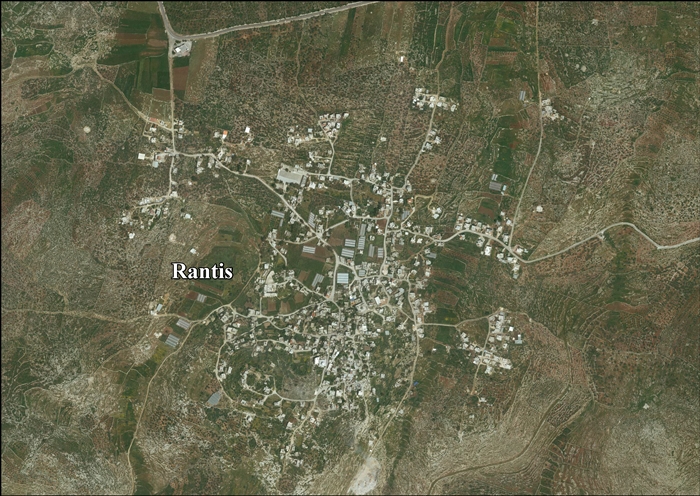
Rantis (Arabic: رنتيس) is a Palestinian town in the West Bank, located in the northwestern Ramallah and al-Bireh Governorate, 33 kilometers northwest of Ramallah. According to the Palestinian Central Bureau of Statistics, it had a population of 3,179 in 2017.[1] Its population consists primarily of six clans: Danoun, Wahdan, Khallaf, Ballot, Dar Abo Salim, al-Ryahee and Hawashe.[3]
Rantis has a land area 11,046 dunams of which 589 dunams are built-up area.[3] The town's main economic sector is agriculture and 20% of its land area is planted with crops. There are two primary schools and two kindergartens. Other facilities include three clinics, a bus station, a club and two mosques.[3]
Location
[edit | edit source]Rantis is located 22.2 km northwest of Ramallah. It is bordered by Al Lubban al Gharbi and Abud land to the east, Al Lubban al Gharbi village land to the north, Israel to the west and Shuqba to the south.[4]
Connection to Arimathea of the Gospels
[edit | edit source]All the four Gospels mention Joseph of Arimathea, the man who placed Christ's body in his own tomb.[5] Conflicting traditions urge[clarification needed] Arimathea's location at modern Rantis, 15 miles east of Jaffa.[6][clarification needed] A monastery dedicated to Joseph of Arimathea was erected there.[when?][6] Other suggestions for Arimathea include ar-Ram and al-Bireh-Ramallah, 5 and 8 miles north of Jerusalem, respectively.[6]
Both Eusebius and Jerome identify Arimathea with the birthplace of biblical prophet Samuel.[6] Strong mediaeval traditions supporting this claim celebrated this place as the prophet's original home.[6] In the 4th century, Jerome reported that his friend, Saint Paula, visited the location.[6]
History
[edit | edit source]Prehistory
[edit | edit source]In a nearby cave, flint artefacts have been found, possibly produced during the Middle Paleolithic period, occasionally by the Levallois technique.[7]
Iron Age to Byzantine period
[edit | edit source]The Survey of Western Palestine assumed the village was "ancient", as rock-cut tombs were found south-west of the village.[8]
Archaeological excavation have uncovered sherds from the Iron Age and Persian period.[9]
In 145 BCE, Rentis, then known as Rathamin, was cut off from Samaria and incorporated into Judaea. It served as a toparchy's headquarters before Thamna took its position.[10]
Other archaeological finds include remains of a road and a building from the Roman period.[9] A building, probably dating to the Byzantine period, has also been excavated.[11]
Crusader period
[edit | edit source]During the Crusader period, it was known as Arimathia, Arimatie, Abarimatie, and Rantis.[12] By 1150, the Premonstratensians were represented in Rentis with a house.[12] In 1159–60, Crusader sources mention a church in the village.[12][13]
In 1187 Rantis was conquered by Saladin, and the Crusaders were never able to return despite the very fact that Amalric of Jerusalem used to rule the area before being succeeded to Sidon at around 1153.[12]
Ottoman period
[edit | edit source]16th century
[edit | edit source]Rantis was incorporated into the Ottoman Empire in 1517 with all of Palestine, and in 1596 it appeared in the tax registers as being in the Nahiya of Jabal Qubal of the Liwa of Nablus. It had a population of 20 households and 2 bachelors, all Muslim. The villagers paid a fixed tax-rate of 33.3% on agricultural products, including wheat, barley, summer crops, olive trees, goats and/or beehives, and a wine- or olive press; a total of 2,500 Akçe.[14]
19th century
[edit | edit source]In 1838, Edward Robinson noted it as a village, Rentis, in the Jurat Merda district, south of Nablus.[15]
The French explorer Victor Guérin visited the village in 1870, and found that it had 400 inhabitants, and that it was surrounded by olives and tobacco-plantations.[16]
In 1870/71 (1288 AH), an Ottoman census listed the village in the nahiya (sub-district) of Jamma'in al-Awwal, subordinate to Nablus.[17]
In 1882, the PEF's Survey of Western Palestine (SWP) described Rantis as a village, principally made of adobe, on a slope, surrounded by open ground and a few olive trees. Water was supplied by cisterns. The SWP assumed the village was "ancient", as rock-cut tombs were found there.[18]
British Mandate
[edit | edit source]In the 1922 census of Palestine conducted by the British Mandate authorities, Rantis had a population of 824 inhabitants, all Muslims,[19] increasing in the 1931 census to 954, still all Muslims, in a total of 213 houses.[20]
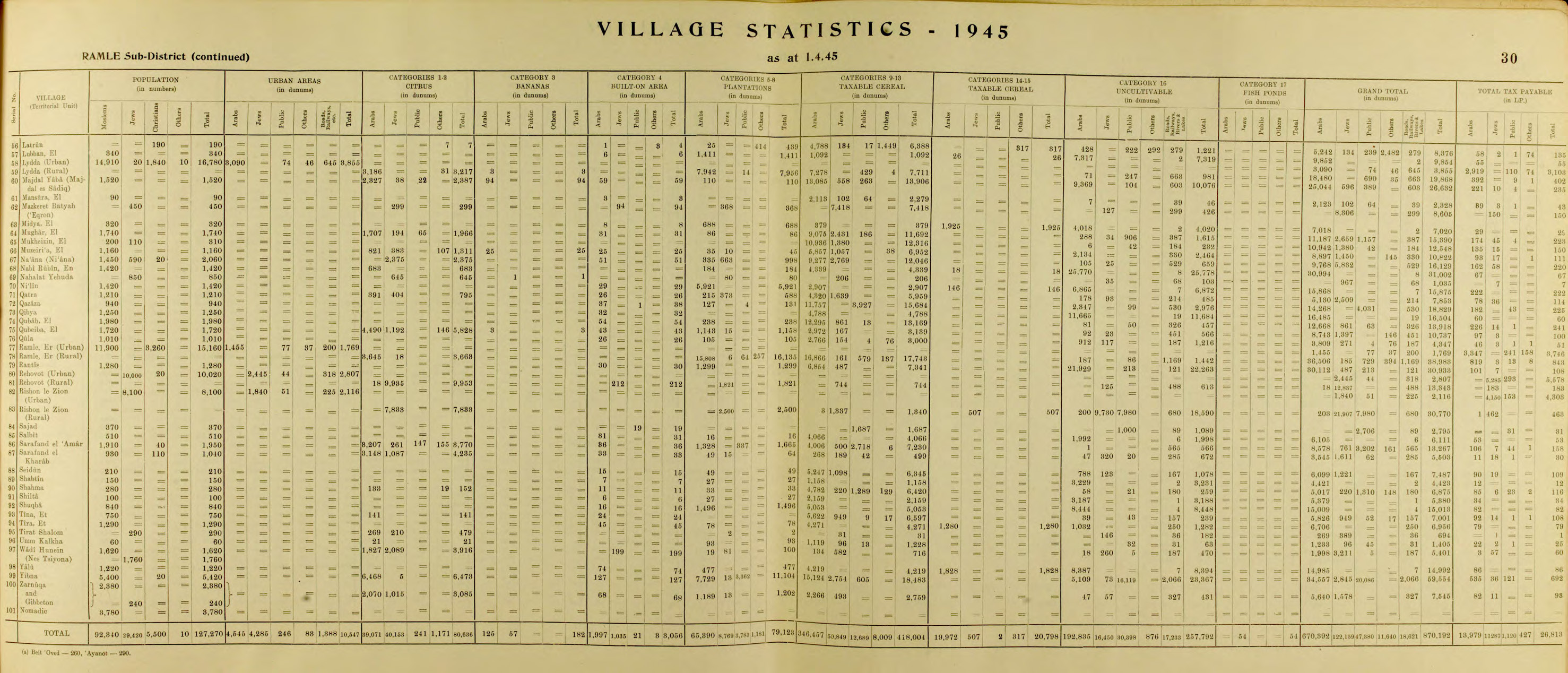
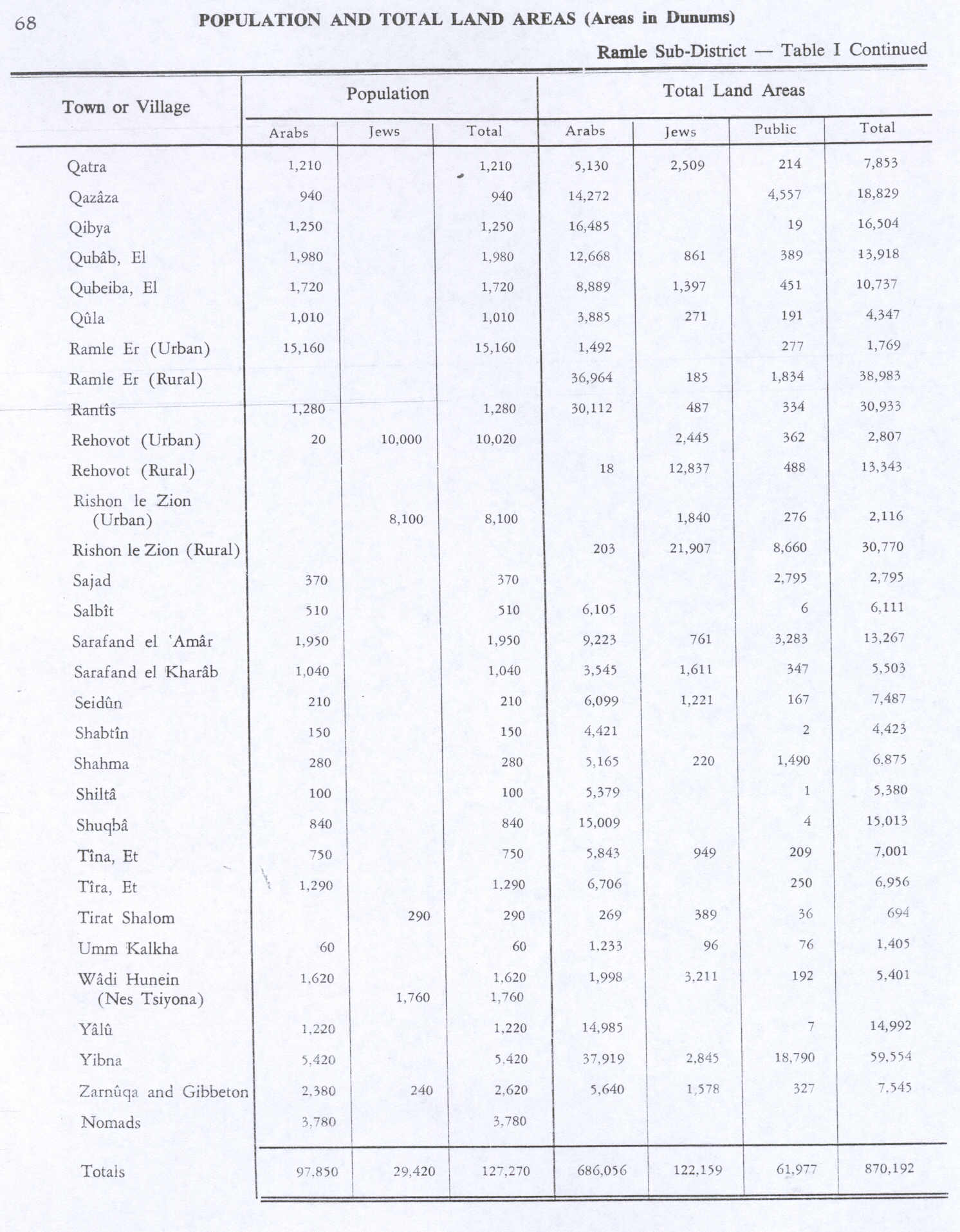
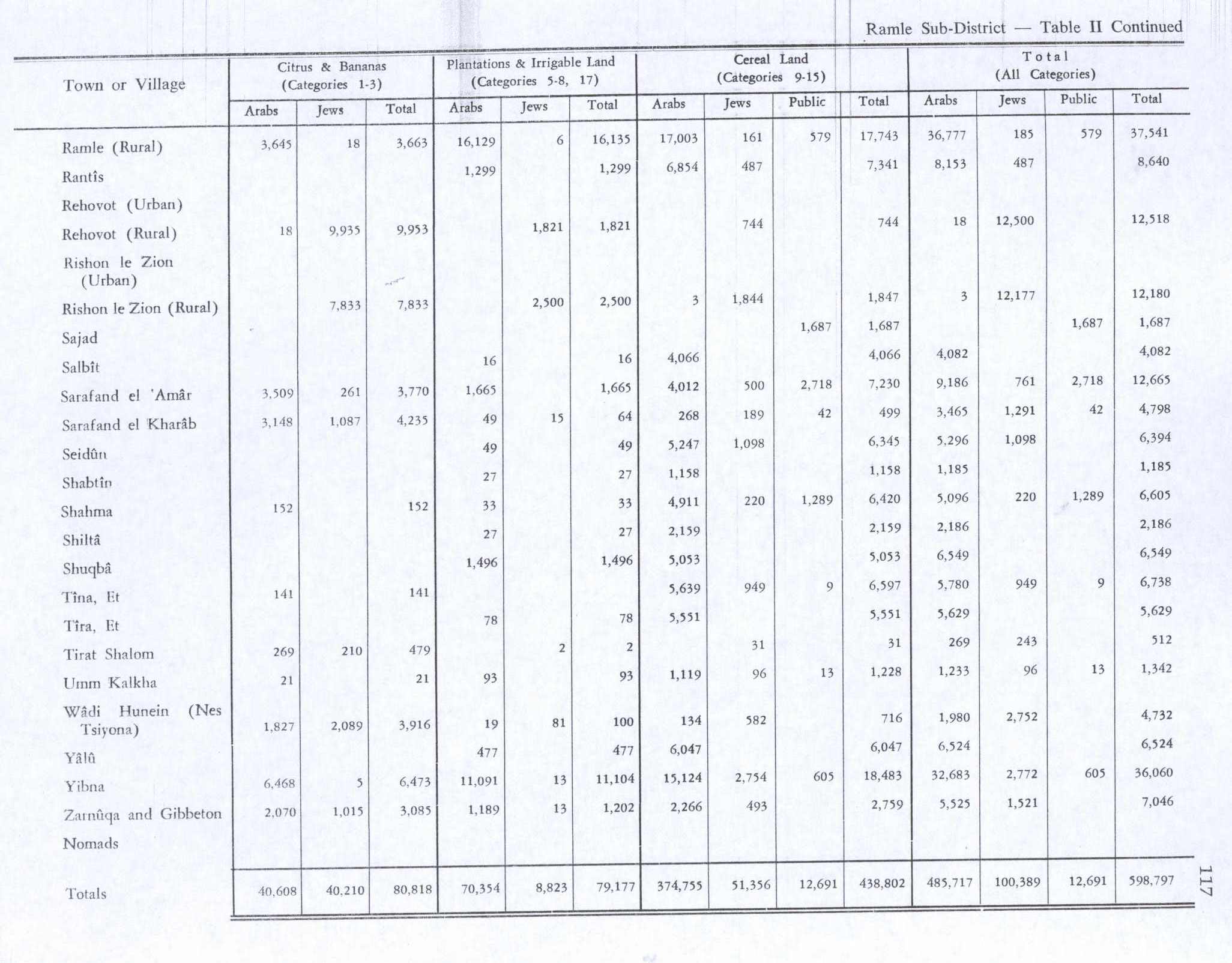
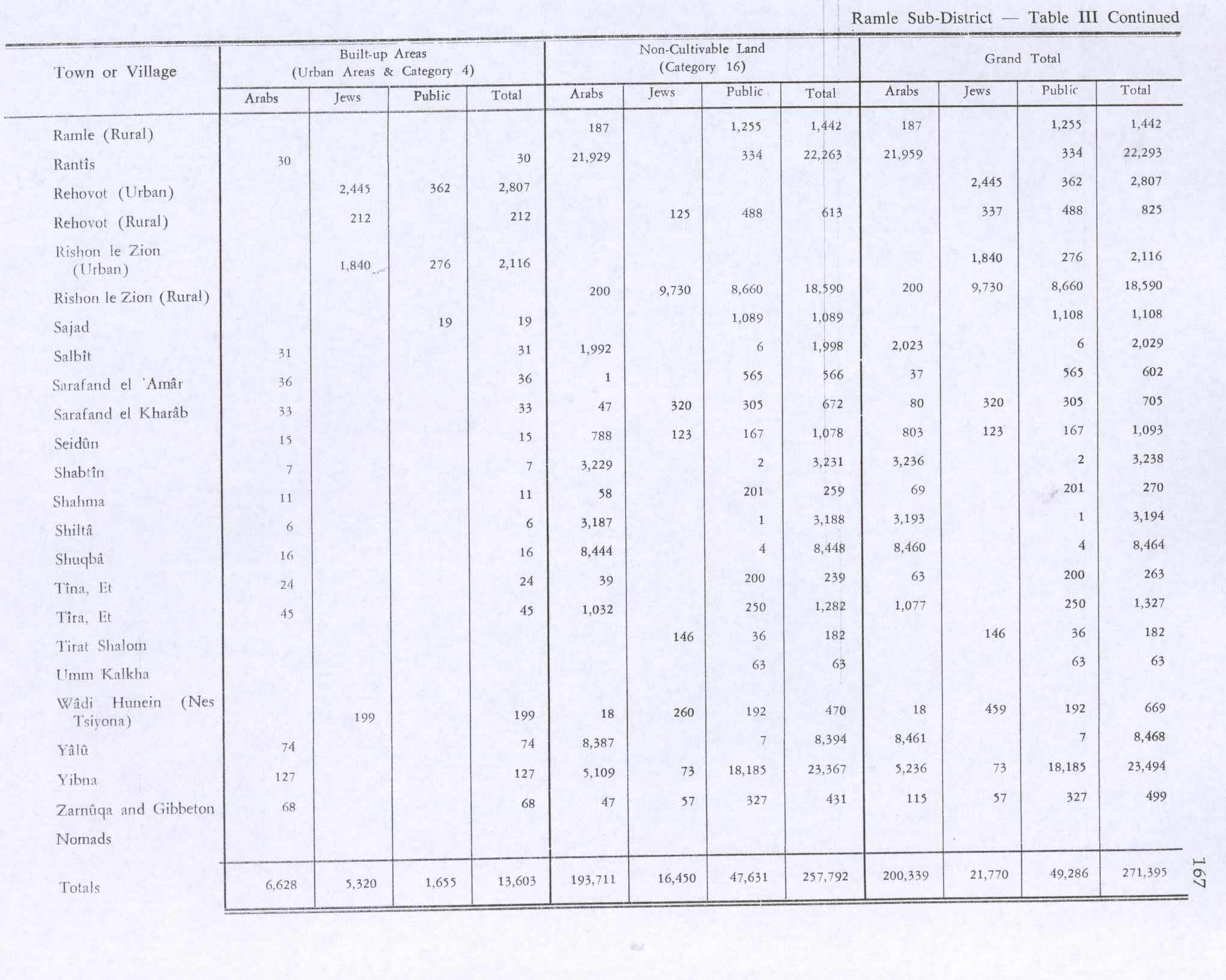
In the 1945 statistics, the population was of 1,280, all Muslims,[21] while the total land area was 30,933 dunams, according to an official land and population survey.[22] Of this, 1,299 were allocated for plantations and irrigable land, 7,341 for cereals,[23] while 30 dunams were classified as built-up (urban) areas.[24]
-
Rantis 1944 1:20,000
-
Rantis 1945 1:250,000


Jordanian period (1948-1967)
[edit | edit source]In the wake of the 1948 Arab–Israeli War, and after the 1949 Armistice Agreements, Rantis came under Jordanian rule.
1953 Israeli raid
[edit | edit source]A report by Major General Vagn Bennike, Chief of Staff of the United Nations Truce Supervision Organization, to the United Nations Security Council read:
On 28–29 January 1953 Israeli military forces estimated at 120 to 150 men, using 2-inch mortars, 3-inch mortars, P.I.A.T. (projectors, infantry, anti-tank) weapons, bangalore torpedoes (long metal tubes containing an explosive charge), machine-guns, grenades and small arms, crossed the demarcation line and attacked the Arab villages of Falameh [Falāma, Falamya] and Rantis. At Falameh the mukhtar was killed, seven other villagers were wounded, and three houses were demolished. The attack lasted four and a half hours. Israel was condemned for this act by the Mixed Armistice Commission.[25][26]
1961 population numbers
[edit | edit source]In 1961, the population of Rantis was 1,539.[27]
Post-1967
[edit | edit source]After the Six-Day War in 1967, Rantis has been under Israeli occupation. The population in the 1967 census conducted by the Israeli authorities was 897, 27 of whom originated from Israeli territory.[28]
After the 1995 accords, about 12% of the village land was classified as Area B, while the remainder 88% was classified as Area C. According to ARIJ, Israel has confiscated village land to be used for bypass roads for Israeli settlements. The Israeli West Bank barrier will extend for 4 km on Rantis village land, and leave 1,815 dunams (16.6%) of the village land behind the barrier.[29]
References
[edit | edit source]- ^ a b Lua error in Module:Citation/CS1/Configuration at line 2172: attempt to index field '?' (a nil value).
- ^ Palmer, 1881, p. 241
- ^ a b c The Segregation Wall threatens the practice of territorial expansion in Rantis village Archived 2016-04-14 at the Wayback Machine Applied Research Institute - Jerusalem. 2004-06-26.
- ^ Rantis Village Profile, ARIJ, p. 4
- ^ Matthew 27:57; Mark 15:43; Luke 23:50–51; John 19:38.
- ^ a b c d e f Armathaim, also Arimathea - (Ranthis). Studium Biblicum Franciscanum - Jerusalem. [dead link]
- ^ Lupu et al, 2009, Rantis Cave
- ^ Conder and Kitchener, 1882, SWP II, p. 367
- ^ a b Elisha, 2011, Rantis (Northwest)
- ^ Lua error in Module:Citation/CS1/Configuration at line 2172: attempt to index field '?' (a nil value).
- ^ Elisha, 2013, Rantis, Spot Height 211
- ^ a b c d Pringle, 1998, pp. 199-200
- ^ de Roziére, 1849, pp. 131-133; pp. 133-135. Cited in Röhricht, 1893, RHH, pp. 94-95, Nos 358, 360
- ^ Hütteroth and Abdulfattah, 1977, p. 136
- ^ Robinson and Smith, 1841, vol 3, Appendix 2, p. 126
- ^ Guérin, 1875, p. 113
- ^ Lua error in Module:Citation/CS1/Configuration at line 2172: attempt to index field '?' (a nil value).
- ^ Conder and Kitchener, 1882, SWP II, pp. 286-287
- ^ Barron, 1923, Table VII, Sub-district of Ramleh, p. 22
- ^ Mills, 1932, p. 22.
- ^ Government of Palestine, Department of Statistics, 1945, p. 30
- ^ Government of Palestine, Department of Statistics. Village Statistics, April, 1945. Quoted in Hadawi, 1970, p. 68
- ^ Government of Palestine, Department of Statistics. Village Statistics, April, 1945. Quoted in Hadawi, 1970, p. 117
- ^ Government of Palestine, Department of Statistics. Village Statistics, April, 1945. Quoted in Hadawi, 1970, p. 167
- ^ UNSC official records, Report of Major General Vagn Bennike to 630th Meeting held on 27 October 1953 S/PV.630
- ^ Attacks on West Bank village Qibya, Gaza Bureij camp – UNTSO report (Bennike), SecCo debate, SecGen statement – Verbatim record
- ^ Government of Jordan, Department of Statistics, 1964, p. 24
- ^ Lua error in Module:Citation/CS1/Configuration at line 2172: attempt to index field '?' (a nil value).
- ^ Rantis Village Profile, ARIJ, pp. 16-17
Bibliography
[edit | edit source]- Lua error in Module:Citation/CS1/Configuration at line 2172: attempt to index field '?' (a nil value).
- Lua error in Module:Citation/CS1/Configuration at line 2172: attempt to index field '?' (a nil value).
- Lua error in Module:Citation/CS1/Configuration at line 2172: attempt to index field '?' (a nil value).
- Lua error in Module:Citation/CS1/Configuration at line 2172: attempt to index field '?' (a nil value).
- Lua error in Module:Citation/CS1/Configuration at line 2172: attempt to index field '?' (a nil value).
- Lua error in Module:Citation/CS1/Configuration at line 2172: attempt to index field '?' (a nil value). (pp. 179–181)
- Lua error in Module:Citation/CS1/Configuration at line 2172: attempt to index field '?' (a nil value).
- Lua error in Module:Citation/CS1/Configuration at line 2172: attempt to index field '?' (a nil value).
- Lua error in Module:Citation/CS1/Configuration at line 2172: attempt to index field '?' (a nil value).
- Lua error in Module:Citation/CS1/Configuration at line 2172: attempt to index field '?' (a nil value).
- Lua error in Module:Citation/CS1/Configuration at line 2172: attempt to index field '?' (a nil value).
- Lua error in Module:Citation/CS1/Configuration at line 2172: attempt to index field '?' (a nil value).
- Lua error in Module:Citation/CS1/Configuration at line 2172: attempt to index field '?' (a nil value).
- Lua error in Module:Citation/CS1/Configuration at line 2172: attempt to index field '?' (a nil value).
- Lua error in Module:Citation/CS1/Configuration at line 2172: attempt to index field '?' (a nil value).
- Lua error in Module:Citation/CS1/Configuration at line 2172: attempt to index field '?' (a nil value). (p. 414)
- Lua error in Module:Citation/CS1/Configuration at line 2172: attempt to index field '?' (a nil value).
- Lua error in Module:Citation/CS1/Configuration at line 2172: attempt to index field '?' (a nil value).
- Lua error in Module:Citation/CS1/Configuration at line 2172: attempt to index field '?' (a nil value).
External links
[edit | edit source]- Welcome To Rantis
- Rantis, Welcome to Palestine
- Survey of Western Palestine, Map 14: IAA, Wikimedia commons
- Rantis Village (Fact Sheet), Applied Research Institute–Jerusalem (ARIJ)
- Rantis Village Profile, (ARIJ)
- Rantis aerial photo, (ARIJ)
- Rantis.org


Lua error in Module:Authority_control at line 153: attempt to index field 'wikibase' (a nil value).