Half tower
A half tower (sometimes half-tower), open tower,[1] or open-gorged tower[2] (German: Schalenturm, Halbschalenturm or Schanzturm) is a fortified stone tower in an external wall or castle enceinte that is open, or only lightly constructed, at the rear. Towers of this type were used, for example, in city walls. City gates can also be incorporated into a type of half tower.
Description
[edit | edit source]Unlike closed towers, which were fully enclosed by walls, half towers were open on the inside, typically the side facing the city or the inner bailey of a castle. On this side, a wooden railing on individual floors stopped people or objects from falling off. Sometimes the open side was sealed with wooden planking or weaker timber framed walls. Towers that are fully open at the top and rear are open towers, whilst those only open on the lower floors (i.e., the top floor is walled and roofed) are partially open towers.[1]
Most half towers were semi-circular in plan, but some were rectangular.
Examples
[edit | edit source]- Semi-circular half towers
- Bergerschanzturm in Aachen, Germany
- Endingerturm in Rapperswil, Switzerland
- Haldenturm in Rapperswil
- Karlsturm in Aachen
- Schildturm in Aachen
- Dover Castle, Kent, England
- Framlingham Castle, Suffolk, England
- Orford Castle, Suffolk, England (possible)
- Wehrturm am Gänsbühl in Ravensburg, Germany
City or town wall towers
- Dinkelsbühl, Germany
- Bad Hersfeld, Germany
- Einbeck, Germany
- Freiburg im Üechtland, Switzerland
-
 Bitzenturm, Ahrweiler
 -
 Dinkelsbühl
 -
 Ravensburg
 -
 Sisteron (South France)


- Rectangular half towers
- Krichelenturm in Aachen
- Schänzchen in Aachen
- Porte d'Orange in Carpentras, France
Town wall towers in
- Payerne, Switzerland
- Ston, Croatia
- Głogów, Poland
- Avignon and Aigues-Mortes (illustrated)
-
 Payerne
 -
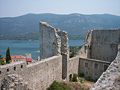 Ston
Ston -
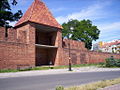 Głogów
 -
 Avignon, Aigues-Mortes


.jpg)

References
[edit | edit source]- ^ a b Kaufmann, J.E. and Kaufmann, H.W. (2001). The Medieval Fortress. Castles, Forts and Walled Cities of the Middle Ages, Da Capo, Cambridge, MA, p. 27. Lua error in Module:Citation/CS1/Configuration at line 2172: attempt to index field '?' (a nil value)..
- ^ Hull, Lise. Understanding the Castle Ruins of England and Wales: How to Interpret the History and Meaning of Masonry and Earthworks. London: MacFarland, 2009. p. 137. Lua error in Module:Citation/CS1/Configuration at line 2172: attempt to index field '?' (a nil value)..
Literature
[edit | edit source]- Lua error in Module:Citation/CS1/Configuration at line 2172: attempt to index field '?' (a nil value). (Online version, pdf, 6.61MB[permanent dead link])

