Beit Junblatt
| Beit Junblatt | |
|---|---|
بيت جنبلاط | |
 Beit Junblatt | |
| Lua error in Module:Location_map at line 415: attempt to index field 'wikibase' (a nil value). | |
| Alternative names | Qasr Junblatt |
| General information | |
| Type | Palace, Museum |
| Location | Aleppo, Syria, Al-Bandarah area, al-Farafira district Ancient Aleppo |
| Completed | 16th century |
| Cost | One thousand Ottoman gold lira |
| Client | Janpolad bek ibn Qasim |
| Technical details | |
| Floor count | 2 |
Beit Junblatt (Arabic: بيت جنبلاط) is a historic mansion that resides in Aleppo, Syria, built in the 16th century by a Kurdish emir of the Janbulad family.
Background
[edit | edit source]Beit Junblatt (Arabic: بيت جنبلاط); originally Janpolad Palace (Arabic: قصر جان بولاد), is a historic mansion in Aleppo, Syria, built during the 2nd half of the 16th century by a Kurdish emir of the Janbulad family, Janbulad ibn Qasim.[1] In 1604–1605, it briefly served as a residence for the Ottoman wāli of Aleppo Hussein Pasha Janpolad.[2]
The mansion is located at al-Bandarah area of al-Farafira district, within the walls of the Ancient City of Aleppo.[3] According to the Aleppine historian sheikh Kamel al-Ghazzi, emir Janpolad spent 1,000 Ottoman gold lira to build the palace. Since 1766, the palace became the property of al-Kawakibi family. In 1814, it then served as the residence of the mufti of Aleppo sheikh Hasan Afandi al-Kawakibi.
Beit Junblatt is believed to have the largest iwan in Aleppo, decorated with fine qashani ceramic-tiled mosaic wall, depicting several Persian-type inscriptions.[4] Like the vast majority of Arabic traditional houses, the square-shaped courtyard of the palace has a large water fountain in the centre mainly used for wudu. It has been described as one of the most beautiful palaces built in the city.[5]
However, many associated external buildings around the palace—including a military barrack and stables—were said to have been ruined during the 1960s. It was subsequently restored by the Kuwait-Syria-Arab Fund to serve as a cultural center and library.[6]
War damage
[edit | edit source]Beit Junblatt (Dar Janpolad) suffered material damage from fighting and looting during the Battle of Aleppo (2012–2016).[7][8] Numerous tiles were removed from the building's iwan allegedly to be shown as samples to international antiquities dealers.[9][10] Similar tiles were sold at a Western auction house in 2015.[11][2]
Gallery
[edit | edit source]-
 Beit Junblatt Iwan (2001)
 -
 Beit Junblatt (2001)
 -
 Beit Junblatt (2001)
 -
 Beit Junblatt (2001)
 -
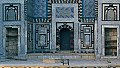 Beit Junblatt (2001)
 -
 Beit Junblatt (2018) missing decorative elements
 -
 Beit Junblatt Iwan (2018) Aleppo


References
[edit | edit source]- ^ Kurds in Lebanon
- ^ a b Lua error in Module:Citation/CS1/Configuration at line 2172: attempt to index field '?' (a nil value).
- ^ Lua error in Module:Citation/CS1/Configuration at line 2172: attempt to index field '?' (a nil value).
- ^ Lua error in Module:Citation/CS1/Configuration at line 2172: attempt to index field '?' (a nil value).
- ^ Lua error in Module:Citation/CS1/Configuration at line 2172: attempt to index field '?' (a nil value).
- ^ Lua error in Module:Citation/CS1/Configuration at line 2172: attempt to index field '?' (a nil value).
- ^ Lua error in Module:Citation/CS1/Configuration at line 2172: attempt to index field '?' (a nil value).
- ^ Lua error in Module:Citation/CS1/Configuration at line 2172: attempt to index field '?' (a nil value).
- ^ Lua error in Module:Citation/CS1/Configuration at line 2172: attempt to index field '?' (a nil value).
- ^ Lua error in Module:Citation/CS1/Configuration at line 2172: attempt to index field '?' (a nil value).
- ^ Lua error in Module:Citation/CS1/Configuration at line 2172: attempt to index field '?' (a nil value).
External links
[edit | edit source]- Lua error in Module:Citation/CS1/Configuration at line 2172: attempt to index field '?' (a nil value).
- Stock images folder of Beit Jamblatt decorated with coloured and patterned tiles (2008)
- Image of the Iwan of Beit Jumblat in black and white
- No Strike List for Aleppo | Heritage for Peace

Lua error in Module:Coordinates at line 489: attempt to index field 'wikibase' (a nil value).