511 Davida
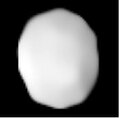 | |
| Discovery | |
|---|---|
| Discovered by | R. S. Dugan |
| Discovery date | May 30, 1903 |
| Designations | |
Designation | (511) Davida |
| Pronunciation | /dəˈviːdə/,[1] Latin Dāvīda |
Named after | David Peck Todd |
| 1903 LU | |
| main-belt · (outer) Meliboea[2] | |
| Adjectives | Davidian /dəˈvɪdiən/[3] |
| Orbital characteristics[4] | |
| Epoch July 01, 2021 (JD 2459396.5, heliocentric) | |
| Aphelion | 3.759 AU |
| Perihelion | 2.569 AU |
| 3.163 AU | |
| Eccentricity | 0.188 |
| 5.626 yr (2055 d) | |
| 113° | |
| Inclination | 15.94° |
| 107.6° | |
| 337.2° | |
| Physical characteristics | |
| Dimensions | (357 ± 2) × (294 ± 2) × (231 ± 50) km[6][a] |
| 298±4 km[7] | |
| Flattening | 0.30[b] |
| Mass | (26.6±7.3)×1018 kg[7] (38±2)×1018 kg[c][5] |
Mean density | 1.92±0.53 g/cm3[7] 2.97±1.30 g/cm3[5] |
| 0.2137 d (5.130 h) | |
| Albedo | 0.076±0.007 geometric (0.717±0.013 BV, 0.363±0.020)[4] |
| Temperature | ~160 K |
Spectral type | C |
| 9.50[8] to 12.98 | |
| 6.43[4] | |
511 Davida is a large C-type asteroid in the asteroid belt. It is one of the largest asteroids; approximately tied for 7th place, to within measurement uncertainties, and the 5th or 6th most massive. It was discovered by R. S. Dugan in 1903. Davida is named after David Peck Todd, an astronomy professor at Amherst College.
Physical characteristics
[edit | edit source]


Davida is approximately 270–310 km in diameter and comprises an estimated 1.5% of the total mass of the asteroid belt.[9][10][d] It is a C-type asteroid, which means that it is dark in colouring with a carbonaceous chondrite composition.
From 2002 to 2007, astronomers at the Keck Observatory used the Keck II telescope, which is fitted with adaptive optics, to photograph Davida. The asteroid is not a dwarf planet: there are at least two promontories and at least one flat facet with 15-km deviations from a best-fit ellipsoid. The facet is presumably a 150-km global-scale crater like the ones seen on 253 Mathilde. Conrad et al. (2007) show that craters of this size "can be expected from the impactor size distribution, without likelihood of catastrophic disruption of Davida."
Mass
[edit | edit source]In 2001, Michalak estimated Davida to have a mass of (6.64±0.56)×1019 kg.[11][e] In 2007, Baer and Chesley estimated Davida to have a mass of (5.9±0.6)×1019 kg.[12] As of 2010[update], Baer suggests Davida has a mass of (3.84±0.20)×1019 kg.[9] This most recent estimate by Baer indicates that Davida is approximately tied with 704 Interamnia as the fifth-most-massive asteroid, though the error bars of Interamnia are large.[9]
Composition
[edit | edit source]Davida's ore content is calculated to be large, and tops other asteroids in calculated worth, with 16 Psyche coming second with a large difference in hypothetical worth.[13]
Occultations
[edit | edit source]There have been 9 occultation events observed since 1987, many of which produced two or three chords.[14] Two examples shown here.
.jpg)
.jpg)
.jpg)
Notes
[edit | edit source]- ^ Measurements of the short axis are less precise than the other two, but also involve a discrepancy between fitting the convolved and deconvolved images (241±40 km), and fitting the edges (191±114 km).
- ^ Flattening derived from the maximum aspect ratio (c/a): , where (c/a) = 0.70±0.06.[7]
- ^ (18.96 ± 0.99) × 10−12 M☉
- ^ "Baer Mass of 511 Davida" 0.220 / "Mass of Mbelt" 15 = 0.0146
- ^ (3.34±0.28)×10−11 solar masses, per Michalak (2001), extended dynamic model.
References
[edit | edit source]- ^ John Daintith & William Gould, eds. (2006) The Facts On File Dictionary of Astronomy. 5th edition. Infobase Publishing.
- ^ Lua error in Module:Citation/CS1/Configuration at line 2172: attempt to index field '?' (a nil value).
- ^ Lua error in Module:Citation/CS1/Configuration at line 2172: attempt to index field '?' (a nil value).
- ^ a b c JPL data Retrieved 2021-09-29
- ^ a b c James Baer, Steven Chesley & Robert Matson (2011) "Astrometric masses of 26 asteroids and observations on asteroid porosity." The Astronomical Journal, Volume 141, Number 5
- ^ Conrad (2007), as cited in Baer et al. (2011).[5]
- ^ a b c d P. Vernazza et al. (2021) VLT/SPHERE imaging survey of the largest main-belt asteroids: Final results and synthesis. Astronomy & Astrophysics 54, A56
- ^ Lua error in Module:Citation/CS1/Configuration at line 2172: attempt to index field '?' (a nil value).[permanent dead link]
- ^ a b c Lua error in Module:Citation/CS1/Configuration at line 2172: attempt to index field '?' (a nil value).
- ^ Lua error in Module:Citation/CS1/Configuration at line 2172: attempt to index field '?' (a nil value).
- ^ Lua error in Module:Citation/CS1/Configuration at line 2172: attempt to index field '?' (a nil value).
- ^ Lua error in Module:Citation/CS1/Configuration at line 2172: attempt to index field '?' (a nil value).
- ^ Lua error in Module:Citation/CS1/Configuration at line 2172: attempt to index field '?' (a nil value).
- ^ Lua error in Module:Citation/CS1/Configuration at line 2172: attempt to index field '?' (a nil value).
External links
[edit | edit source]
- Asteroid occultations, IOTA – International Occultation Timing Association (2011)
- Time lapse photography of Davida
- Al Conrad's research page at Keck
- 511 Davida at AstDyS-2, Asteroids—Dynamic Site
- 511 Davida at the JPL Small-Body DatabaseLua error in Module:EditAtWikidata at line 29: attempt to index field 'wikibase' (a nil value).
Lua error in Module:Authority_control at line 153: attempt to index field 'wikibase' (a nil value).