48 Doris
 | |
| Discovery | |
|---|---|
| Discovered by | Hermann Mayer Salomon Goldschmidt |
| Discovery date | 19 September 1857 |
| Designations | |
| (48) Doris | |
| Pronunciation | /ˈdɔːrɪs/[1] |
Named after | Doris |
| Main belt | |
| Adjectives | Dorian /ˈdɔːriən/[2] |
| Orbital characteristics[3] | |
| Epoch 31 December 2006 (JD 2454100.5) | |
| Aphelion | 500.093 million km (3.343 AU) |
| Perihelion | 430.463 million km (2.877 AU) |
| 465.278 million km (3.110 AU) | |
| Eccentricity | 0.075 |
| 2003.453 d (5.49 a) | |
| 336.191° | |
| Inclination | 6.554° |
| 183.754° | |
| 257.583° | |
| Physical characteristics | |
| Dimensions | 278 km × 142 km[4] |
| 215±3 km[5] 221.8±7.5 km (IRAS)[3] | |
| Flattening | 0.28[a] |
| Mass | (6.9±2.9)×1018 kg[5] (12.3±6.0)×1018 kg[b][6] |
Mean density | 1.32±0.55 g/cm3[5] 2.12±1.07 g/cm3[6] |
| 11.89 h[3] | |
| 0.066[5] 0.062[7] | |
| C[3] | |
| 7.14[3] | |
48 Doris is one of the largest main belt asteroids. It was discovered on 19 September 1857 by Hermann Goldschmidt from his balcony in Paris.
To find a name for the object, Jacques Babinet of the Academy of Sciences created a shortlist and asked the geologist Élie de Beaumont to make the selection. De Beaumont chose Doris, after an Oceanid in Greek mythology. Since Doris was discovered on the same night as 49 Pales, de Beaumont suggested naming the two "The Twins".[8]
Physical characteristics
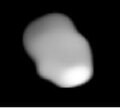
[edit | edit source]An occultation on 19 March 1981 suggested a diameter of 219±25 km.[9] Observations of an occultation on 14 October 1999, using four well-placed chords, indicate an ellipsoid of 278×142 km and that 48 Doris is an extremely irregularly shaped object.[4]
Doris will pass within 0.019 AU of Pallas in June 2132.[10]
In popular culture
[edit | edit source]48 Doris is a location in the text-based science fiction game Federation 2.[citation needed]
Notes
[edit | edit source]References
[edit | edit source]- ^ Lua error in Module:Citation/CS1/Configuration at line 2172: attempt to index field '?' (a nil value).
- ^ Lua error in Module:Citation/CS1/Configuration at line 2172: attempt to index field '?' (a nil value). (Subscription or participating institution membership required.)
- ^ a b c d e Lua error in Module:Citation/CS1/Configuration at line 2172: attempt to index field '?' (a nil value).
- ^ a b Lua error in Module:Citation/CS1/Configuration at line 2172: attempt to index field '?' (a nil value).
- ^ a b c d e P. Vernazza et al. (2021) VLT/SPHERE imaging survey of the largest main-belt asteroids: Final results and synthesis. Astronomy & Astrophysics 54, A56
- ^ a b Masses and densities of minor planets Archived 2011-06-04 at the Wayback Machine - Yu. Chernetenko, O. Kochetova, and V. Shor
Kochetova (2004) - ^ Asteroid Data Sets Archived 2009-12-17 at the Wayback Machine
- ^ Lua error in Module:Citation/CS1/Configuration at line 2172: attempt to index field '?' (a nil value).
- ^ Lua error in Module:Citation/CS1/Configuration at line 2172: attempt to index field '?' (a nil value).
- ^ Lua error in Module:Citation/CS1/Configuration at line 2172: attempt to index field '?' (a nil value).
External links
[edit | edit source]- 48 Doris at AstDyS-2, Asteroids—Dynamic Site
- 48 Doris at the JPL Small-Body DatabaseLua error in Module:EditAtWikidata at line 29: attempt to index field 'wikibase' (a nil value).
Lua error in Module:Authority_control at line 153: attempt to index field 'wikibase' (a nil value).