Wörgl
Wörgl | |
|---|---|
 Wörgl seen from the east (Grattenbergl) | |
 Coat of arms | |
 Location within Kufstein district | |
| Lua error in Module:Location_map at line 411: Malformed coordinates value. | |
| Coordinates: Lua error in Module:Coordinates at line 489: attempt to index field 'wikibase' (a nil value). | |
| Country | Austria |
| State | Tyrol |
| District | Kufstein |
| Government | |
| • Mayor | Michael Riedhart |
| Area Lua error in Module:Settlement_Wikidata at line 197: attempt to index field 'wikibase' (a nil value). | |
• Total | [convert: invalid number] |
| Elevation | 511 m (1,677 ft) |
| Population (Lua error in Module:Settlement_Wikidata at line 197: attempt to index field 'wikibase' (a nil value).)Lua error in Module:Settlement_Wikidata at line 197: attempt to index field 'wikibase' (a nil value). | |
• Total | Lua error in Module:Settlement_Wikidata at line 197: attempt to index field 'wikibase' (a nil value). |
| Time zone | UTC+1 (CET) |
| • Summer (DST) | UTC+2 (CEST) |
| Postal code | 6300-6302 |
| Area code | 043-5332 |
| Vehicle registration | KU |
| Website | www.woergl.at |
Wörgl (German pronunciation: [ˈvœrɡəl]) is a city in the Austrian state of Tyrol, in the Kufstein district. It is 20 km (12 mi) from the international border with Bavaria, Germany.
It is known for the "Miracle of Wörgl" in the 1930s, a local currency experiment credited with reviving the local economy in an economic depression.
Population
[edit | edit source]| Year | Pop. | ±% |
|---|---|---|
| 1869 | 1,080 | — |
| 1880 | 1,485 | +37.5% |
| 1890 | 2,319 | +56.2% |
| 1900 | 3,126 | +34.8% |
| 1910 | 4,232 | +35.4% |
| 1923 | 4,155 | −1.8% |
| 1934 | 4,196 | +1.0% |
| 1939 | 4,689 | +11.7% |
| 1951 | 6,247 | +33.2% |
| 1961 | 6,828 | +9.3% |
| 1971 | 7,937 | +16.2% |
| 1981 | 8,598 | +8.3% |
| 1991 | 10,041 | +16.8% |
| 2001 | 10,885 | +8.4% |
| 2011 | 12,645 | +16.2% |
Transport
[edit | edit source]Wörgl is a railway junction on the line between Innsbruck and Munich, as well as the inner-Austrian line to Salzburg. Its railway station has been designated as a Hauptbahnhof (German: main station) since 10 December 2006.
European route E641 connects Wörgl with Salzburg. The E45 and E60 routes (Austrian autobahn A12) pass through Wörgl.
-
 Wörgl railway station in 1900
 -
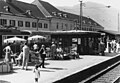 Wörgl railway station in 1965


History
[edit | edit source]The Wörgl Experiment
[edit | edit source]
Wörgl was the site of the "Miracle of Wörgl", beginning on 31 July 1932 during the Great Depression. Beginning with the issuing of "Certified Compensation Bills", a form of local currency commonly known as Stamp Scrip or Freigeld. This was an application of the monetary theories of the economist Silvio Gesell by the town's then-mayor, Michael Unterguggenberger.
The experiment resulted in a growth of employment and meant that local government projects such as new houses, a reservoir, a ski jump and a bridge could all be completed, contrasting with much of the depression in the rest of the country. Inflation and deflation are also reputed to have been non-existent for the duration of the experiment.[citation needed]
Despite attracting great interest at the time, including from French Premier Edouard Daladier and economist Irving Fisher,[1] the "experiment" was ended by Austria's central bank Oesterreichische Nationalbank on 1 September 1933, so that the federal government would maintain a monopoly on the country's legal tender.[2][3]
British economist John Maynard Keynes thought that "future economics will learn more from Gesell's ideas than from Marx's".[4]
In 2006, milestones were placed across the town to commemorate this event.[5]
World War II
[edit | edit source]The nearby Itter Castle (8 kilometres (5 miles) away from Wörgl) was the site of one of the last European battles of World War II.[6] The castle had been seized from Grüner by SS Lieutenant General Oswald Pohl under the orders of Heinrich Himmler on 7 February 1943. The transformation of the castle into a prison was completed by 25 April 1943, and the facility was placed under the administration of the Dachau concentration camp.[6]
The Battle for Itter Castle took place on 5 May 1945, with surrendered Wehrmacht troops, the United States Army, Austrian Resistance fighters and former French political prisoners fighting against the 17th Waffen-SS Panzer Grenadier Division.[7] The leader of the surrendered Wehrmacht troops, Major Josef Gangl, was killed during the battle by a sniper and is buried in Wörgl's municipal cemetery.[7] Sepp Gangl-Straße is a street in Wörgl named after Gangl.[7][8]

Waldemar von Knoeringen's [de] resistance network against the Nazi Party was based in Wörgl.[9][10] Commemoratives plaques and memorials have been established in the town, including to resistance member Josefine Brunner.[11][12]
Twin towns – sister cities
[edit | edit source]- Czech Republic Albrechtice nad Orlicí, Czech Republic
- Japan Suwa, Japan


Notable people
[edit | edit source]- Reinhard Furrer, German scientist.
- Gerhard Berger, Former Formula One racing driver and former co-owner of Scuderia Toro Rosso.
- Stefan Horngacher, Olympic ski jumper.
- Hans Peter Haselsteiner, Building tycoon and former deputy chair of the Liberal Forum.
- Richard Kitzbichler, Former Austria national football team player and present assistant manager of Premier League side Southampton F.C.
- Hannes Staudinger, Austrian cinematographer.
- Gisela Wurm, Austrian politician.
Gallery
[edit | edit source]


See also
[edit | edit source]References
[edit | edit source]- ^ Working for Irving Fischer cato.org Retrieved 18 June 2023
- ^ Lua error in Module:Citation/CS1/Configuration at line 2172: attempt to index field '?' (a nil value).
- ^ Lua error in Module:Citation/CS1/Configuration at line 2172: attempt to index field '?' (a nil value).
- ^ Lua error in Module:Citation/CS1/Configuration at line 2172: attempt to index field '?' (a nil value).
- ^ Lua error in Module:Citation/CS1/Configuration at line 2172: attempt to index field '?' (a nil value).
- ^ a b Lua error in Module:Citation/CS1/Configuration at line 2172: attempt to index field '?' (a nil value).
- ^ a b c Lua error in Module:Citation/CS1/Configuration at line 2172: attempt to index field '?' (a nil value).
- ^ Lua error in Module:Citation/CS1/Configuration at line 2172: attempt to index field '?' (a nil value).
- ^ Lua error in Module:Citation/CS1/Configuration at line 2172: attempt to index field '?' (a nil value).
- ^ Lua error in Module:Citation/CS1/Configuration at line 2172: attempt to index field '?' (a nil value).
- ^ Lua error in Module:Citation/CS1/Configuration at line 2172: attempt to index field '?' (a nil value).
- ^ Lua error in Module:Citation/CS1/Configuration at line 2172: attempt to index field '?' (a nil value).
External links
[edit | edit source]

- Lua error in Module:Citation/CS1/Configuration at line 2172: attempt to index field '?' (a nil value).
- Wörgl's attempt in the 1930s to establish a local currency
- Wörgl Gigapixel Panorama (11.000 Megapixel)
- Community Currency Online Magazine
- Website of the Wörgl Tourist Board
Lua error in Module:Authority_control at line 153: attempt to index field 'wikibase' (a nil value).