Visual pun
 | This article may need to be rewritten to comply with Wikipedia's quality standards, as almost the whole article is unsourced and unlikely to be sourced; some new sources are listed in the Further reading section. (March 2018) |
 | This article includes a list of references, related reading, or external links, but its sources remain unclear because it lacks inline citations. (September 2014) |

A visual pun is a pun involving an image or images (in addition to or instead of language), often based on a rebus.
Visual puns in which the image is at odds with the inscription are common in cartoons such as Lost Consonants or The Far Side as well as in Dutch gable stones. For instance, a gable stone in the village of Batenburg puns on the words baten ('to profit') and burg ('castle') by depicting silver coins becoming gold in a castle.
European heraldry contains the technique of canting arms, which can be considered punning.
In heraldry
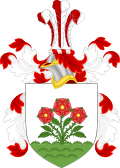
[edit | edit source]Visual puns on the bearer's name are used extensively as forms of heraldic expression. These are called canting arms. They have been used for centuries across Europe and have also been used recently by members of the British royal family, such as on the arms of Queen Elizabeth, the Queen Mother and of Princess Beatrice of York. The arms of U.S. Presidents Theodore Roosevelt and Dwight D. Eisenhower are also canting.
In visual arts
[edit | edit source]Surrealist artists such as Salvador Dalí, René Magritte, Marcel Duchamp, and Remedios Varo made extensive use of visual puns, as they played with shifting perceptions and reality. Graphic artists (such as Maurits Cornelis Escher and Noma Bar) and photographers (such as Man Ray and Dora Maar) have used visual puns for a surreal or humorous effect, or to catch the attention of a viewer. Some types of optical illusions also operate within the liminal zones of perception.
Gallery
[edit | edit source]-
 USAF squadron emblem shows a kicking donkey (ass) with slogan "Kickin' Ass"
 -
-
 All is Vanity (1892) by C. Allan Gilbert (the table is a vanity)
 -
 Royal standard of Queen Elizabeth, the Queen Mother (a canting arms), her maiden name being Bowes-Lyon: bows and lions.
 -
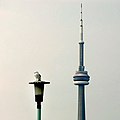 A lamppost (foreground) and Toronto's CN Tower (in distance)
 -
-


.jpg)


See also
[edit | edit source]Further reading
[edit | edit source]- Christian Hempelmann and Andrea C. Samson. “Visual Puns and Verbal Puns: Descriptive Analogy or False Analogy?” In: Diana Popa and Salvatore Attardo (Eds.), “New Approaches to the Linguistics of Humor.” Galati: Dunarea de Jos. 2007. 180-196.
- Lua error in Module:Citation/CS1/Configuration at line 2172: attempt to index field '?' (a nil value).
- Lua error in Module:Citation/CS1/Configuration at line 2172: attempt to index field '?' (a nil value).
- Lua error in Module:Citation/CS1/Configuration at line 2172: attempt to index field '?' (a nil value).
- Lua error in Module:Citation/CS1/Configuration at line 2172: attempt to index field '?' (a nil value).
- Lua error in Module:Citation/CS1/Configuration at line 2172: attempt to index field '?' (a nil value).
- Lua error in Module:Citation/CS1/Configuration at line 2172: attempt to index field '?' (a nil value).
- Lua error in Module:Citation/CS1/Configuration at line 2172: attempt to index field '?' (a nil value).
References
[edit | edit source]
