Ventifact
 | This article needs additional citations for verification. (April 2019) |
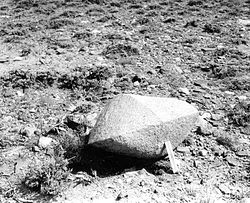
A ventifact (also wind-faceted stone, windkanter[1]) is a rock that has been abraded, pitted, etched, grooved, or polished by wind-driven sand or ice crystals.[2] The word "Ventifact" is derived from the Latin word "Ventus" meaning 'wind'. These geomorphic features are most typically found in arid environments where there is little vegetation to interfere with aeolian particle transport, where there are frequently strong winds, and where there is a steady but not overwhelming supply of sand.

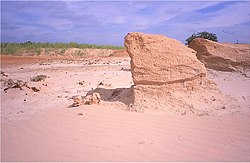
Ventifacts can be abraded to eye-catching natural sculptures such as the main features of the White Desert National Park near Farafra Oasis in Egypt. In moderately tall, isolated rock outcrops, mushroom-shaped pillars of rock may form as the outcrop is eroded by saltating sand grains. This occurs because, even in strong winds, sand grains cannot be continuously held in the air. Instead, the particles bounce along the ground, rarely reaching higher than a few feet above the Earth. Over time, the bouncing sand grains can erode the lower portions of a ventifact, while leaving a larger, less-eroded cap. The resulting forms thus frequently resemble fantastical stone mushrooms.
Individual stones, such as those forming desert pavement, are often found with grooved, etched, or polished surfaces where these same wind-driven processes have slowly worn away the rock.
Ventifacts are typically of three types:
- Einkanters having one polished side (excluding the bottom part) (the German word 'ein' means 'one')
- Zweikanters having two polished sides (excluding the bottom part) (the German word 'zwei' means 'two')
- Dreikanters having three polished surface (excluding the polished surface at bottom) that meet up at sharp angles (the German word 'drei' means 'three')[3]
When ancient ventifacts are preserved without being moved or disturbed, they may serve as a paleo-wind indicators. The wind direction at the time the ventifact formed will be parallel to grooves or striations cut into the rock.
Ventifacts have also been discovered on Mars, where such sharp immobile rocks have caused significant damage to the wheels of the Curiosity rover.[4] An example of a Martian ventifact was named Jake Matijevic. By analyzing its shape, it was possible to reconstruct the main wind direction which sculpted the rock.[5]
-
 Schist boulder pitted by sand blast near Palm Springs Station, Colorado Desert. Riverside County, California (Mendenhall, 1905)
 -

-
 Ventifact at Ventifact Ridge in Death Valley (Mayer, 2003)
 -
-

-
-


See also
[edit | edit source]- Arkenu structures – Pair of geological features in Libya
- Blowout (geomorphology) – Depressions in a sand dune ecosystem caused by the removal of sediments by wind
- Dune – Hill of loose sand built by aeolian processes or the flow of water
- Yardang – Streamlined aeolian landform
- Ventifact Knobs – Geographic feature in Antarctica, Antarctica
References
[edit | edit source]- ^ Klaus K. E. Neuendorf, Glossary of Geology, p. 723
- ^ Lua error in Module:Citation/CS1/Configuration at line 2172: attempt to index field '?' (a nil value).
- ^ Lua error in Module:Citation/CS1/Configuration at line 2172: attempt to index field '?' (a nil value).
- ^ NASA, Premature Wear of the MSL Wheels, 2017-09-26
- ^ Patrick Zasada (2013) Entstehung des Mars-Gesteins "Jake Matijevic". Sternzeit, issue 2/2013: pp. 98–101. (German language).
External links
[edit | edit source]
Lua error in Module:Authority_control at line 153: attempt to index field 'wikibase' (a nil value).