Urna

| Translations of Urna | |
|---|---|
| Sanskrit | ऊर्णा (IAST: ūrṇā) |
| Pali | उण्ण (uṇṇa) |
| Chinese | 白毫 (Pinyin: Báiháo) |
| Japanese | 白毫 (Rōmaji: byakugō) |
| Korean | 백호 (RR: baekho) |
| Tibetan | མཛོད་སྦུས་ (Wylie: mdzod spu) |
| Vietnamese | Bạch mao tướng |
| Glossary of Buddhism | |
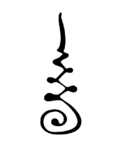
In Buddhist art and culture, the Urna (Sanskrit: ūrṇā, ūrṇākeśa or ūrṇākośa, lit. "hair treasure")[1][2] is a spiral or circular mark placed on the forehead of Buddhist images as an auspicious sign.[2][3]
As set out in the Lakkhana Sutta (Discourse on Marks), the ūrṇā is the thirty-first physical characteristic of the Buddha.[4]
The urna is generally interpreted as a whorl of white hair which is a marks a Buddha as a great being (mahāpuruṣa). In the Mahayana Sutras, the Buddha is often depicted as shining light out of his urna to illuminate distant world systems.[1] This light became an object of meditation in Mahayana Buddhism.[5]
The urna is often seen on Buddhist sculptures from the 2nd century CE onwards. The urna remains part of standard Buddhist iconography today, often depicted as a gem placed slightly above and between the eyebrows of a Buddha or a bodhisattva.[1]
Gallery
[edit | edit source]-
 Buddha with urna depicted as a circular dot
 -
 Buddha sculpture found within the vihāra of Wat Phra Si Sanphet, Phra Nakhon Si Ayutthaya Province, Thailand, 16th century CE
 -

.jpg)

See also
[edit | edit source]References
[edit | edit source]- ^ a b c Lua error in Module:Citation/CS1/Configuration at line 2172: attempt to index field '?' (a nil value).
- ^ a b Lua error in Module:Citation/CS1/Configuration at line 2172: attempt to index field '?' (a nil value).
- ^ Lua error in Module:Citation/CS1/Configuration at line 2172: attempt to index field '?' (a nil value).
- ^ Lua error in Module:Citation/CS1/Configuration at line 2172: attempt to index field '?' (a nil value).
- ^ Rhodes, Robert. (2007). Ōjōyōshū, Nihon Ōjō Gokuraku-ki, and the Construction of Pure Land Discourse in Heian Japan. Japanese Journal of Religious Studies. 34. 10.18874/jjrs.34.2.2007.249-270.


.svg) | This Buddhism-related article is a stub. You can help Wikipedia by expanding it. |