Summer squash
 'Zephyr', a variety of straightnecked summer squash[1] | |||||||||||||||||||||||
| Nutritional value per 100 g (3.5 oz) | |||||||||||||||||||||||
|---|---|---|---|---|---|---|---|---|---|---|---|---|---|---|---|---|---|---|---|---|---|---|---|
| Energy | 20 kcal (84 kJ) | ||||||||||||||||||||||
4.1 g | |||||||||||||||||||||||
| Sugars | 2.0 g | ||||||||||||||||||||||
| Dietary fiber | 2 g | ||||||||||||||||||||||
0 g | |||||||||||||||||||||||
1 g | |||||||||||||||||||||||
| |||||||||||||||||||||||
| †Percentages estimated using US recommendations for adults.[2] | |||||||||||||||||||||||
Summer squash can either refer to a squash plant with fruit that is harvested when immature, or the fruit itself. The word "summer" reflects their early harvest period and short storage life, in contrast to winter squashes. Some Cucurbita species and varieties are cultivated for both "summer" and "winter" fruit.
Cultivation
[edit | edit source]Summer squash often have a bushy growth habit, unlike the rambling vines of many winter squash varieties.[3][4]
The varieties grown for use as summer squash vary by region and culture but include types from each of the five Cucurbita species generally acknowledged as domesticated.[3][5][6][7][8]
The species Cucurbita pepo[3] is thought to include the greatest diversity of summer squash varieties.
Summer squash varieties by species
[edit | edit source]
Cucurbita maxima varieties:[6][10]
Cucurbita moschata varieties:[11]
- Aehobak
- Tromboncino or zucchetta[3]
Cucurbita pepo varieties:
- Crookneck squash
- Gem squash
- Kamokamo
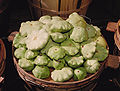
- Pattypan squash
- Straightneck squash
- Zucchini (courgette) and marrow, respectively immature and mature fruits of the same variety
History
[edit | edit source]In the journals of Lewis and Clark, on October 12, 1804, Clark recorded that the Arikara tribe raised "great quantities of Corn Beens Simmins, &c."[12] Clark also used the spelling simlin in his journal entries. Simlin, variously spelled simblin, symnel, cymling, cimnel (Thomas Jefferson's spelling) and simnel were words for summer squash, particularly Cucurbita pepo ssp. pepo, common name pattypan squash. The word simnel was used because of the visual similarity between the squash and the simnel cake.[13]
Gallery
[edit | edit source]-
 Pipián fresco (Cucurbita argyrosperma)
 -
 Chilacayote or shark fin melon (Cucurbita ficifolia)
 -
 Trombetta d'Albenga (Cucurbita moschata)
 -
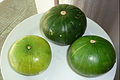 Zapallito (Cucurbita maxima)
 -


References
[edit | edit source]- ^ Lua error in Module:Citation/CS1/Configuration at line 2172: attempt to index field '?' (a nil value).
- ^ Lua error in Module:Citation/CS1/Configuration at line 2172: attempt to index field '?' (a nil value).
- ^ a b c d Lua error in Module:Citation/CS1/Configuration at line 2172: attempt to index field '?' (a nil value).
- ^ Lua error in Module:Citation/CS1/Configuration at line 2172: attempt to index field '?' (a nil value).
- ^ Lua error in Module:Citation/CS1/Configuration at line 2172: attempt to index field '?' (a nil value).
- ^ a b Lua error in Module:Citation/CS1/Configuration at line 2172: attempt to index field '?' (a nil value).
- ^ a b Lua error in Module:Citation/CS1/Configuration at line 2172: attempt to index field '?' (a nil value).
- ^ a b Lua error in Module:Citation/CS1/Configuration at line 2172: attempt to index field '?' (a nil value).
- ^ Lua error in Module:Citation/CS1/Configuration at line 2172: attempt to index field '?' (a nil value).
- ^ Lua error in Module:Citation/CS1/Configuration at line 2172: attempt to index field '?' (a nil value).
- ^ Lua error in Module:Citation/CS1/Configuration at line 2172: attempt to index field '?' (a nil value).
- ^ Lua error in Module:Citation/CS1/Configuration at line 2172: attempt to index field '?' (a nil value).
- ^ Lua error in Module:Citation/CS1/Configuration at line 2172: attempt to index field '?' (a nil value).
External links
[edit | edit source]| Species |  | ||||||
|---|---|---|---|---|---|---|---|
| Cultivars |
| ||||||
| Related topics |
| ||||||

 | This fruit-related article is a stub. You can help Wikipedia by expanding it. |