Sucellus


In Gallo-Roman religion, Sucellus or Sucellos (/suːˈkɛləs/) was a god shown carrying a large mallet (or hammer) and an olla (or barrel). Originally a Celtic god, his cult flourished not only among Gallo-Romans, but also to some extent among the neighbouring peoples of Raetia and Britain. He has been associated with agriculture and wine, particularly in the territory of the Aedui.[1]
Sculptures
[edit | edit source]
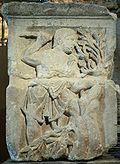
He is usually portrayed as a middle-aged bearded man wearing a wolf-skin, with a long-handled hammer, or perhaps a beer barrel suspended from a pole. His companion Nantosuelta is sometimes depicted alongside him. When together, they are accompanied by symbols associated with prosperity and domesticity.
In a well-known relief from Sarrebourg, near Metz, Nantosuelta, wearing a long gown, is standing to the left. In her left hand she holds a small house-shaped object with two circular holes and a peaked roof – perhaps a dovecote – on a long pole. Her right hand holds a patera which she is tipping onto a cylindrical altar. To the right Sucellus stands, bearded, in a tunic with a cloak over his right shoulder. He holds his mallet in his right hand and an olla in his left. Above the figures is a dedicatory inscription and below them in very low relief is a raven. This sculpture was dated by Reinach, from the form of the letters, to the end of the first century or start of the second century.[2]
Inscriptions
[edit | edit source]At least eleven inscriptions to Sucellus are known,[3] mostly from Gaul. One (RIB II, 3/2422.21) is from Eboracum (modern York) in Britain.
In an inscription from Augusta Rauricorum (modern Augst), Sucellus is identified with Silvanus:[4]
- In honor(em) /
- d(omus) d(ivinae) deo Su/
- cello Silv(ano) /
- Spart(us) l(ocus) d(atus) d(ecreto) d(ecurionum)
The syncretism of Sucellus with Silvanus can also be seen in artwork from Narbonensis.[5]
Roles and Duties
[edit | edit source]In Italy, Silvanus was said to protect forests and fields. He presided over the boundaries of properties, together with a host of local silvani, three for each property. These were the silvanus of the home, the silvanus of the fields, and the silvanus of the boundaries.[6] Silvanus also takes care of flocks, guaranteeing their fertility and protecting them from wolves, which is why he often wears the skin of a wolf.[7] When moving north into Gaul, Silvanus was syncretically merged with Sucellus to form the conflated Sucellus-Silvanus. It was Sucellus who carried the mallet and bowl. It has been suggested that the mallet was for construction and the erection of fence-posts (establishing boundaries), but this is far from certain.[8][9] Green claims that Sucellus may also relate to a chthonic deity, especially in maintain boundaries between the living and dead.[10]
Sucellus has been frequently identified as a candidate for Gaulish Dis Pater, the Gaulish god of the underworld and progenitor of the Gauls described by Caesar.[11]
Etymology
[edit | edit source]
In Gaulish, the root cellos can be interpreted as 'striker', derived from Proto-Indo-European *-kel-do-s whence also come Latin per-cellere ('striker'), Greek klao ('to break') and Lithuanian kálti ('to hammer, to forge').[12] The prefix su- means 'good' or 'well' and is found in many Gaulish personal names.[13] Sucellus is therefore commonly translated as 'the good striker.'
An alternate etymology is offered by Celticist Blanca María Prósper, who posits a derivative of the Proto-Indo-European root *kel- ‘to protect’, i.e. *su-kel-mó(n) "having a good protection" or *su-kel-mṇ-, an agentive formation meaning "protecting well, providing good protection", with a thematic derivative built on the oblique stem, *su-kel-mn-o- (and subsequent simplification and assimilation of the sonorant cluster and a secondary full grade of the root). Prósper suggests the name would then be comparable to the Indic personal name Suśarman-, found in Hindu mythology.[14]
See also
[edit | edit source]- The Dagda, a similar figure from Irish mythology
References
[edit | edit source]- ^ Lua error in Module:Citation/CS1/Configuration at line 2172: attempt to index field '?' (a nil value).
- ^ Reinach (1922), pp. 217–232.
- ^ Jufer & Luginbühl (2001), p. 63.
- ^ AE 1926, 00040
- ^ Duval (1993), p. 78.
- ^ Lua error in Module:Citation/CS1/Configuration at line 2172: attempt to index field '?' (a nil value).
- ^ Lua error in Module:Citation/CS1/Configuration at line 2172: attempt to index field '?' (a nil value).
- ^ Lua error in Module:Citation/CS1/Configuration at line 2172: attempt to index field '?' (a nil value).
- ^ Lua error in Module:Citation/CS1/Configuration at line 2172: attempt to index field '?' (a nil value).[permanent dead link]
- ^ Lua error in Module:Citation/CS1/Configuration at line 2172: attempt to index field '?' (a nil value).
- ^ Lua error in Module:Citation/CS1/Configuration at line 2172: attempt to index field '?' (a nil value).
- ^ Delamarre (2003), p. 113.
- ^ Delamarre (2003), pp. 283–284.
- ^ Lua error in Module:Citation/CS1/Configuration at line 2172: attempt to index field '?' (a nil value).
Bibliography
[edit | edit source]
- Lua error in Module:Citation/CS1/Configuration at line 2172: attempt to index field '?' (a nil value).
- Lua error in Module:Citation/CS1/Configuration at line 2172: attempt to index field '?' (a nil value).
- Lua error in Module:Citation/CS1/Configuration at line 2172: attempt to index field '?' (a nil value).
- Lua error in Module:Citation/CS1/Configuration at line 2172: attempt to index field '?' (a nil value).
- Lua error in Module:Citation/CS1/Configuration at line 2172: attempt to index field '?' (a nil value).
Further reading
[edit | edit source]- Heichelheim F. M., Housman J. E. "Sucellus and Nantosuelta in Mediaeval Celtic Mythology". In: L'antiquité classique, Tome 17, fasc. 1, 1948. Miscellanea Philologica Historica et archaelogia in honorem Hvberti Van De Weerd. pp. 305–316. [DOI: https://doi.org/10.3406/antiq.1948.2845] www.persee.fr/doc/antiq_0770-2817_1948_num_17_1_2845
- Lua error in Module:Citation/CS1/Configuration at line 2172: attempt to index field '?' (a nil value).
- Lua error in Module:Citation/CS1/Configuration at line 2172: attempt to index field '?' (a nil value).
- Lua error in Module:Citation/CS1/Configuration at line 2172: attempt to index field '?' (a nil value).
- Lua error in Module:Citation/CS1/Configuration at line 2172: attempt to index field '?' (a nil value).

Lua error in Module:Authority_control at line 153: attempt to index field 'wikibase' (a nil value).