Small angle shades
| Small angle shades | |
|---|---|

| |
Scientific classification 
| |
| Kingdom: | Animalia |
| Phylum: | Arthropoda |
| Class: | Insecta |
| Order: | Lepidoptera |
| Superfamily: | Noctuoidea |
| Family: | Noctuidae |
| Genus: | Euplexia |
| Species: | E. lucipara
|
| Binomial name | |
| Euplexia lucipara | |
The small angle shades (Euplexia lucipara) is a moth of the family Noctuidae. It is distributed throughout the Palearctic. The species was first described by Carl Linnaeus in his 1758 10th edition of Systema Naturae.
As the common name suggests, this species is closely related to the angle shades (Phlogophora meticulosa), and is considerably smaller (wingspan 30–35 mm), but does not especially resemble that species. The forewings are dark brown with a broad, pale subterminal band, wider and paler towards the costa. The hindwings are whitish at the base, graduating to brown at the margins. In the British Isles this species flies at night in June and July, with a second generation sometimes emerging in September. It is attracted to light and sugar.
Distribution
[edit | edit source]It is found throughout Europe, in Algeria, in western Asia and through the Palearctic to Siberia, China, and Japan.
Technical description
[edit | edit source]Forewing rufous ochreous tinged with purplish and mixed with olive brown; median area, a triangular blotch on inner margin near base, and a narrow praesubmarginal cloud deep olive; costa to beyond middle, the terminal area, and the orbicular stigma leaden purple; lines indistinct, the outer and inner approximating on inner margin; claviform stigma olive, dark edged; orbicular roundish, oblique, with paler ring; reniform conspicuously whitish, containing a double brown lunule; submarginal line pale, waved; veins towards termen dotted dark and pale; hindwing ochreous with dark cell mark and veins, darker in terminal half where there is visible a dark pale-edged outer and submarginal line.[1]

Biology
[edit | edit source]Larva velvety green with darker green oblique subdorsal stripes; tubercles pale; spiracular line yellowish white; 11th segment slightly swollen, with a pair of white dots; head green.
The larvae often feed on ferns and the species is usually associated with them. Other recorded food plants include birch, false bindweed, dogwood, larkspur, willowherb, ash, ivy, lettuce, privet, loosestrife, oak, buttercup, currant, raspberry, willow, tomato, coltsfoot, nettle, and guelder rose.[2] The species overwinters as pupae.
Gallery
[edit | edit source]-
 Illustration from British Entomology, Volume 5, by John Curtis
 -
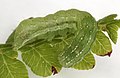 Larva.Flint, North Wales

.jpg)
Notes
[edit | edit source]- ^ Seitz, A. Ed., 1914 Die Großschmetterlinge der Erde, Verlag Alfred Kernen, Stuttgart Band 3: Abt. 1, Die Großschmetterlinge des palaearktischen Faunengebietes, Die palaearktischen eulenartigen Nachtfalter, 1914
- ^ Lua error in Module:Citation/CS1/Configuration at line 2172: attempt to index field '?' (a nil value).
References
[edit | edit source]- Chinery, Michael (1986, reprinted 1991). Collins Guide to the Insects of Britain and Western Europe.
- Skinner, Bernard The Colour Identification Guide to Moths of the British Isles. 1984
External links
[edit | edit source]
- Lua error in Module:Citation/CS1/Configuration at line 2172: attempt to index field '?' (a nil value).
- Lua error in Module:Citation/CS1/Configuration at line 2172: attempt to index field '?' (a nil value). Taxonomy
- Lepiforum e.V.
- De Vlinderstichting (in Dutch)
Lua error in Module:Taxonbar at line 165: attempt to index field 'wikibase' (a nil value).