Sarat Chandra Das
Sarat Chandra Dash শরৎচন্দ্র দাশ | |
|---|---|
 Sarat Chandra Dash | |
| Born | 18 July 1849 |
| Died | 5 January 1917 (aged 67) |
| Occupations | Explorer, Scholar, Spy |
| Parent | Dindayal Dash |
Sarat Chandra Dash (Bengali: শরৎচন্দ্র দাশ) (18 July 1849 – 5 January 1917) was an Indian scholar of Tibetan language and culture most noted for his two journeys to Tibet in 1879 and in 1881–1882.
Biography
[edit | edit source]_(cropped).jpg)
Born in Chittagong, eastern Bengal to a Bengali Hindu Vaidya-Brahmin family,[1] Sarat Chandra Dash attended Presidency College, as a student of the University of Calcutta. In 1874 he was appointed headmaster of the Bhutia Boarding School at Darjeeling. In 1878, a Tibetan teacher, Lama Ugyen Gyatso arranged a passport for Sarat Chandra to go the monastery at Tashilhunpo. In June 1879, Das and Ugyen-gyatso left Darjeeling for the first of two journeys to Tibet. They remained in Tibet for six months, returning to Darjeeling with a large collection of Tibetan and Sanskrit texts which would become the basis for his later scholarship. Sarat Chandra spent 1880 in Darjeeling poring over the information he had obtained. In November 1881, Sarat Chandra and Ugyen-gyatso returned to Tibet, where they explored the Yarlung Valley, returning to India in January 1883.[2] Along with Satish Chandra Vidyabhusan, he prepared Tibetan-English dictionary.[3]
For a time, he worked as a spy for the British, accompanying Colman Macaulay on his 1884 expedition to Tibet[4] to gather information on the Tibetans, Russians and Chinese. After he left Tibet, the reasons for his visit were discovered and many of the Tibetans who had befriended him suffered severe reprisals.[5]
For the latter part of his life, Das settled in Darjeeling. He named his house "Lhasa Villa" and played host to many notable guests including Sir Charles Alfred Bell and Ekai Kawaguchi. Johnson stated that, in 1885 and 1887 Das met with Henry Steel Olcott, co-founder and first President of the Theosophical Society.[6]
Publications
[edit | edit source]- Contributions on the Religion, History &c., of Tibet. In Journal of the Asiatic Society of Bengal, Volume LI (51), Part I for 1882. Publisher: Asiatic Society, Calcutta (1882). Also, PDF file here [1]
- Narrative of a journey to Lhasa in 1881-82. Publisher: s.n. (1885).
- Narrative of a journey round Lake Yamdo (Palti), and in Lhokha, Yarlung, and Sakya, in 1882. publisher: s.n (1887).
- Avadānakalpalatā: a collection of legendary stories about the Bodhisattvas. Asiatic Society (1890).
- The doctrine of transmigration. Buddhist Text Society (1893).
- Indian Pandits in the Land of Snow. Originally published at the end of the 19th century. Reprint: Rupa (2006).Lua error in Module:Citation/CS1/Configuration at line 2172: attempt to index field '?' (a nil value)..
- Sarat Chandra Das, Graham Sandberg & Augustus William Heyde A Tibetan-English dictionary, with Sanskrit synonyms. 1st Edition - Calcutta, 1902. Reprint: Sri Satguru Publications, Delhi, 1989 and Motilal Banarsidass, Delhi, 1970, 1973, 1976, 1979, 1983, 1991, 1995 and 2000.
- Journey To Lhasa & Central Tibet. 1st Edition: John Murray (England) (1902). Reprint: Kessinger Publishing, LLC (2007). Lua error in Module:Citation/CS1/Configuration at line 2172: attempt to index field '?' (a nil value).. Republished as: Lhasa and Central Tibet, Cosmo (Publications, India); New edition (2003). Lua error in Module:Citation/CS1/Configuration at line 2172: attempt to index field '?' (a nil value)..
- An introduction to the grammar of the Tibetan language;: With the texts of Situ sum-tag, Dag-je sal-wai melong, and Situi shal lung. Darjeeling Branch Press, 1915. Reprint: Motilal Banarsidass, Delhi, 1972 and 1983.
- Autobiography: Narratives of the incidents of my early life. Reprint: Indian studies: past & present (1969).
References
[edit | edit source]- ^ Lua error in Module:Citation/CS1/Configuration at line 2172: attempt to index field '?' (a nil value).
- ^ Journey to Lhasa and Central Tibet, Das, Sarat Chandra, pp xi–xiii, Paljor Publications, New Delhi, 2001
- ^ Lua error in Module:Citation/CS1/Configuration at line 2172: attempt to index field '?' (a nil value).
- ^ Lua error in Module:Citation/CS1/Configuration at line 2172: attempt to index field '?' (a nil value).
- ^ Laurence Austine Waddell, Lhasa and Its Mysteries: With a Record of the Expedition of 1903-1904, Cosimo, Inc., 2007, 740 pages, p. 79: "The ruin thus brought about by the Babu's visit extended also to the unfortunate Lama's relatives, the governor of Gyantsé (the Phal Dahpön) and his wife (Lha-cham), whom he had persuaded to befriend Sarat C. Das. These two were cast into prison for life, and their estates confiscated, and several of their servants were barbarously mutilated, their hands and feet were cut off and their eyes gouged out, and they were then left to die a lingering death in agony, so bitterly cruel was the resentment of the Lamas against all who assisted the Babu in this attempt to spy into their sacred city."
- ^ The Masters Revealed: Madame Blavatsky and the Myth of the Great White Lodge, Johnson, Paul K., p 191-192, State University of New York Press, Albany, 1994
External links
[edit | edit source]- Lua error in Module:Citation/CS1/Configuration at line 2172: attempt to index field '?' (a nil value).
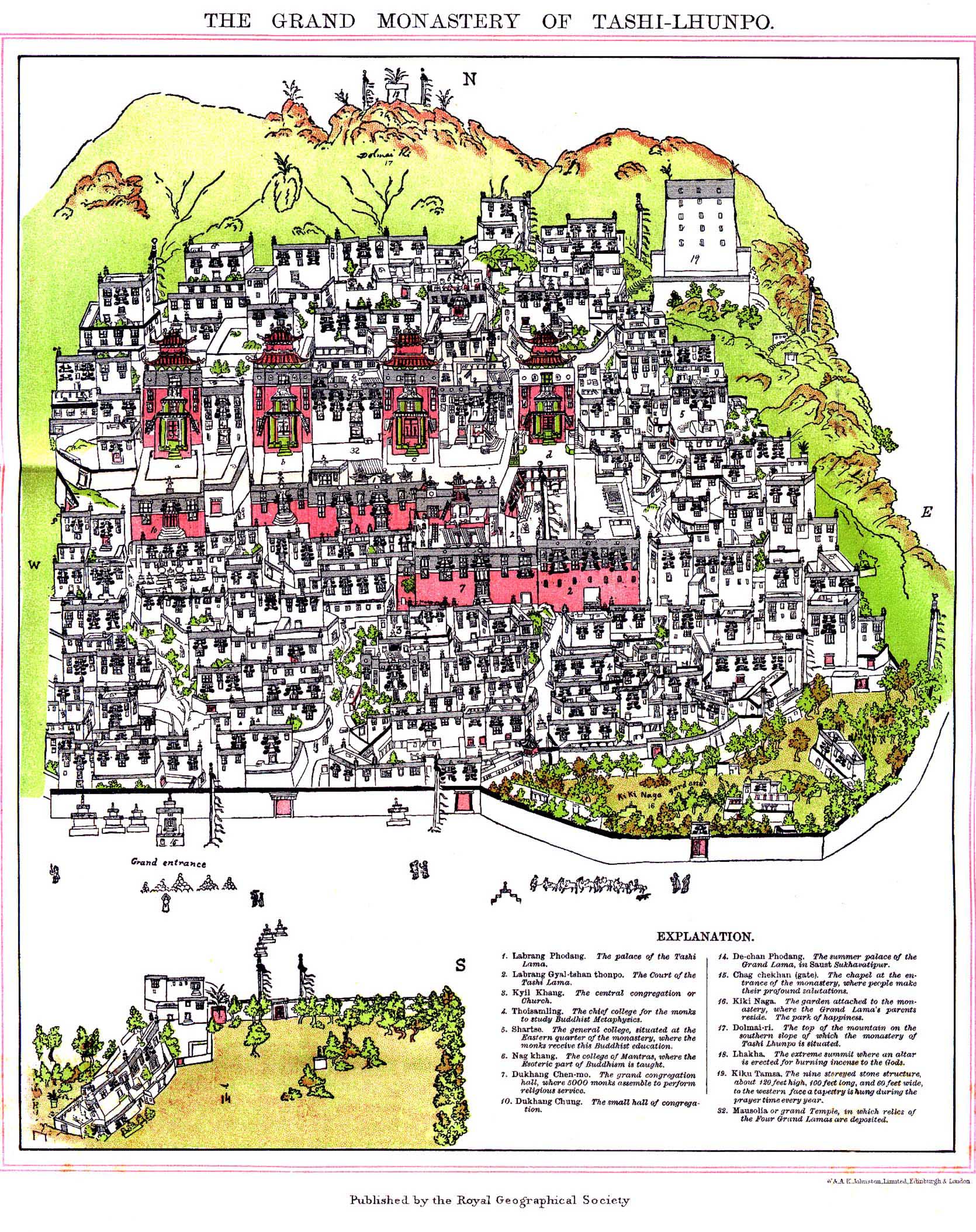
- Map of Tashilhunpo in 1902, Perry–Castañeda Library Map Collection
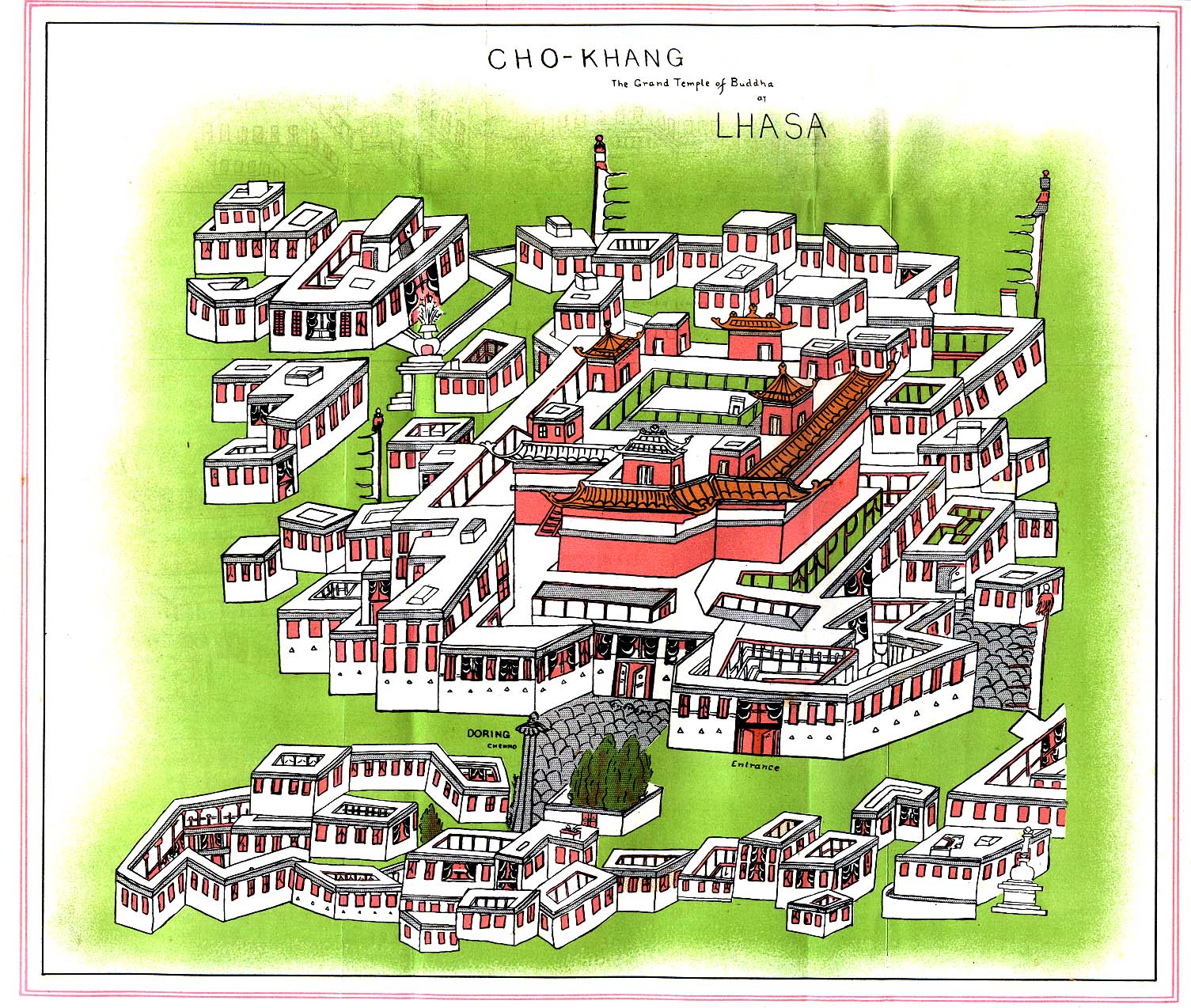
- Grand Temple at Lhasa in 1902, Perry–Castañeda Library Map Collection
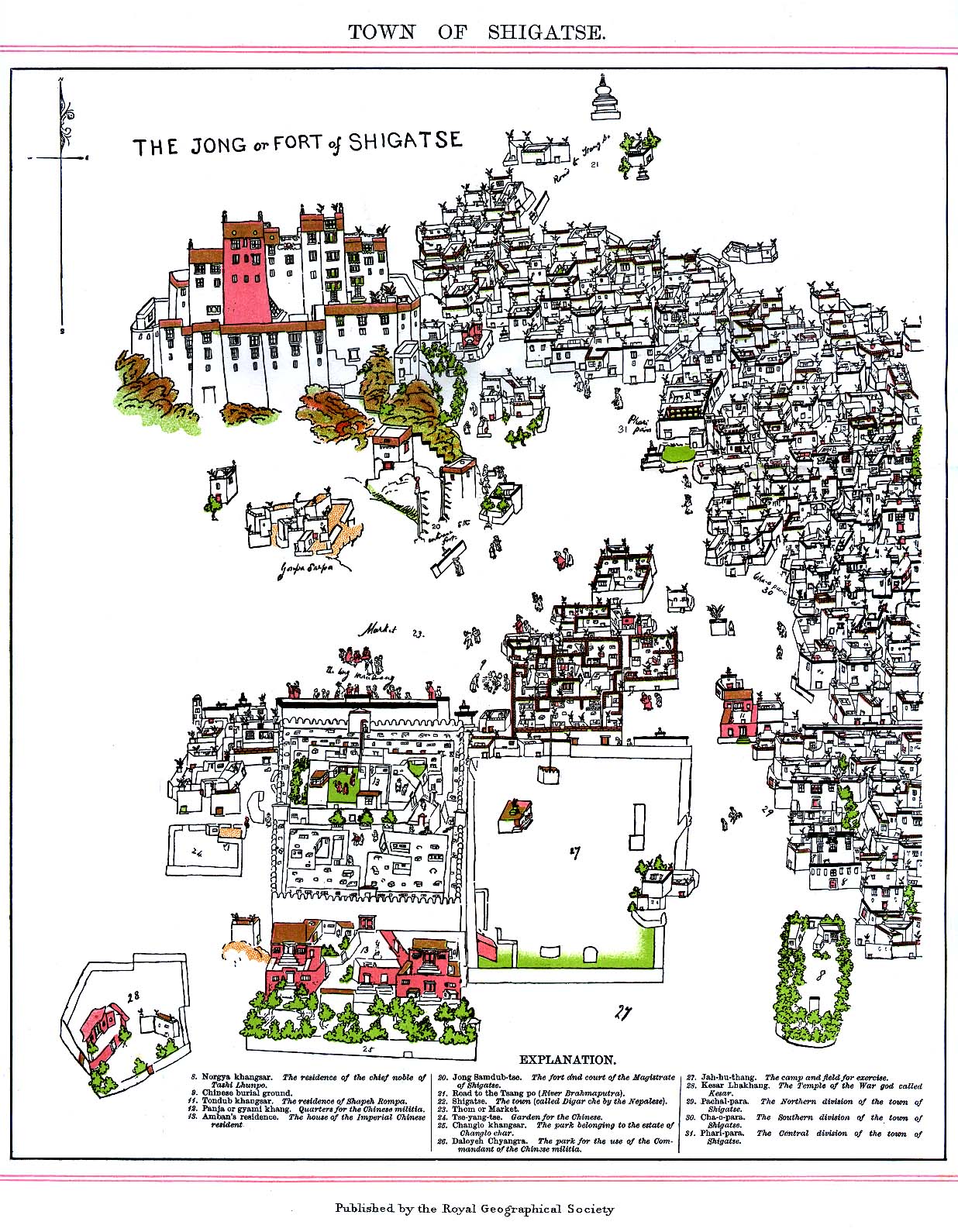
- Fort of Shigatse in 1902, Perry–Castañeda Library Map Collection

Lua error in Module:Authority_control at line 153: attempt to index field 'wikibase' (a nil value).