Ruellia simplex
| Ruellia simplex | |
|---|---|

| |
| Scientific classification Edit this classification | |
| Kingdom: | Plantae |
| Clade: | Tracheophytes |
| Clade: | Angiosperms |
| Clade: | Eudicots |
| Clade: | Asterids |
| Order: | Lamiales |
| Family: | Acanthaceae |
| Genus: | Ruellia |
| Species: | R. simplex
|
| Binomial name | |
| Ruellia simplex | |
| Synonyms | |
|
See text | |
Ruellia simplex, the Mexican petunia, Mexican bluebell or Britton's wild petunia, is a species of flowering plant in the family Acanthaceae that is native to Mexico, the Caribbean, and South America. It has become a widespread invasive plant in Florida, where it was likely introduced as an ornamental before 1933,[1][2] as well as in the eastern Mediterranean, South Asia and other parts of the Eastern Hemisphere.
Taxonomy and synonyms
[edit | edit source]Ruellia simplex C.Wright is the oldest and accepted name for this species, which has been variously called Ruellia angustifolia (Nees) Lindau, Ruellia brittoniana Leonard, and Cryphiacanthus angustifolius Nees, among several synonyms.[3] The genus is named after French botanist Jean Ruel, while the specific name refers to the simple, not compound leaves.[4]
Description
[edit | edit source]Ruellia simplex is an evergreen perennial growing 3 ft (0.91 m) tall, forming colonies of stalks with lance-shaped leaves that are 6 to 12 in (15 to 30 cm) long and .5 to .75 in (1.3 to 1.9 cm) wide.
The flowers are metallic blue to purple, trumpet-shaped with an about 2 in (5.1 cm)-wide, five-lobed corolla. There is a dwarf variety that is only 1 ft (0.30 m) tall.[1]
Distribution
[edit | edit source]Ruellia simplex is native to Mexico, the West Indies, western Bolivia, southwestern Brazil, Paraguay, Uruguay, and northeastern Argentina. It has been widely used as an ornamental plant and has escaped from cultivation in the United States, Australia and parts of Asia, as well as several Pacific Islands. It is one of the most common landscape plants in Dubai, due to its drought-tolerance.[5]
It has become invasive in some of these areas, forming dense, single-species stands of vegetation which threaten native plants. It is mainly a plant of wet places such as ditches, pond verges, lakesides and marshes, but can survive in drier conditions.[6]
Control
[edit | edit source]The University of Florida's Institute of Food and Agricultural Sciences is trying to reduce the number of home gardeners who plant R. simplex by recommending alternatives, especially Silphium asteriscus, Sisyrinchium angustifolium, Stachytarpheta jamaicensis, Stokesia laevis, but also including some R. simplex cultivars that are sterile.[7]
-
 Dwarf Mexican Petunia or Katie Pink or Katie Ruellia -- Ruellia simplex
 -
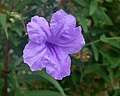 Wild Petunia—Ruellia Simplex
 -
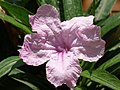 Ruellia simplex, pink
 -
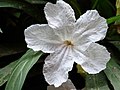 Ruellia simplex, white
 -
 Trumpet shaped flowers
 -
 Leaves and stem
 -
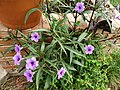 Blooms often fall within hours.


References
[edit | edit source]- ^ a b Lua error in Module:Citation/CS1/Configuration at line 2172: attempt to index field '?' (a nil value).
- ^ Lua error in Module:Citation/CS1/Configuration at line 2172: attempt to index field '?' (a nil value).
- ^ Lua error in Module:Citation/CS1/Configuration at line 2172: attempt to index field '?' (a nil value).
- ^ Lua error in Module:Citation/CS1/Configuration at line 2172: attempt to index field '?' (a nil value).
- ^ Lua error in Module:Citation/CS1/Configuration at line 2172: attempt to index field '?' (a nil value).
- ^ Lua error in Module:Citation/CS1/Configuration at line 2172: attempt to index field '?' (a nil value).
- ^ Lua error in Module:Citation/CS1/Configuration at line 2172: attempt to index field '?' (a nil value).
External links
[edit | edit source]
- Ruellia simplex in Florida. Atlas of Florida Vascular Plants.
- IPNI Listing
Lua error in Module:Taxonbar at line 165: attempt to index field 'wikibase' (a nil value).