Rubus argutus
| Rubus argutus | |
|---|---|

| |

| |
Scientific classification 
| |
| Kingdom: | Plantae |
| Clade: | Tracheophytes |
| Clade: | Angiosperms |
| Clade: | Eudicots |
| Clade: | Rosids |
| Order: | Rosales |
| Family: | Rosaceae |
| Genus: | Rubus |
| Subgenus: | Rubus subg. Rubus |
| Species: | R. argutus
|
| Binomial name | |
| Rubus argutus Link. 1822
| |
| Synonyms[1] | |
|
Synonymy
| |

Rubus argutus is a North American species of prickly bramble in the rose family. It is a perennial plant native to the eastern and south-central United States. Common names are sawtooth blackberry[2] or tall blackberry after its high growth.
Description
[edit | edit source]R. argutus usually forms woody shrubs or vines, up to 2 metres (6+1⁄2 ft) tall,[3] with thorns on stems, leaves, and flowers. The leaves are alternate and palmately compound. First-year plants have palmate leaves with 5 leaflets while second-year plants have palmate leaves with 3 leaflets.[4]
Second-year plants develop racemes of flowers each containing 5–20 flowers.[4] The flowers are typically 5-merous with large, white petals and light green sepals, borne in mid-spring.[5] Second-year plants are also capable of growing the fruit which gives the plant's common name, the blackberry. The fruits are compound drupes which change from bright red to black at maturity. Each section (drupelet) of a blackberry contains a single seed. Second-year plants die after bearing fruits, but regrow from the underground portion of the plant.
Distribution and habitat
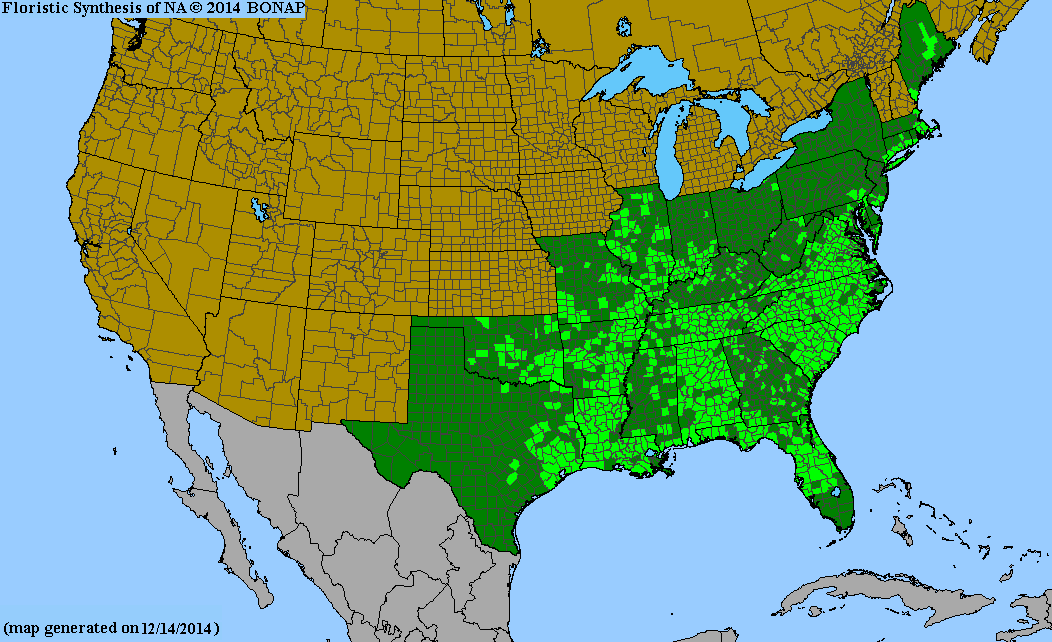
[edit | edit source]The species grows from Florida to Texas, Missouri, Illinois, and Maine.[6]
Uses
[edit | edit source]The species is one of many that produces edible blackberries, which differ by size.[7]
Blackberry leaves were in the official U.S. pharmacopoeia for a time and were said to treat digestive problems, particularly diarrhea. Their dried leaves make an excellent tea.[8]
References
[edit | edit source]- ^ The Plant List, Rubus argutus Link
- ^ Lua error in Module:Citation/CS1/Configuration at line 2172: attempt to index field '?' (a nil value).
- ^ Rydberg, Per Axel (1901) Rubus argutus in Britton, Nathaniel, Manual of the Flora of the northern States and Canada. p. 498.
- ^ a b "Highbush Blackberry". Illinois Wildflowers.
- ^ Lua error in Module:Citation/CS1/Configuration at line 2172: attempt to index field '?' (a nil value).
- ^ County distribution map. Biota of North America Program 2014
- ^ Lua error in Module:Citation/CS1/Configuration at line 2172: attempt to index field '?' (a nil value).
- ^ Lua error in Module:Citation/CS1/Configuration at line 2172: attempt to index field '?' (a nil value).
External links
[edit | edit source]
- Lua error in Module:Citation/CS1/Configuration at line 2172: attempt to index field '?' (a nil value).
- Lua error in Module:Citation/CS1/Configuration at line 2172: attempt to index field '?' (a nil value).
- Lua error in Module:Citation/CS1/Configuration at line 2172: attempt to index field '?' (a nil value).
- photo of herbarium specimen at Missouri Botanical Garden, collected in 1989 in Missouri
- US Wildflowers
Lua error in Module:Taxonbar at line 165: attempt to index field 'wikibase' (a nil value).
 | This Rubus article is a stub. You can help Wikipedia by expanding it. |