Proto-celadon

Proto-celadon (Chinese: 灰釉陶, also 原始青瓷) was a type of Chinese ceramic which developed during the Shang and Jin periods. It is often described as "proto-porcelain", and was usually glazed in light yellowish green.[1]

The body of proto-celadon was high-fired, the Chinese classification including porcelain, with an iron content below 3%.[2] Firing temperature was around 1200 degrees Celsius. In Western terms the wares are stoneware. Surface treatment consisted of a lime glaze.[2] The shapes manufactured in proto-celadon were similar to the objects manufactured in bronze.[1]
Proto-celadon was mainly produced in the areas south of the Yangtze river.[2] From the Han dynasty onward, production greatly improved in quantity and quality.[2]
Inception of true celadon
[edit | edit source]
From the Eastern Han period, true celadon ware (Chinese: 成熟青瓷) started to appear, with production focused in Zhejiang province.[1] Although still following the shapes and patterns of proto-celadon wares, these advances now represented the characteristics of porcelain, with refined clays and appropriate firing temperatures.[1]
These advances were followed by those of Yue ware, and the blooming of celadon production from the period of the Song dynasty.[1]
-
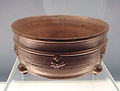 Celadon Lian bowl with Buddhist figures, Western Jin, 265–317 CE.
 -
 Celadon jar, Eastern Jin, 317–420 CE.
 -
 Celadon jar with brown spots, Eastern Jin, 317–420 CE.


Notes
[edit | edit source]External links
[edit | edit source]- A Handbook of Chinese Ceramics from The Metropolitan Museum of Art
