Neoscona oaxacensis
| Neoscona oaxacensis | |
|---|---|
| File:NeoscanaOaxacensisLagunaBeach1.JPG | |
| In Laguna Beach, California | |
| Scientific classification Edit this classification | |
| Kingdom: | Animalia |
| Phylum: | Arthropoda |
| Subphylum: | Chelicerata |
| Class: | Arachnida |
| Order: | Araneae |
| Infraorder: | Araneomorphae |
| Family: | Araneidae |
| Genus: | Neoscona |
| Species: | N. oaxacensis
|
| Binomial name | |
| Neoscona oaxacensis (Keyserling, 1863)[1]
| |
| Synonyms[1][2] | |
| |
Neoscona oaxacensis, known as western spotted orbweaver[3] and zig-zag spider,[4] is a species of spider in the family Araneidae. It is distributed in the Americas, from Kansas and California south to Venezuela and Peru, including the Galápagos Islands.[1]
Description
[edit | edit source]Neoscona oaxacensis is a relatively large spider, females being about 9–18 mm (0.35–0.7 in) long overall, with a carapace of about 4–8 mm (0.15–0.3 in) long by 3–6 mm (0.1–0.25 in) wide. Males are smaller, being about 6–13 mm (0.25–0.5 in) long overall, with a carapace of about 3–6 mm (0.1–0.25 in) long by 3–5 mm (0.1–0.2 in) wide. Specimens from the Galápagos are among the largest found. The black-and-white pattern on the upper (dorsal) surface of the abdomen is considered to be distinctive. South American specimens have a more slender abdomen than North American ones, with a more distinct light central band, which has a wavy border. Females have an epigyne appearing 2.5 times as long as wide when viewed from the rear. Males have a palp with an S-shaped conductor.[1][2]
-
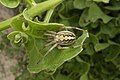 Paler form from Santa Fé, Galapagos
 -
 From Coacalco, Mexico
 -
 View from below
.jpg)


Taxonomy
[edit | edit source]The species was first described by Eugen Keyserling in 1863, as Epeira oaxacensis. The specific name oaxacensis refers to Keyserling's description of its origin as Oaxaca, Mexico.[5] (The Latin ending -ensis is commonly added to a place name to mean "originating from".[6]) The genus Epeira was divided by Eugène Simon in 1864, one of the divisions being Neoscona.[7][8] F.O. Pickard-Cambridge placed Epeira oaxacensis in Neoscona in 1904.[9]
When found in the Galápagos, the species is often called Neoscona cooksoni and is said to be endemic,[10] but this name is now regarded as a synonym of N. oaxacensis.[1][4]
References
[edit | edit source]- ^ a b c d e Lua error in Module:Citation/CS1/Configuration at line 2172: attempt to index field '?' (a nil value).
- ^ a b Lua error in Module:Citation/CS1/Configuration at line 2172: attempt to index field '?' (a nil value).
- ^ Lua error in Module:Citation/CS1/Configuration at line 2172: attempt to index field '?' (a nil value).
- ^ a b Lua error in Module:Citation/CS1/Configuration at line 2172: attempt to index field '?' (a nil value).
- ^ Lua error in Module:Citation/CS1/Configuration at line 2172: attempt to index field '?' (a nil value).
- ^ Lua error in Module:Citation/CS1/Configuration at line 2172: attempt to index field '?' (a nil value)., pp. 208–209
- ^ Lua error in Module:Citation/CS1/Configuration at line 2172: attempt to index field '?' (a nil value).
- ^ Lua error in Module:Citation/CS1/Configuration at line 2172: attempt to index field '?' (a nil value)., p. 261
- ^ Lua error in Module:Citation/CS1/Configuration at line 2172: attempt to index field '?' (a nil value).
- ^ Lua error in Module:Citation/CS1/Configuration at line 2172: attempt to index field '?' (a nil value).
Lua error in Module:Taxonbar at line 165: attempt to index field 'wikibase' (a nil value).