
Messier 78
| Reflection nebula | |
|---|---|
 Image of Messier 78 captured using the Wide Field Imager camera on the MPG/ESO 2.2-metre telescope at the La Silla Observatory. | |
| Observation data: J2000.0 epoch | |
| Right ascension | 05h 46m 46.7s[1] |
| Declination | +00° 00′ 50″[1] |
| Distance | 1,350 ly (415 pc)[2] ly |
| Apparent magnitude (V) | 8.3[3] |
| Apparent dimensions (V) | 8′ × 6′[3] |
| Constellation | Orion |
| Physical characteristics | |
| Radius | 5 ly |
| Notable features | Part of the Orion complex |
| Designations | Ced 55u, DG 80, IRAS 05442-0000, [KPS2012] MWSC 0664, NGC 2068[1] |
Messier 78 (also known as M78 or NGC 2068) is a reflection nebula in the constellation Orion. It is the brightest diffuse reflection nebula in a group that includes NGC 2064, NGC 2067, and NGC 2071, all part of the Orion B molecular cloud complex. Located approximately 1,350 light-years from Earth,[2] M78 is visible in small telescopes as a hazy patch illuminated by two B-type stars, HD 38563 A and HD 38563 B, of 10th and 11th magnitude.[4] It is a popular target for amateur astronomers, who have given it the common name Casper the Friendly Ghost Nebula[5]
Discovery
[edit | edit source]Discovered by Pierre Méchain in 1780, M78 was included in Charles Messier's catalog of comet-like objects that same year.[6]
Structure and composition
[edit | edit source]The nebula's dust cloud reflects light from its two central stars, making it visible. Infrared observations reveal an embedded star cluster[2] and a hierarchy of gas clumps with core masses ranging from 0.3 M☉ to 5 M☉.[7] M78 hosts:
- 45 T Tauri stars (young stellar objects still forming).[8]
- 17 Herbig–Haro objects (jets emitted by nascent stars).[9]
Observations
[edit | edit source]On May 23, 2024, the European Space Agency released a high-resolution image of M78 from the Euclid mission, revealing hundreds of thousands of previously unseen objects, including substellar bodies.[10]
Gallery
[edit | edit source]-
 VISTA image of Messier 78.
 -
 Spitzer image of Messier 78.
 -
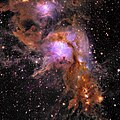 Euclid image of star-forming region Messier 78


See also
[edit | edit source]References
[edit | edit source]- ^ a b c Lua error in Module:Citation/CS1/Configuration at line 2172: attempt to index field '?' (a nil value).
- ^ a b c Lua error in Module:Citation/CS1/Configuration at line 2172: attempt to index field '?' (a nil value).
- ^ a b Lua error in Module:Citation/CS1/Configuration at line 2172: attempt to index field '?' (a nil value).
- ^ Lua error in Module:Citation/CS1/Configuration at line 2172: attempt to index field '?' (a nil value).
- ^ https://www.aapod2.com/blog/messier-78-casper-the-friendly-ghost
- ^ Lua error in Module:Citation/CS1/Configuration at line 2172: attempt to index field '?' (a nil value).
- ^ Lua error in Module:Citation/CS1/Configuration at line 2172: attempt to index field '?' (a nil value).
- ^ Lua error in Module:Citation/CS1/Configuration at line 2172: attempt to index field '?' (a nil value).
- ^ Lua error in Module:Citation/CS1/Configuration at line 2172: attempt to index field '?' (a nil value).
- ^ Lua error in Module:Citation/CS1/Configuration at line 2172: attempt to index field '?' (a nil value).
External links
[edit | edit source]
- Messier 78 on WikiSky: DSS2, SDSS, GALEX, IRAS, Hydrogen α, X-Ray, Astrophoto, Sky Map, Articles and images
- SEDS: Starforming Nebula M78
- NASA Astronomy Picture of the Day: M78: Stardust and Starlight (4 November 2005)
- NightSkyInfo.com – M78
- Astronomy Picture of the Day
- M78 Wide Field 2009 November 26
- M78 and Reflecting Dust Clouds in Orion 2010 March 2
- Lua error in Module:Citation/CS1/Configuration at line 2172: attempt to index field '?' (a nil value).
Lua error in mw.title.lua at line 392: bad argument #2 to 'title.new' (unrecognized namespace name 'Portal').


