Welcome to the Wikipedia Mathematics Reference Desk Archives
The page you are currently viewing is a transcluded archive page. While you can leave answers for any questions shown below, please ask new questions on one of the current reference desk pages.
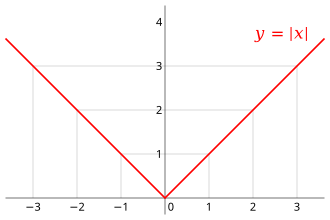
I don't quite understand Differentiable function, but I'm really confused by the statement about the absolute value of 0. The singularity article's previous example (the function of 1/x when x=0) fails because it forces division by zero. But this one is sensible to me, since the absolute value of zero is zero, and g×0=0 is sensible regardless of what g is.
So where am I misunderstanding? Is this somehow related to signed zero or a similar concept? Nyttend (talk) 19:03, 19 January 2024 (UTC)
From the first sentence of the article, one of the meanings of "a singularity" is "a point where the mathematical object ceases to be well-behaved in some particular way, such as by lacking differentiability or analyticity". The absolute value function has a singularity of this kind at 0 (it is not differentiable there, while it is differentiable everywhere else). (I am not entirely convinced that this sentence is correct; the sources on it are of mediocre quality and only questionably verify the statement, and I don't see better sources in the body.) --JBL (talk) 19:09, 19 January 2024 (UTC)
Hmm. It would not really have occurred to me to dispute that characterization; it strikes me as standard usage. I don't know specifically where to find sources though. --Trovatore (talk) 19:27, 19 January 2024 (UTC)
I'm not disputing anything; I just don't understand how x=0 produces a fundamentally different result from x=1 or any other value of x. If a differentiable function of one real variable is a function whose derivative exists at each point in its domain, and a derivative is a line that's tangential to a curve at a given point, why can't that be true at x=0? Is it somehow related to the fact that you can have many different lines be tangential to this function at x=0 [I understand that it's true of a line that goes between (-1,0) and (1,0) and also a line between (-2,-1) and (2,1)], while it's not true of lines elsewhere? In writing this response, I may be understanding it a little bit. Nyttend (talk) 20:08, 19 January 2024 (UTC)
You are correct in that it relates to uniqueness. When the derivative is described as a tangent line, what is really meant is that the derivative (being a numerical value) is the limit of the slope of that line. When such a limit does not exist (e.g. when multiple tangent lines with varying slopes exist) then there is no valid derivative. GalacticShoe (talk) 20:43, 19 January 2024 (UTC)
The derivative of absolute value is the sign function, a step function, which does not have a well-defined two-sided limit at 0. –jacobolus(t) 05:56, 20 January 2024 (UTC)
You should consider function
, a>0.
It is obvious that
but the series does not have a limit in this case. Ruslik_Zero 21:05, 19 January 2024 (UTC)
It is not obvious that this implies that is not differentiable at the origin. The latter, which is equivalent to the statement that fails to have a derivative there, is in fact easy to see, using the definition of the derivative as a limit. For having a derivative at the origin requires to exist, which should not depend on the way approaches . But --Lambiam 22:08, 19 January 2024 (UTC)