Multivox
Multivox was an American-based synthesizer company since the mid-1970s until the 1980s. Originally it was founded in the mid-1940s as the guitar and amplifier manufacturing subsidiary of Peter Sorkin Music Company (Sorkin Music), a New York-based retailer/wholesaler. Then eventually it established separate corporate identity, and after the close of Sorkin Music in the mid-1970s, it continued in existence for fourteen years, according to the Blue Book of Guitar Values.[1] In addition to synthesizers, the company marketed several effects pedals. These included the Big Jam series guitar effects line.
They specialized in delivering Japanese-designed and built equipment to the American market.[2] They usually licensed from lesser-known[citation needed] Japanese companies, such as Hillwood, also known as Firstman, founded in 1972 by Kazuo Morioka, who later worked for Akai in the early 1980s.[3][4] Multivox were criticized as having design and circuitry extremely similar to but inferior to designs by Roland[citation needed]. Multivox ceased trading in the early 1980s having "faded into synth history", according to the Synthmuseum.[2]
_(clip).jpg)
Re-branding
[edit | edit source]As a result of the old criticism of Multivox synthesizer technology and their comparisons with Roland hardware, several hoax/fraudulent cases have occurred. The main hoax was based around a Multivox MX-3000 synthesizer (the flagship of the Multivox range). These machines are quite rare although not particularly sought for by collectors and musicians. Hence when a Roland MX-3000 was offered for sale much controversy surrounding the original Multivox design was stirred up. Eventually the seller admitted that the synthesizer was in fact Multivox, but he had re-badged it in an attempt to generate interest.[citation needed] [5]
The Multivox range
[edit | edit source]Synthesizers
[edit | edit source]Multivox produced over 15 different types of synthesizers, almost all with names beginning with "MX-" (except for SQ-01).
- MX-20 - An electric piano produced from 1977 to 1978.[6] Had five presets (high/low piano and clavichord and 'honky tonk') and a bass split with independent volume control. 61 key keyboard. Tune, Sustain and vibrato controls.
- MX-28 - The MX-28's literature says (C)1981. It is very similar to MX20 except that it uses sliders instead of rotary knobs and has a Phaser instead of vibrato. It also has a built in speaker on the right side. The 'high/low' variations of the voices is omitted, but on this machine you can actually blend the voices together.
- MX-30 - This model is a slight expansion on the MX-20 having a 61-key velocity-sensitive keyboard.[7]
- MX-51 - Another piano-based model.[citation needed]
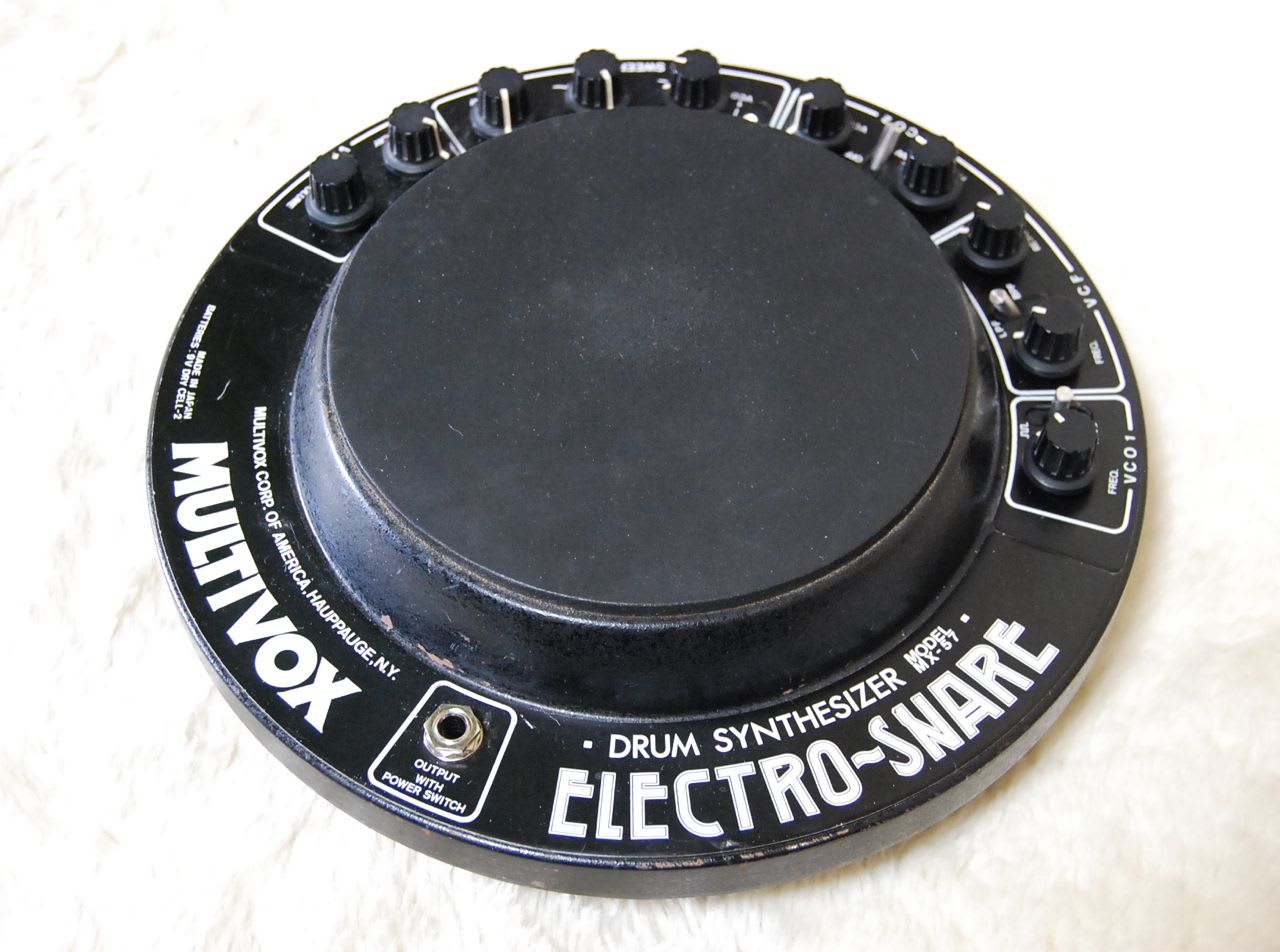
- MX-57/Electro-Snare - A drum synthesizer with 2VCO/VCF/VCA/SWEEP.[8] The design is similar to the Star Instruments SYNARE 3.
- MX-65 - Polyphonic Keyboard with 6 string sounds. Envelope, LFO and Ensemble controls.
- MX-75 - Duophonic preset synthesizer with aftertouch effect. Also known as Pulser M75. Developed by Hillwood.[9]
- MX-99 - Mini Echo - An analog delay with volume tone repeat and delay controls
- MX-150/Basky II - An organ-style bass pedal.[10]
- MX-202 - String & Bass ensemble. Very similar to the Roland RS-202 synthesizer.[11]
- MX-440 - Same as above. Some MX-440 might be re-badged MX-202.[12][13]
- MX-450 - Very rare Bass Pedal.[14] Little is known. More sources needed.
- MX-880 DUO - Same as below.[15]
- MX-2000 DUO - Duophonic preset synthesizer with aftertouch effect. It has similarities with the Roland SH-2000 design,[3] but are different instruments.[16] Developed by Hillwood.[9]
- MX-3000 - The largest and most feature-laden synthesizer of the range. Includes an individual bass synth, preset synth, preset edit synth, and monophonic lead synth. And a blend control for all 4 synths. Also known as Pulser M85. Developed by Hillwood.[9]
Digital sequencers
[edit | edit source]
- SQ-01 - A combination of synthesizer and sequencer. Performs bass synth functions similar to the later Roland TB-303 released in 1981.[20] Originally released in 1980 by Hillwood under Firstman brand, before Multivox released it in 1981.[17][9]
- MX-8100 Sequencer - Digital keyboard sequencer with up to 4 patterns depending on how much memory you use for the patterns. The MX-8100 has separate outputs for V/Oct and Hz/V control voltages. Developed by Hillwood.[9]
- MX-S100 - Misreference- no such model exists.
Drum machines
[edit | edit source]
- Rhythm Ace FR-3S (c. 1979) - Multivox version of Rhythm Ace analog drum machine. It seems released after the Multivox/Sorkin Music stopped the engage with former OEM manufacturers, Ace Tone by Ace Electronics and Roland Corporation. AnalogAudio1 on YouTube pointed out the similarity with Korg Mini-Pops hardware.[21]
Effect processors
[edit | edit source]- LD-2/Little David - One of the world first Leslie speaker simulator.[22]
Big Jam series - guitar effect pedals
[edit | edit source]
- SE-1 Phaser - Phaser
- SE-2 Spit Wah - Auto Wah - It is a close clone to the Mutron III filter. For this reason and because it is a rare pedal it is becoming increasingly sought after since the 2010s.
- SE-3 Compressor - Compressor
- SE-4 Octave - Octaver
- SE-5 Flanjam Flanger - Flanger
- SE-6 Graphic Equalizer - 6 band analog EQ band sliders for 100 Hz, 200 Hz, 400 Hz, 800 Hz, 1.6 kHz, 3.2 kHz
- SE-7 Delay Machine - Delay/Reverb with Mode switch for Delay/(Rev)erb, Delay, Repeat, (Bal)ance
- SE-8 Distortion - Distortion
- SE-9 Biphase Phaser - Dual Phaser with Width, Rate, and (Reso)nance sliders
- SE-10 Quartz Guitar Tuner - Tuner
- SE-11 Jazz Flanger - Flanger
- SE-12 Chorus - Chorus with Warp, Speed, Depth sliders
- SE-13 Space Driver - Boost/Overdrive with Expand, Drive, and Level sliders
- SE-14 Stop Noise - Noise Gate with Sensitivity and Decay slider controls
- SE-15 "Unknown" -
- SE-16 "Unknown" -
- SE-17 "Unknown" -
- SE-18 Parametric EQ - Parametric Eq
- SE-XP Pulse Regulator Power Supply - A Power supply that powered up to 5 Big Jam Effects units via 9 volt dc supply and cables.
- SE-PB Pedal Board - Self-enclosed pedal board that included the SE-XP Pulse Power Supply and room for up to 5 Big Jam Effects in a flight case design with power cables and linking audio jacks connections.
See also
[edit | edit source]External links
[edit | edit source]
- Synthmusem.com: Multivox - List of Multivox instruments.
- Sonic State: Multibox - Reviews of Multivox instruments.
- SYNRISE - Multivox Corporation of America - Another product list including fairly unknown models (in Deutsche. Internet Archive cache at 2005-02-21).
References
[edit | edit source]- ^ Lua error in Module:Citation/CS1/Configuration at line 2172: attempt to index field '?' (a nil value).
- ^ a b Multivox, Synthmuseum
- ^ a b A TALE OF TWO STRING SYNTHS, Sound on Sound, July 2002
- ^ Mark Jenkins (2009), Analog Synthesizers, page 107, CRC Press
- ^ rüediger lorenz_synthesizer collection, a sample of re-badged MX-3000.
- ^ Nabble - Electronic Music » Analogue Heaven, "FS: Multivox MX-20"
- ^ Multivox MX-30, Synthmuseum
- ^ Multivox MX-57/ELECTRO-SNARE (photo)
- ^ a b c d e Mark Jenkins (2009), Analog Synthesizers, pages 107–108, CRC Press
- ^ Multivox MX-150/Basky II Archived 2005-12-14 at the Wayback Machine (photo)
- ^ Multivox MX-202 Archived 2007-08-09 at the Wayback Machine, Hollowsun
- ^ Multivox MX-440 #1-4, Transanalog - Front panel of re-badged MX-440 said "MX-440".
- ^ Multivox MX-440 #1-11, Transanalog - Manufacture's plate of re-badged MX-440 said "Model MX-202".
- ^ MX-450 Bass Pedal Synthesizer Demo (movie), MATRIXSYNTH
- ^ MX-880, MATRIXSYNTH
- ^ Multivox MX-2000, Roland SH-2000, Roland SH-1000, MATRIXSYNTH - Comparison report of 3 models.
- ^ a b Lua error in Module:Citation/CS1/Configuration at line 2172: attempt to index field '?' (a nil value).
- ^ Lua error in Module:Citation/CS1/Configuration at line 2172: attempt to index field '?' (a nil value).
- ^ Lua error in Module:Citation/CS1/Configuration at line 2172: attempt to index field '?' (a nil value). ("Keyboard Report, Oct. '81", according to the Lua error in Module:Citation/CS1/Configuration at line 2172: attempt to index field '?' (a nil value).)
- ^ Lua error in Module:Citation/CS1/Configuration at line 2172: attempt to index field '?' (a nil value).
- ^ Lua error in Module:Citation/CS1/Configuration at line 2172: attempt to index field '?' (a nil value).
- ^ Hammond Leslie FAQ - Hammond and Leslie Clones, TheatreOrgans.com