Merodon equestris
| Merodon equestris | |
|---|---|
| File:Narcissus bulb fly (Merodon equestris) grooming.jpg | |
| Grooming | |
| Scientific classification Error creating thumbnail: | |
| Kingdom: | Animalia |
| Phylum: | Arthropoda |
| Class: | Insecta |
| Order: | Diptera |
| Family: | Syrphidae |
| Genus: | Merodon |
| Species: | M. equestris
|
| Binomial name | |
| Merodon equestris (Fabricius, 1794)
| |
| File:Merodon equestris map.png | |
| Distribution map | |
| Synonyms | |
Merodon equestris (Narcissus bulb fly, greater bulb fly, large bulb fly, large Narcissus fly)[2] is a Holarctic species of hoverfly (Family Syrphidae).[3][4][5] [6][7][8] Like many other hoverflies it displays a colouration pattern similar to a stinging insect (a bumblebee in this case) as an evolutionary defense mechanism. Other syrphid bee mimics are Mallota, Arctophila, Criorhina, Pocota and Brachypalpus. Merodon species are distinguished from these by the very strong hind femora, which bear a large triangular projection on the underside near the tip. It flies in low vegetation while the other bumblebee mimics prefer higher vegetation layers.
Description
[edit | edit source]A stout fly with a small head (10–14 mm in length).[9] The tergites are black, without the dust spots or blue-purple sheen of other Merodon species. The thorax and abdomen are hidden by dense, long, erect hairs of variable colouration. Tibia 3 of the male has 2 spurs at the apex.[10] The larva is described and figured by Hodson (1932) [11] and it is illustrated in colour by Rotheray (1993).[12]
Distribution
[edit | edit source]In the Palearctic it is found from Fennoscandia south to Iberia and the Mediterranean basin, and Ireland east through Europe into Russia and Japan. In the Nearctic it is found from British Columbia south to California. It has been introduced to New Zealand. (see map) [13]
Biology
[edit | edit source]They inhabit open areas in deciduous forest up into the subalpine zone but significantly synanthropic, occurring in suburban parks and gardens and on horticultural land.[13] The adult flies low in April to July with a fast zig-zag flight, among ground vegetation frequently settling on bare ground. Adult M. equestris feed on pollen and nectar. They visit a large variety of flowers for nectar,[14] while the larvae feed internally in tissues of bulbs of Amaryllidaceae, and they are regarded as a horticultural pest, especially of Narcissus. Females lay 1 egg at a time on leaves of this plant (or in soil by it). Larvae overwinter in the bulbs.[9] A bibliography of the literature on the biology of M. equestris is given by Barkemeyer (1994).[15]
Colour forms
[edit | edit source]-
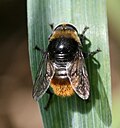 var. equestris (female)
 -
 var. narcissi (male)
 -
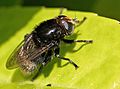 var. validus (female)
.jpg)
.jpg)

_grooming.jpg)


References
[edit | edit source]- ^ Lua error in Module:Citation/CS1/Configuration at line 2172: attempt to index field '?' (a nil value).
- ^ Lua error in Module:Citation/CS1/Configuration at line 2172: attempt to index field '?' (a nil value).
- ^ Lua error in Module:Citation/CS1/Configuration at line 2172: attempt to index field '?' (a nil value).
- ^ Van Veen, M. (2004) Hoverflies of Northwest Europe: identification keys to the Syrphidae. 256pp. KNNV Publishing, Utrecht.addendum
- ^ Van der Goot, V.S. (1981) De zweefvliegen van Noordwest - Europa en Europees Rusland, in het bijzonder van de Benelux. KNNV, Uitgave no.32: 275pp. Amsterdam.
- ^ Bei-Bienko, G.Y. & Steyskal, G.C. (1988) Keys to the Insects of the European Part of the USSR, Volume V: Diptera and Siphonaptera, Part I. Amerind Publishing Co., New Delhi. Lua error in Module:Citation/CS1/Configuration at line 2172: attempt to index field '?' (a nil value)..
- ^ Coe, R.L. (1953) Diptera: Syrphidae. Handbks.ident.Br.insects, 10(1): 1-98. R.ent.Soc.London. pdf
- ^ Peck, L.V. (1988) Syrphidae. In: Soos, A. & Papp, L. (eds.) Catalogue of Palaearctic Diptera, 8: 11-230. Akad.Kiado, Budapest.
- ^ a b Lua error in Module:Citation/CS1/Configuration at line 2172: attempt to index field '?' (a nil value).
- ^ Bradescu, V. (1991) Les Syrphides de Roumanie (Diptera, Syrphidae), Clés de détermination et répartition. Trav.Mus.Hist. nat. Grigore Antipa, 31: 7-83.
- ^ Hodson, W.E.H. (1932) The large narcissus fly, Merodon equestris, Fab. (Syrphidae). Bull.Ent.Res., 23: 429-448
- ^ Rotheray G., 1993 Colour Guide to Hoverfly Larvae Diptera, Syrphidae in Britain and Europe Dipterists Forum pdf
- ^ a b Lua error in Module:Citation/CS1/Configuration at line 2172: attempt to index field '?' (a nil value).
- ^ de Buck, N. (1990) Bloembezoek en bestuivingsecologie van Zweefvliegen (Diptera, Syrphidae) in het bijzonder voor elgië. Doc.Trav. IRSNB, no.60, 1-167.
- ^ Barkemeyer, W. (1994) Untersuchung zum Vorkommen der Schwebfliegen in Niedersachsen und Bremen (Diptera: Syrphidae). Naturschutz und Landschaftspflege in Niedersachsen, 31: 1-514.
External links
[edit | edit source]Error creating thumbnail: File missing Media related to Lua error in Module:Commons_link at line 62: attempt to index field 'wikibase' (a nil value). at Wikimedia Commons

Lua error in Module:Taxonbar at line 165: attempt to index field 'wikibase' (a nil value).