Malus fusca
| Malus fusca | |
|---|---|
| File:Malusfusca.jpg | |
| Flowers and leaves at Humboldt Bay National Wildlife Refuge in California | |
| Scientific classification Edit this classification | |
| Kingdom: | Plantae |
| Clade: | Tracheophytes |
| Clade: | Angiosperms |
| Clade: | Eudicots |
| Clade: | Rosids |
| Order: | Rosales |
| Family: | Rosaceae |
| Genus: | Malus |
| Species: | M. fusca
|
| Binomial name | |
| Malus fusca | |
| Synonyms | |
|
Synonymy
| |


Malus fusca, with the common names Oregon crabapple and Pacific crabapple, is a species of crabapple native to western North America.[1]
Description
[edit | edit source]
Malus fusca is a deciduous tree growing up to 13 metres (43 feet) tall, with a trunk 20–25 centimetres (8–10 inches) thick.[2] The leaves are 5–8 cm (2–3 in) long, dark green above, and both pale and fibrous beneath; they turn bright orange to red in autumn.[2]
The flowers are white or pale pink, blooming in spring. The fruits are small round apple-shaped pomes, about 2 cm (3⁄4 in) long and from red to yellow-green in colour.[3][4] They may stay on the tree until winter.[5]
The trees can reach at least 100 years of age.[2]
-
Botanical illustration
-
Tree at Royal Botanic Gardens, Kew
-
Leaves
-
Leaf undersides
-
Close-up of flower

_C.K.Schneid._cultivated_at_Royal_Botanic_Gardens,_Kew.jpg)


Taxonomy
[edit | edit source]Archibald Menzies described the species in 1792 after finding it near today's Port Angeles, Washington.[2]
Distribution and habitat
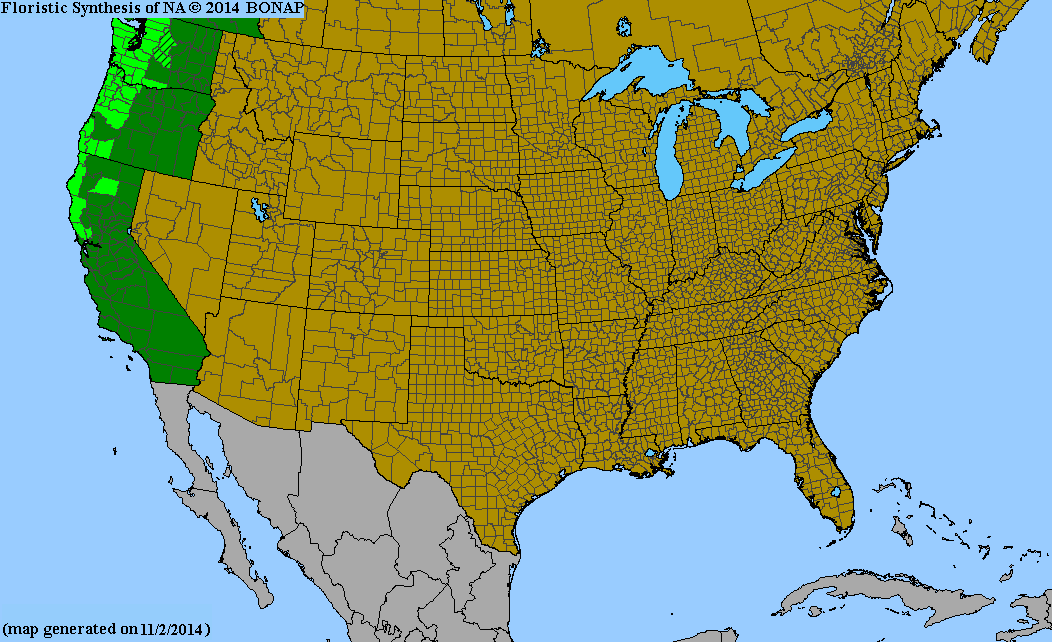
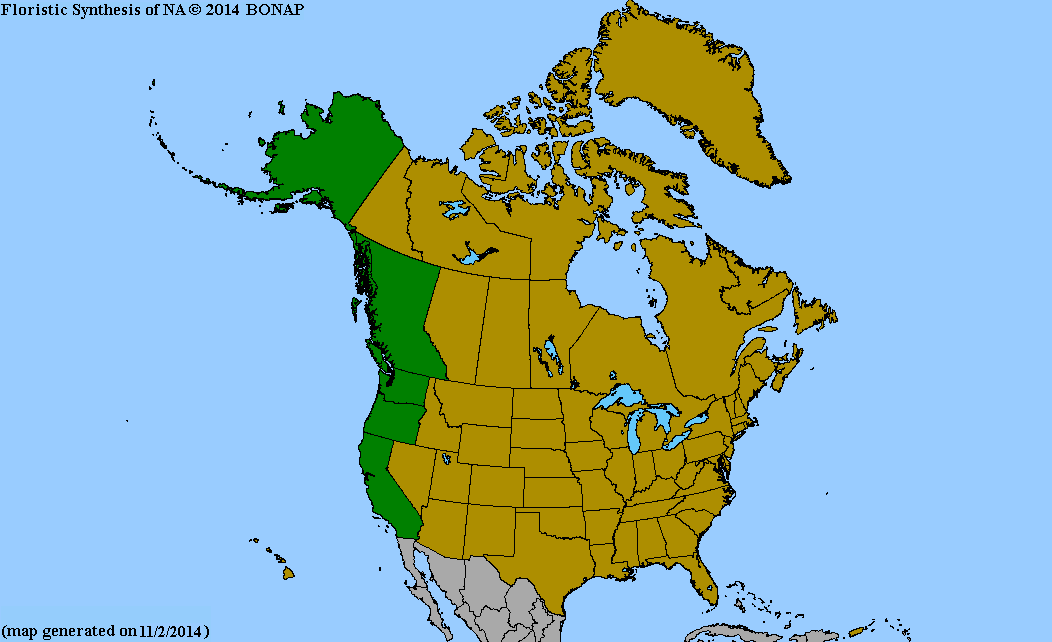
[edit | edit source]The species can be found from Alaska, through British Columbia, to northwestern California. It grows in temperate coniferous forest, primarily in the Cascade Range and the Pacific Coast Ranges.[6][7][8][9][10]
The tree can grow in a variety of maritime conditions, its rootstock tolerating wet soils (including saltwater estuaries), poorly drained areas and heavy clay soils. It can be found in high-rainfall regions.[11][12]
Ecology
[edit | edit source]It can be found growing along with red alder, bigleaf maple, willows, and cascara. Animals including grouse and bears eat the fruit.[2]
Uses
[edit | edit source]The oblong fruit can be eaten, but has a sour flavor.[13] The fruit can also be used for extraction of pectin, useful in helping make jams and jellies from other fruits, and is also made into jams and jellies itself.[14] The bark can be used as an herbal medicine. It is also grown in parks and gardens as an ornamental plant.[citation needed]
Pacific crabapple fruits were prized by indigenous peoples of the Pacific Northwest as a food source,[13] and were gathered all along the coast. As a traditional medicinal plant, infusions of the bark and/or fruit were used, including for stomach disorders, skin and eye infections, and as an analgesic.[15]
The tree was also valued for its tough, resilient wood, used for making implements, and for its bark, used for a wide range of medicinal purposes.[16][17]
References
[edit | edit source]- ^ Plants for a Future−PFAF: Malus fusca
- ^ a b c d e Lua error in Module:Citation/CS1/Configuration at line 2172: attempt to index field '?' (a nil value).
- ^ Malus fusca'- Árboles ornamentales (in Spanish)
- ^ Flora of North America, Malus fusca (Rafinesque) C. K. Schneider, 1906. Oregon or Western or Pacific crabapple
- ^ Lua error in Module:Citation/CS1/Configuration at line 2172: attempt to index field '?' (a nil value).
- ^ Biota of North America Program: 2014 county distribution map
- ^ Biota of North America Program 2014 state-level distribution map
- ^ Calflora taxon report, University of California, Malus fusca (Raf.) C. Schneider Oregon crab apple, Oregon crabapple
- ^ University of Washington, Burke Museum
- ^ Biodiversity of the Central Coast: Pacific Crab Apple
- ^ Deur Keeping it Living. University of Washington Press, 2005, p. 13.
- ^ Lua error in Module:Citation/CS1/Configuration at line 2172: attempt to index field '?' (a nil value).
- ^ a b Lua error in Module:Citation/CS1/Configuration at line 2172: attempt to index field '?' (a nil value).
- ^ Lua error in Module:Citation/CS1/Configuration at line 2172: attempt to index field '?' (a nil value).
- ^ University of Michigan at Dearborn: Native American Ethnobotany of Malus fusca (Oregon Crabapple)
- ^ Deur, Douglas and Turner, Nancy J. Keeping it Living. University of Washington Press, 2005, p. 13.
- ^ Crabapples - University of Alaska Fairbanks description, photos, recipes
External links
[edit | edit source]
- CalFlora Database: Malus fusca (Oregon crab apple, Oregon crabapple)
- Dreamstime, Royalty Free Stock Images: Photos of the Pacific Crabapple tree (Malus Fusca)
- UC Calphoto Photos gallery — Malus fusca


Lua error in Module:Taxonbar at line 165: attempt to index field 'wikibase' (a nil value).