Low-Density Supersonic Decelerator
.jpg) Artist's rendering of LDSD test vehicle in flight | |
| Manufacturer | Jet Propulsion Laboratory |
|---|---|
| Country of origin | United States |
| Operator | NASA |
| Applications | Technology demonstrator |
| Specifications | |
| Spacecraft type | Hypercone |
| Launch mass | 3,120 kg (6,878 lb)[1] |
| Dimensions | Diameter: 4.7 m (15 ft 5 in)[1] |
| Regime | Suborbital |
| Production | |
| Status | In production |
| On order | 0 |
| Built | 3 |
| Launched | 2 |
| Maiden launch | June 28, 2014 |
The Low-Density Supersonic Decelerator or LDSD is a reentry vehicle designed to test techniques for atmospheric entry on Mars. The disc-shaped LDSD uses an inflatable structure called the Supersonic Inflatable Aerodynamic Decelerator (SIAD), which is essentially a donut-shaped balloon, to create atmospheric drag in order to decelerate the vehicle before deploying a large supersonic parachute.[2] The goal of the $230 m project is to develop a reentry system capable of landing 2- to 3-ton payloads on Mars, as opposed to the 1-ton limit of the currently used systems.[3]
The vehicle is being developed and tested by NASA's Jet Propulsion Laboratory.[1] Mark Adler is the project manager.[4]
The vehicle was tested in 2014 and 2015.[5]
June 2014 test flight
[edit | edit source]The test flight took place on June 28, 2014, with the test vehicle launching from the United States Navy's Pacific Missile Range Facility on Kauaʻi, Hawaiʻi, at 18:45 UTC (08:45 local).[4] A high-altitude helium balloon, which when fully inflated has a volume of 975,000 cubic meters (34,430,000 ft3),[1] lifted the vehicle to 36,500 meters (119,900 ft).[6] The vehicle detached at 21:05 UTC (11:05 local),[4] and four small, solid-fuel rocket motors spun up the vehicle to provide stability.[6]
A half second after spin-up, the vehicle's Star 48B solid-fuel motor ignited, powering the vehicle to Mach 4.32 and a peak altitude of 58,200 meters (190,900 ft).[6] Immediately after rocket burn-out, four more rocket motors despun the vehicle.[1] Upon slowing to Mach 4.08, the 6-meter (20 ft) tube-shaped Supersonic Inflatable Aerodynamic Decelerator (SIAD-R configuration) deployed.[6] SIAD is intended to increase atmospheric drag on the vehicle by increasing the surface area of its leading side, thus increasing the rate of deceleration.[7]
Upon slowing to Mach 2.54 (around 86 seconds after SIAD deployment[1]), the Supersonic Disksail (SSDS) parachute was deployed to slow the vehicle further.[6] This parachute measures 30.5 meters (100 ft) in diameter, twice the area of the one used for the Mars Science Laboratory mission.[8] However, it began tearing apart after deployment,[9] and the vehicle impacted the Pacific Ocean at 21:35 UTC (11:35 local) travelling 32 to 48 kilometers per hour (20 to 30 mph).[4][10] All hardware and data recorders were recovered.[7][10] Despite the parachute incident, the mission was declared a success; the primary goal was proving the flight worthiness of the test vehicle, while SIAD and SSDS were secondary experiments.[7]
2015 test flights
[edit | edit source]A second test flight of LDSD took place in June 2015, at the Pacific Missile Range Facility. This test focused on the 6-meter (20 ft) SIAD-R and Supersonic Ringsail (SSRS) technologies, incorporating lessons learned during the 2014 test.[11] Changes planned for the parachute included a rounder shape and structural reinforcement.[9] After several weather-related scrubs, the flight occurred on June 8.[12][13] As in the first test, the SIAD structure inflated successfully but the parachute was damaged during deployment,[14][3] this time after 600 ms and at 80,000 pounds (36,000 kg) drag.[15]
After 2015
[edit | edit source]A 3rd test was expected in 2016,[3] after some smaller scale tests with sounding rockets.[15][needs update]
The parachute team wanted Mars 2020 to have a camera on the parachute deployment and opening in 2021.[15]
Gallery
[edit | edit source]-
 33.5-meter Supersonic Ring Sail Parachute
 -
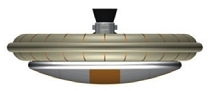 6-meter SIAD-R
 -
 8-meter SIAD-E
_-_33.5-meter_Supersonic_Ring_Sail_Parachute.jpg)
_-_6-meter_SIAD-R.jpg)
_-_8-meter_SIAD-E.jpg)
See also
[edit | edit source]- HIAD, NASA's Hypersonic Inflatable Aerodynamic Decelerator
- LOFTID, 2022 test from Earth orbit
- Rockoon
References
[edit | edit source]- ^ a b c d e f Lua error in Module:Citation/CS1/Configuration at line 2172: attempt to index field '?' (a nil value).
- ^ Lua error in Module:Citation/CS1/Configuration at line 2172: attempt to index field '?' (a nil value).
- ^ a b c Lua error in Module:Citation/CS1/Configuration at line 2172: attempt to index field '?' (a nil value).
- ^ a b c d Lua error in Module:Citation/CS1/Configuration at line 2172: attempt to index field '?' (a nil value).
- ^ Lua error in Module:Citation/CS1/Configuration at line 2172: attempt to index field '?' (a nil value).
- ^ a b c d e Lua error in Module:Citation/CS1/Configuration at line 2172: attempt to index field '?' (a nil value).
- ^ a b c Lua error in Module:Citation/CS1/Configuration at line 2172: attempt to index field '?' (a nil value).
- ^ Lua error in Module:Citation/CS1/Configuration at line 2172: attempt to index field '?' (a nil value).
- ^ a b Lua error in Module:Citation/CS1/Configuration at line 2172: attempt to index field '?' (a nil value).
- ^ a b Lua error in Module:Citation/CS1/Configuration at line 2172: attempt to index field '?' (a nil value).
- ^ Lua error in Module:Citation/CS1/Configuration at line 2172: attempt to index field '?' (a nil value).
- ^ Lua error in Module:Citation/CS1/Configuration at line 2172: attempt to index field '?' (a nil value).
- ^ Lua error in Module:Citation/CS1/Configuration at line 2172: attempt to index field '?' (a nil value).
- ^ Lua error in Module:Citation/CS1/Configuration at line 2172: attempt to index field '?' (a nil value).
- ^ a b c How to Land a House on Mars Feb 2016
