Lingual tonsils
| Lingual tonsils | |
|---|---|
| File:Illu04 tongue.jpg Tongue | |
| Details | |
| System | Immune system (lymphatic system) |
| Identifiers | |
| Latin | tonsilla lingualis |
| TA98 | Lua error in Module:Wikidata at line 746: attempt to index field 'wikibase' (a nil value). |
| TH | {{#property:P1694}} |
| TE | {{#property:P1693}} |
| FMA | {{#property:P1402}} |
| Anatomical terminology [[[d:Lua error in Module:Wikidata at line 865: attempt to index field 'wikibase' (a nil value).|edit on Wikidata]]] | |
The lingual tonsils are a collection of lymphoid tissue located in the lamina propria of the root of the tongue.[1] This lymphoid tissue consists of the nodules rich in cells of the immune system (immunocytes).[2] The immunocytes initiate the immune response when the lingual tonsils get in contact with invading microorganisms (pathogenic bacteria, viruses or parasites).[2][3][4]
Structure
[edit | edit source]Microanatomy
[edit | edit source]Lingual tonsils are covered externally by stratified squamous epithelium (nonkeratinized) that invaginates inward forming tonsillar crypts. Beneath the epithelium is a layer of lymphoid nodules containing lymphocytes. Mucous glands located at the root of the tongue are drained through several ducts into the crypts of the lingual tonsils.[2][3] Secretions of these mucous glands keep the crypts clean and free of any debris.
Blood supply
[edit | edit source]Lingual tonsils are located on posterior aspect of tongue which is supplied through:[1]
- Lingual artery, branch of external carotid artery
- Tonsillar artery
- Ascending and descending palatine arteries
- Ascending pharyngeal branch of external carotid artery
Nerve supply
[edit | edit source]Lingual tonsils are innervated by tonsillar nerves from the tonsilar plexus, formed by the glossopharyngeal and vagus nerves.[1]
Function
[edit | edit source]Like other lymphatic tissues, the function of lingual tonsils is to prevent infections. These tonsils contain B and T lymphocytes which get activated when harmful bacteria and viruses come in contact with tonsils. B lymphocytes kill pathogens by producing antibodies against them, while T lymphocytes directly kill them releasing cytotoxic substances or indirectly by stimulating other cells of the immune system.[2][3][4]
Clinical significance
[edit | edit source]Cancer
[edit | edit source]Squamous cell carcinoma is a type of neoplasm that can affect lingual tonsils.[5]
Sleep apnea
[edit | edit source]Enlarged or hypertrophic lingual tonsils have the potential to cause or exacerbate sleep apnea.[6]
Additional images
[edit | edit source]-
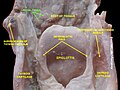 Lingual tonsil
 -
Lingual tonsil
-
Lingual tonsils


References
[edit | edit source]Public domain This article incorporates text in the public domain from the 20th edition of Gray's Anatomy (1918)

- ^ a b c Lua error in Module:Citation/CS1/Configuration at line 2172: attempt to index field '?' (a nil value).
- ^ a b c d Lua error in Module:Citation/CS1/Configuration at line 2172: attempt to index field '?' (a nil value).
- ^ a b c Lua error in Module:Citation/CS1/Configuration at line 2172: attempt to index field '?' (a nil value).
- ^ a b Lua error in Module:Citation/CS1/Configuration at line 2172: attempt to index field '?' (a nil value).
- ^ Lua error in Module:Citation/CS1/Configuration at line 2172: attempt to index field '?' (a nil value).
- ^ Lua error in Module:Citation/CS1/Configuration at line 2172: attempt to index field '?' (a nil value).
External links
[edit | edit source]- Pictures at usc.edu(Registration required)
- Anatomy Atlases – Microscopic Anatomy, plate 09.163
- Histology image: 09802loa – Histology Learning System at Boston University
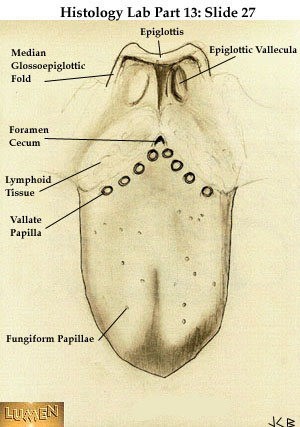
- MedEd at Loyola histo/HistoImages/hl6-27.jpg (labeled as 'lymphoid tissue')]
- Lingual Tonsil Archived 2016-03-04 at the Wayback Machine
Lua error in mw.title.lua at line 392: bad argument #2 to 'title.new' (unrecognized namespace name 'Portal').
Lua error in Module:Authority_control at line 153: attempt to index field 'wikibase' (a nil value).