Lesser black-backed gull
| Lesser black-backed gull | |
|---|---|
| File:Larus-fuscus-taxbox.jpg | |
| Larus fuscus graellsii | |
Scientific classification 
| |
| Kingdom: | Animalia |
| Phylum: | Chordata |
| Class: | Aves |
| Order: | Charadriiformes |
| Family: | Laridae |
| Genus: | Larus |
| Species: | L. fuscus
|
| Binomial name | |
| Larus fuscus | |
| File:Larus fuscus map.svg | |
The lesser black-backed gull (Larus fuscus) is a large gull that breeds on the Atlantic and Arctic coasts of Europe. It is migratory, wintering from the British Isles south to West Africa. However, it has increased dramatically in North America, especially along the east coast. Formerly just a winter visitor to North America, it now occurs in large numbers some winters and birds are recorded year-round.[2] However, there is serious concern about decline in many parts of its range. The species is on the UK Amber List[3] because the UK is home to 40 per cent of the European population and more than half of these are found at fewer than ten breeding sites.[3]
Taxonomy
[edit | edit source]The lesser black-backed gull was one of the many species originally described by Carl Linnaeus in his 1758 10th edition of Systema Naturae, and it still bears its original name Larus fuscus.[4] The scientific name is from Latin. Larus appears to have referred to a gull or other large seabird, and fuscus meant black or brown.[5]
Subspecies
[edit | edit source]Five subspecies are accepted:[6]
| Image | Subspecies | Distribution |
|---|---|---|
| File:Larus fuscus on the wall of Mont St Michel.jpg | L. f. graellsii Brehm, 1857 | Greenland, Iceland, Faroe Islands, British Isles, western Europe - mantle dark grey |
| File:Larus fuscus EM1B1660 (40890382754).jpg | L. f. intermedius Schiøler, 1922 | Netherlands, Germany, Denmark, southwest Sweden and western Norway - mantle sooty black |
| File:Larus fuscus, a gull in Helsinki, Finland, 2020 August.jpg | L. f. fuscus Linnaeus, 1758 | northern Norway, Sweden and Finland to the White Sea - mantle jet black |
| File:Sea-Gull.jpg | L. f. heuglini Bree, 1876 | northern Russia to north-central Siberia; known as Heuglin's gull, this was previously considered a separate species. |
| File:Чайка на фоне оголившихся корней сосны.jpg | L. f. barabensis Johansen, 1960 | central Asia |
Description
[edit | edit source]The lesser black-backed gull is smaller than the European herring gull. The taxonomy of the herring gull / lesser black-backed gull complex is complicated; different authorities recognise between two and eight species. This group has a ring species distribution around the Northern Hemisphere. Differences between adjacent forms in this ring are fairly small, but by the time the circuit is completed, the end members, herring gull and lesser black-backed gull, are clearly different species.
The lesser black-backed gull measures 51–64 cm (20–25 in), 124–150 cm (49–59 in) across the wings, and weighs 452–1,100 g (0.996–2.425 lb), with the nominate race averaging slightly smaller than the other two subspecies.[7] Males, at an average weight of 824 g (1.817 lb), are slightly larger than females, at an average of 708 g (1.561 lb). The wing chord is 38 to 45 cm (15 to 18 in), the bill is 4.2 to 5.8 cm (1.7 to 2.3 in), and the tarsus is 5.2 to 6.9 cm (2.0 to 2.7 in).[8][9][10] A confusable species is the great black-backed gull. The lesser is a much smaller bird, with slimmer build, yellow rather than pinkish legs, and smaller white "mirrors" at the wing tips. The adults have black or dark grey wings (depending on race) and back. The bill is yellow with a red spot at which the young peck, inducing feeding (see fixed action pattern). The head is greyer in winter, unlike that of the great black-backed gull. The annual moult for adults begins between May and August and is not complete on some birds until November. A partial prebreeding moult occurs between January and April.[11]
Young birds have scaly black-brown upperparts and a neat wing pattern. They take four years to reach maturity. Identification from juvenile herring gulls is most readily done by the more solidly dark (unbarred) tertial feathers.
Their call is a "laughing" cry like that of the herring gull, but with a markedly deeper pitch.
Distribution
[edit | edit source]Lesser black-backed gulls have expanded their range westwards, first colonising Greenland in the 1980s. The species has not yet bred in the United States, although hybrid pairs with American herring gulls have been recorded twice.[2]
Breeding
[edit | edit source]This species breeds colonially on coasts and lakes, making a lined nest on the ground or a cliff. Normally, three eggs are laid. In some cities, the species nests within the urban environment, often in association with herring gulls.[12]
Feeding
[edit | edit source]They are omnivores, like most Larus gulls, and eat fish, insects, crustaceans, worms, starfish, molluscs, seeds, berries, small mammals, eggs, small birds, chicks, scraps, offal, and carrion.
Gallery
[edit | edit source]-
 L. f. intermedius in flight, Sweden
 -
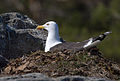
-
 Mother gull and her baby
 -
 Close up
 -
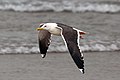 L. f. graellsii adult, Morocco
 -
 L. f. graellsii young adult, Morocco
 -
 L. f. graellsii juvenile, Portugal
 -
First cycle plumage
-
Flying in a lake near the city hall in Reykjavik
-
ID composite
-
Larus fuscus fuscus - MHNT
_in_flight_composite.jpg)


.jpg)
_young_adult_in_flight.jpg)
_juvenile_in_flight_Sagres.jpg)


.jpg)


References
[edit | edit source]- ^ Lua error in Module:Citation/CS1/Configuration at line 2172: attempt to index field '?' (a nil value).
- ^ a b Lua error in Module:Citation/CS1/Configuration at line 2172: attempt to index field '?' (a nil value).
- ^ a b Lua error in Module:Citation/CS1/Configuration at line 2172: attempt to index field '?' (a nil value).
- ^ Lua error in Module:Citation/CS1/Configuration at line 2172: attempt to index field '?' (a nil value).
- ^ Lua error in Module:Citation/CS1/Configuration at line 2172: attempt to index field '?' (a nil value).
- ^ Lua error in Module:Citation/CS1/Configuration at line 2172: attempt to index field '?' (a nil value).
- ^ Lua error in Module:Citation/CS1/Configuration at line 2172: attempt to index field '?' (a nil value).
- ^ Lua error in Module:Citation/CS1/Configuration at line 2172: attempt to index field '?' (a nil value).
- ^ Lua error in Module:Citation/CS1/Configuration at line 2172: attempt to index field '?' (a nil value).
- ^ Lua error in Module:Citation/CS1/Configuration at line 2172: attempt to index field '?' (a nil value).
- ^ RSPB Handbook of British Birds (2014). UK Lua error in Module:Citation/CS1/Configuration at line 2172: attempt to index field '?' (a nil value).
- ^ Lua error in Module:Citation/CS1/Configuration at line 2172: attempt to index field '?' (a nil value).
External links
[edit | edit source]
- Lesser black-backed gull pages on www.gull-research.org
- Lesser black-backed gulls in Amsterdam
- BirdLife species factsheet for Larus fuscus
- Lua error in Module:Citation/CS1/Configuration at line 2172: attempt to index field '?' (a nil value).Lua error in Module:EditAtWikidata at line 29: attempt to index field 'wikibase' (a nil value).
- Lua error in Module:Citation/CS1/Configuration at line 2172: attempt to index field '?' (a nil value).
- Lesser black-backed gull photo gallery at VIREO (Drexel University)
- Interactive range map of Larus fuscus at IUCN Red List
- Audio recordings of Lesser black-backed gull on Xeno-canto.
- Larus fuscus in Field Guide: Birds of the World on Flickr
- Lesser black-backed gull Structured guide to the species in southern Africa
Lua error in Module:Taxonbar at line 165: attempt to index field 'wikibase' (a nil value). Lua error in Module:Authority_control at line 153: attempt to index field 'wikibase' (a nil value).