Keygubad Mosque
| Keygubad Mosque | |
|---|---|
 Partial ruins of the former mosque in 2008, with the intact conical-domed mausoleum | |
| Religion | |
| Affiliation | Islam (former) |
| Ecclesiastical or organizational status | Mosque (14th century–1918) |
| Status | Abandoned (partial ruins) |
| Location | |
| Location | Old City, Baku |
| Country | Azerbaijan |
| Lua error in Module:Location_map at line 411: Malformed coordinates value. | |
| Coordinates | Lua error in Module:Coordinates at line 489: attempt to index field 'wikibase' (a nil value). |
| Architecture | |
| Type | Mosque architecture |
| Style | |
| Founder | Keyqubad I |
| Completed | 14th century |
| Official name | Keygubad Mosque |
| Type | Cultural |
| Criteria | iv |
| Designated | 2000 (24th session) |
| Part of | Walled City of Baku with the Shirvanshah's Palace and Maiden Tower |
| Reference no. | 958 |
| Region | Europe/Asia |
| Endangered | 2003–2009 |
The Keygubad Mosque (Azerbaijani: Kеyqubаd Məscidi; Persian: مسجد کیقباد) is a historical former mosque, now in partial ruins, located on Gala turn in the Old City of Baku in Azerbaijan. The 14th century former mosque is on the south side of the mausoleum of Seyid Yahya Bakuvi.
The Keygubad Mosque forms part of the UNESCO World Heritage-listed Palace of the Shirvanshahs.
History
[edit | edit source]The precise history and function of the building is controversial. Historically, Keygubad mosque was a building of mosque-madrasa which was adjacent to Darvish tomb. Abbasgulu Bakikhanov wrote about Bakuvi on his teaching and worshipping in the mosque:
“His prayer room, his school and his grave is in there – in the mosque.”
Shirvanshah Keyqubad I was in power in 1317–48. According to prominent researcher, S. Ashurbeyli, Keyqubad was grandfather of Sheikh Ibrahim.[1]
During 1918 events the mosque was burnt by Armenian troops.[2]: 102
In the southern part of the lower courtyard of the Shirvanshahs Palace, only the remains of the foundation and a few arches of Keygubad mosque are left.
Architectural features
[edit | edit source]The mosque consists of a rectangle worshipping hall and a corridor in front of it. Originally on the center of the hall, there used to be 4 columns to hold the dome.[2]: 124 A portal was adjacent to the hall along with vestibule. On the southern wall of the hall there used to be a mihrab.[2]: 102
Together with the mausoleum and the Keygubad Mosque, the middle courtyard occupies a neutral position in the Shirvanshahs' palace complex due to its location.[2]: 103
Gallery
[edit | edit source]-
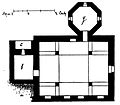 Floor plan
 -
 Cross section
 -
 Side view
 -
 View of the mosque before its destruction


See also
[edit | edit source]References
[edit | edit source]Bibliography
[edit | edit source]- Lua error in Module:Citation/CS1/Configuration at line 2172: attempt to index field '?' (a nil value).
- Lua error in Module:Citation/CS1/Configuration at line 2172: attempt to index field '?' (a nil value).
External links
[edit | edit source]Error creating thumbnail: File missing Media related to Lua error in Module:Commons_link at line 62: attempt to index field 'wikibase' (a nil value). at Wikimedia Commons


| Caravanserais |  | ||||
|---|---|---|---|---|---|
| Bath houses | |||||
| Monuments and memorials | |||||
| Palaces | |||||
| Places of worship |
| ||||
| Other | |||||

