John Koukouzeles
John Koukouzeles | |
|---|---|
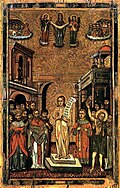
 St. John Koukouzeles depicted on a 15th-century musical codex at the Great Lavra monastery, Mount Athos, Greece | |
| Born | Dyrrhachium or Anatolia |
| Venerated in | Eastern Orthodox Church |
| Feast | 1 October |
John Koukouzeles Papadopoulos (Greek: Ιωάννης Κουκουζέλης Παπαδόπουλος, romanized: Ioannis Koukouzeles Papadopoulos) was a Byzantine composer, singer and reformer of Byzantine chant.[1] He was recognized as a saint by the Eastern Orthodox Church after his death. Among the most illustrious musicians of the Palaiologos dynasty,[1] his music remains held in high esteem by Albanians, Bulgarians, Greeks,[2] Macedonians, Romanians and Serbs.[3]
Name and etymology
[edit | edit source]The name "Koukouzeles" was not the composer's surname. His real surname was Papadopoulos.[1][4][5] "Koukouzeles" is allegedly derived from the Greek word for broad beans (κουκιά, koukia) and a Slavic/Bulgarian word for cabbage (зеле, zele).[4][5] Allegedly, the name appeared when Koukouzeles was asked in school about the food he was eating and he replied koukia kai zelie (Greek: κουκιά και ζελίε).[5] This, however, is regarded as a folk etymology. The name is most likely derived from the Greek word koukoutzi (Greek: κουκούτζι, lit. 'seed') along with the common Greek suffix -elis (Greek: -έλης).[5] A relation with the word koukoutseli (Greek: κουκουτσέλι, lit. 'little chicken (?)'), a Greek word which was used to refer to some kind of bird, has also been proposed.[5]
Life and career
[edit | edit source]Information about Koukouzeles' life and career is unclear and subject to controversy.[4][5] Even the era in which he lived is disputed. It is conjectured that he lived between the 12th and 15th centuries.[5] According to musicologist Gregorios Stathis, it is unlikely that Koukouzeles lived in the 12th or early 13th centuries, or after the late 14th century, proposing instead that he lived during the late 13th (c. 1270) and early 14th centuries (before 1341).[5]
Information about his life is derived mainly from two sources. First, the large body of his musical manuscripts containing his works and secondly from copies of a late, anonymous and problematic work of dubious authority called Life.[4] From the former, we learn that his last name was Papadopoulos;[1][4] he studied with Xenos Koronis under a cantor named John Glykes (likely a reference to John XIII of Constantinople[5]) and changed his name to Ioannikios when he became a monk.[4]

According to the latter, the anonymous biography Life "of dubious authority",[4] Koukouzeles was born in Dyrrhachium (modern-day Durrës, Albania) in the late 13th century to a father of unknown origins,[4][6] (probably Greek)[5] and a Bulgarian mother.[4][7][8] He was orphaned in childhood.[9] Nevertheless, the accuracy of Life is disputed, since it was written many years after the death of Koukouzeles and also makes several fantastical claims.[5] According to a modern German historian, he was instead born in Anatolia under the Empire of Nicaea;[5][10] this opinion is based on the existence of chromatic intervals in Byzantine music.[5] As evidenced by his real surname Papadopoulos, he was probably the son of a priest.[5]
At a young age he was noted and accepted into the school at the imperial court at Constantinople,[11] where he received his education and established himself as one of the leading authorities in his field during the time. A favourite of the Byzantine emperor and a principal choir chanter, he moved to Mount Athos and led a monastic way of life in the Great Lavra. Because of his singing abilities, he was called "Angel-voiced".[12]
Musical style and compositions
[edit | edit source]Koukouzeles established a new melodious ("kalophonic") style of singing out of the sticherarion.[13] Some years after the fall of Constantinople Manuel Chrysaphes characterised the sticheron kalophonikon and the anagrammatismos as new genres of psaltic art which were once created by Koukouzeles.[14]

Reception
[edit | edit source] | This section may be too technical for most readers to understand. (June 2024) |
In general it is useful to make a distinction between compositions which can be verified as the compositions by Koukouzeles, and those which are simply based on the method which he taught (as a stylistic category based on the kalophonic melos as exemplified by Mega Ison). Even concerning famous compositions, their authorship is often a subject of scholarly debates whose concern is not always the talent of one individual composer – like the Polyeleoi of the Voulgara[5] allegedly dedicated to his mother that, according to some Bulgarian researchers, contains elements of traditional Bulgarian mourning songs.[15][12] Greek editions of the same Polyeleos are different and especially the authorship of the Kratema used in the Bulgarian edition has been a controversial issue.[16] Additionally, the word Voulgara might not refer to his alleged mother, but instead to the European bee-eater, a bird which was called by the same name.[5] Concerning stichera kalophonika, there are numerous compositions made up in his name, but his authorship must be regarded as a certain school which had a lot of followers and imitators.
Modern print editions of chant books have only a very few compositions (different melismatic echos varys realisations of Ἄνωθεν οἱ προφήται, several Polyeleos compositions, the cherubikon palatinon, the Mega Ison, the Anoixantaria)[clarification needed] which are almost never sung, except the short Sunday koinonikon, for the very practical reason that most of Koukouzeles' compositions, at least based on the exegetic transcriptions by Chourmouzios Chartophylakos,[17] are simply too long.[18]
Sainthood and legacy
[edit | edit source]Koukouzeles is regarded as the most influential figure in the music of his period. He was later recognized as a saint by the Eastern Orthodox Church, his feast day being on 1 October.[19]
A musical school in his native Durrës bears his name, Shkolla Jon Kukuzeli. Also, Kukuzel Cove in Livingston Island in the South Shetland Islands of Antarctica is named after Koukouzel, using the Bulgarian form of his name.
See also
[edit | edit source]References
[edit | edit source]- ^ a b c d Williams 2001.
- ^ Lua error in Module:Citation/CS1/Configuration at line 2172: attempt to index field '?' (a nil value).
- ^ Lua error in Module:Citation/CS1/Configuration at line 2172: attempt to index field '?' (a nil value).
- ^ a b c d e f g h i Lua error in Module:Citation/CS1/Configuration at line 2172: attempt to index field '?' (a nil value).
- ^ a b c d e f g h i j k l m n o p Γρηγόριος, Στάθης (1986). Ο μαΐστωρ Ιωάννης Παπαδόπουλος Κουκουζέλης. Η ζωή και το έργο του [The magister John Papadopoulos Koukouzelis: His life and works]. Αθήνα: Περιοδικό Εφημεριος. pp. 1–38
- ^ Lua error in Module:Citation/CS1/Configuration at line 2172: attempt to index field '?' (a nil value).
- ^ Lua error in Module:Citation/CS1/Configuration at line 2172: attempt to index field '?' (a nil value).
- ^ Lua error in Module:Citation/CS1/Configuration at line 2172: attempt to index field '?' (a nil value).
- ^ "Venerable John (Koukouzelis)", Orthodox Church in America
- ^ Lua error in Module:Citation/CS1/Configuration at line 2172: attempt to index field '?' (a nil value).
- ^ Lua error in Module:Citation/CS1/Configuration at line 2172: attempt to index field '?' (a nil value).
- ^ a b Lua error in Module:Citation/CS1/Configuration at line 2172: attempt to index field '?' (a nil value).
- ^ See as an example Maria Alexandru's study (Alexandru 2011) of Koukouzeles' composition of a sticheron kalophonikon which he created over a part (ποὺς) of a traditional sticheron for Saint Demetrios.
- ^ See the edition and translation by Dimitri Conomos (Conomos 1985, pp. 40–45).
- ^ Lua error in Module:Citation/CS1/Configuration at line 2172: attempt to index field '?' (a nil value).
- ^ Sarafov's edition (Sarafov 1912, pp. 201–203) has a teretismos which ends a fifth too high for the Polyeleos composition, his edition of compositions ascribed to Koukouzeles is regarded as authoritative by Bulgarian chanters until today (listen to the interpretation of the Bulgarian Byzantine choir under direction of Dimiter Dimitrov) (Belgarkata).
- ^ Chourmouzios 1819.
- ^ Some collections of stichera kalophonika made alone of the Menaion cycle – they were usually called "exercise books" (mathemataria) – have a volume of 1900 pages. In fact, even the traditional way to sing the sticheraric melody had been already so expanded that the modern editions must all regarded as different efforts to abridge the traditional melody.
- ^ Great Synaxaristes: (in Greek) "Ὁ Ὅσιος Ἰωάννης ὁ ψάλτης ὁ καλούμενος Κουκουζέλης". 1 October. synaxarion.gr.
Sources
[edit | edit source]- Lua error in Module:Citation/CS1/Configuration at line 2172: attempt to index field '?' (a nil value).
- Audio on YouTube, John Koukouzelis: "Polielei na Bĕlgarkata in Glas 5" (extracts), Bulgarian Byzantine Choir, Dimitar Dimitrov Archived 2021-12-14 at Ghost Archive
- Lua error in Module:Citation/CS1/Configuration at line 2172: attempt to index field '?' (a nil value).
- Lua error in Module:Citation/CS1/Configuration at line 2172: attempt to index field '?' (a nil value).
- Lua error in Module:Citation/CS1/Configuration at line 2172: attempt to index field '?' (a nil value).
- Lua error in Module:Citation/CS1/Configuration at line 2172: attempt to index field '?' (a nil value). (subscription, Wikilibrary access, or UK public library membership required) (subscription required)
Further reading
[edit | edit source]- Lua error in Module:Citation/CS1/Configuration at line 2172: attempt to index field '?' (a nil value).
- Lua error in Module:Citation/CS1/Configuration at line 2172: attempt to index field '?' (a nil value).
- Lua error in Module:Citation/CS1/Configuration at line 2172: attempt to index field '?' (a nil value).
- Lua error in Module:Citation/CS1/Configuration at line 2172: attempt to index field '?' (a nil value).
- Lua error in Module:Citation/CS1/Configuration at line 2172: attempt to index field '?' (a nil value).
- Lua error in Module:Citation/CS1/Configuration at line 2172: attempt to index field '?' (a nil value).
- Lua error in Module:Citation/CS1/Configuration at line 2172: attempt to index field '?' (a nil value).
- Lua error in Module:Citation/CS1/Configuration at line 2172: attempt to index field '?' (a nil value).
- Lua error in Module:Citation/CS1/Configuration at line 2172: attempt to index field '?' (a nil value).
- Lua error in Module:Citation/CS1/Configuration at line 2172: attempt to index field '?' (a nil value).
External links
[edit | edit source]
- Audio on YouTube, Sticheron kalophonikon about Φρούρηζον (Protect, o most glorious) in echos plagios devteros, Greek Byzantine Choir, Lycourgos Angelopoulos
- Audio on YouTube, Sunday Koinonikon Хвалите Господа с'небес in Glas 5, Sofia Priest Choir, Kiril Popov
| Composers |
|  |
|---|---|---|
| Theorists | ||
| Liturgy | ||
| Forms | ||
| Theory | ||
| Instruments | ||
| Scholars | ||
| Performers | ||
| Related | ||
| ||

Lua error in mw.title.lua at line 392: bad argument #2 to 'title.new' (unrecognized namespace name 'Portal'). Lua error in Module:Authority_control at line 153: attempt to index field 'wikibase' (a nil value).
- 1280 births
- 1360 deaths
- 14th-century Bulgarian people
- 14th-century Christian saints
- Byzantine composers
- Byzantine hymnographers
- Byzantine saints of the Eastern Orthodox Church
- Bulgarian classical composers
- Composers of Christian music
- Eastern Orthodox Christians from Albania
- Medieval Bulgarian saints
- 14th-century composers
- People from Durrës
- Medieval male composers
- 14th-century Byzantine writers
- Albanian saints