Humpy
A humpy, also known as a gunyah,[1][2][3][4] wurley, wurly, wurlie, mia-mia, or wiltija, is a small, temporary shelter, traditionally used by Australian Aboriginal people. These impermanent dwellings, made of branches and bark, are sometimes called a lean-to, since they often rely on a standing tree for support.
Etymology
[edit | edit source]The word humpy comes from the Turrubal language (a Murri people from now-inner Brisbane, e.g. Coorparoo, Nundah). Other languages had different names for the structure. In South Australia, such a shelter is known as a "wurley" (also spelled "wurlie"), possibly from the Kaurna language.[5][6][7] They are called wiltjas in Pitjantjatjara and Yankunytjatjara languages; mia-mia in Wadawurrung language around Melbourne.[8][9]
Usage
[edit | edit source]They were temporary shelters made of bark, branches, leaves and grass used by Indigenous Australians.[10] Both names were adopted by early white settlers, and now form part of the Australian lexicon. The use of the term appears to have broadened in later usage to include any temporary building made from any available materials, including canvas, flattened metal drums, and sheets of corrugated iron.
In Dark Emu, Bruce Pascoe argues that contrary to popular perception of Aboriginal dwellings being only temporary, some gunyahs in the Channel Country could accommodate up to 50 people and formed part of permanent agricultural communities.[11]
Gallery
[edit | edit source]-
Aboriginal family and their temporary bark gunya (shelter), c. 1856
-
Aboriginal woman in front of bark gunya (shelter), Victoria, c. 1872
-
Two Aboriginal woman in front of bark gunya, c. 1850s
-
Temporary lean-to bark gunyah, c. 1888
-
Temporary lean-to bark gunyah, 1889
-
Aboriginal people at the entrance to their dwelling, Western Australia, c. 1876
-
Framework of a humpy in far western Queensland, 1937
-
Native Wurley, 1886
-
 Bushman humpy, 1910s
 -
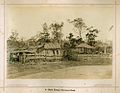 Bark humpy, Brisbane, 1874
 -
[Aboriginal people] and wurlie near Alice Springs (Mparntwe), c. 1930s.
-
Aboriginal wurlie near Alice Springs, c. 1930s


.jpg)


,_Johns_Album_ca._1872.jpg)
_wrapped_in_traditional_pelt_cloaks,_John_Hunter_Kerr._ca._1850s.jpg)
,_ca._1888.jpg)
,_ca._1870.jpg)

_(19306853893).jpg)

See also
[edit | edit source]Notes
[edit | edit source]- ^ Lua error in Module:Citation/CS1/Configuration at line 2172: attempt to index field '?' (a nil value).
- ^ Lua error in Module:Citation/CS1/Configuration at line 2172: attempt to index field '?' (a nil value).
- ^ Lua error in Module:Citation/CS1/Configuration at line 2172: attempt to index field '?' (a nil value).
- ^ Lua error in Module:Citation/CS1/Configuration at line 2172: attempt to index field '?' (a nil value).
- ^ Peters, Pam, The Cambridge Australian English Style Guide, Cambridge University Press, 1996, p818
- ^ Lua error in Module:Citation/CS1/Configuration at line 2172: attempt to index field '?' (a nil value).
- ^ Lua error in Module:Citation/CS1/Configuration at line 2172: attempt to index field '?' (a nil value).
- ^ Australian Indigenous tools and technology - Australia's Culture Portal Archived 2010-04-16 at the Wayback Machine
- ^ Lua error in Module:Citation/CS1/Configuration at line 2172: attempt to index field '?' (a nil value).
- ^ Lua error in Module:Citation/CS1/Configuration at line 2172: attempt to index field '?' (a nil value).
- ^ Lua error in Module:Citation/CS1/Configuration at line 2172: attempt to index field '?' (a nil value).
External links
[edit | edit source]


