Gilded flicker
| Gilded flicker | |
|---|---|
| A male on top of a cactus | |
| A male on a cactus | |
Scientific classification 
| |
| Kingdom: | Animalia |
| Phylum: | Chordata |
| Class: | Aves |
| Order: | Piciformes |
| Family: | Picidae |
| Genus: | Colaptes |
| Species: | C. chrysoides
|
| Binomial name | |
| Colaptes chrysoides (Malherbe, 1852)
| |

| |
| Range | |


_on_top_of_cactus.jpg)
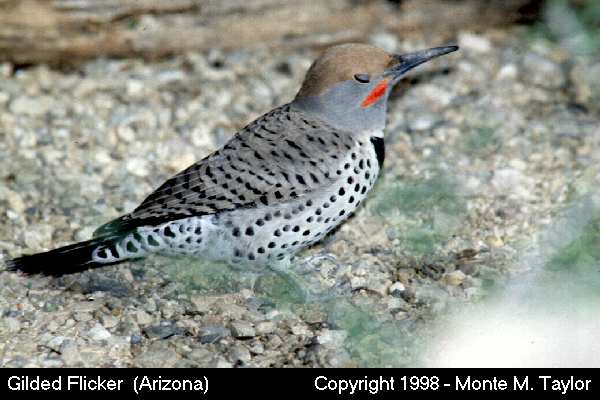
The gilded flicker (Colaptes chrysoides) is a large woodpecker (mean length of 29 cm (11 in)) of the Sonoran, Yuma, and eastern Colorado Desert regions of the Southwestern United States and northwestern Mexico, including all of the Baja California peninsula except the extreme northwestern region. Yellow underwings distinguish the gilded flicker from the northern flicker (Colaptes auratus) found within the same region, which has red underwings.
Taxonomy
[edit | edit source]Four subspecies are recognized:
- The Cape gilded flicker (C. c. chrysoides) resides in southern Baja California.
- The brown gilded flicker (C. c. brunnescens) resides in northern and central Baja California.
- Mearns' gilded flicker (C. c. mearnsi) resides in extreme southeastern California to Arizona and northwestern Mexico.
- The Mexican gilded flicker (C. c. tenebrosus) resides in northwestern Mexico from northern Sonora to northern Sinaloa.
Habitat
[edit | edit source]The gilded flicker most frequently builds its nest hole in a saguaro (Carnegiea gigantea), excavating a nest hole nearer to the top than to the ground.[3] Less frequently, they will also nest in desert dry washes with Frémont's cottonwood (Populus fremontii) or willows (Salix sp.).[4] Cavities in saguaros are excavated one year before they are inhabited. The saguaro defends itself against water loss into the cavity of the nesting hole by secreting sap that hardens into a waterproof structure that is known as a saguaro boot.[5] Northern flickers, on the other hand, nest in riparian trees and very rarely inhabit saguaros. Gilded flickers occasionally hybridize with northern flickers in the narrow zones where their ranges and habitats overlap.[6]
Diet
[edit | edit source]The gilded flicker's diet mostly consists of ants, as well as other insects such as beetles or termites.[6] They forage on the ground by picking up insects or using their tongues to probe anthills.[7] They also feed on fruits and berries.[7]
References
[edit | edit source]- ^ Lua error in Module:Citation/CS1/Configuration at line 2172: attempt to index field '?' (a nil value).
- ^ Lua error in Module:Citation/CS1/Configuration at line 2172: attempt to index field '?' (a nil value).
- ^ Lua error in Module:Citation/CS1/Configuration at line 2172: attempt to index field '?' (a nil value).
- ^ Lua error in Module:Citation/CS1/Configuration at line 2172: attempt to index field '?' (a nil value).
- ^ Lua error in Module:Citation/CS1/Configuration at line 2172: attempt to index field '?' (a nil value).
- ^ a b Lua error in Module:Citation/CS1/Configuration at line 2172: attempt to index field '?' (a nil value).
- ^ a b Lua error in Module:Citation/CS1/Configuration at line 2172: attempt to index field '?' (a nil value).
Gallery
[edit | edit source]-
In flight
_in_flight.jpg)
_by_nest_hole_in_saguaro_cactus.jpg)
Further reading
[edit | edit source]- Corman, T. E., Wise-Gervais, C. Arizona Breeding Bird Atlas. Albuquerque: University of New Mexico Press. (2005) Lua error in Module:Citation/CS1/Configuration at line 2172: attempt to index field '?' (a nil value)..
- National Geographic Society Field Guide to the Birds of North America, Third Edition. Washington, D.C.: National Geographic Society. (1999) Lua error in Module:Citation/CS1/Configuration at line 2172: attempt to index field '?' (a nil value)..
External links
[edit | edit source]
- Gilded flicker photo gallery Archived 2016-03-03 at the Wayback Machine VIREO
- Photo-High Res; Article borderland-tours
- Photo-High Res; Article tsuru-bird.net

Lua error in Module:Taxonbar at line 165: attempt to index field 'wikibase' (a nil value).