Fort Decatur (Alabama)
| Fort Decatur | |
|---|---|
| Milstead, Alabama in United States | |
 Marker placed at the site of Fort Decatur by the Alabama Anthropological Society in 1931. | |
| Site information | |
| Type | Earthen fort |
| Owner | Auburn University |
| Controlled by | Auburn University |
| Open to the public | No |
| Location | |
| Lua error in Module:Location_map at line 411: Malformed coordinates value. | |
| Coordinates | Lua error in Module:Coordinates at line 489: attempt to index field 'wikibase' (a nil value). |
| Site history | |
| Built | March 1814 |
| Built by | United States Army |
| In use | 1814 |
| Battles/wars | Creek War |
| Events | Death of John Sevier |
Fort Decatur was an earthen fort established in March 1814 on the banks of the Tallapoosa River as part of the Creek War and the larger War of 1812. The fort was located on the east bank of the Tallapoosa River, near the modern community of Milstead.[1] Fort Decatur was also located near the Creek town of Tukabatchee. It was most likely named for Stephen Decatur.[2]
History
[edit | edit source]Creek War
[edit | edit source]Colonel Homer Milton, the commanding officer of the 3rd Regiment, ordered the construction of Fort Decatur and Fort Burrows after leaving Fort Hull in March 1814.[3] Fort Burrows was located across the Tallapoosa River from Fort Decatur. Benjamin Hawkins assisted Milton in surveying the site of Fort Decatur.[4] The fort was built under the command of Lieutenant Colonel Richard Atkinson.[5] After pursuing Red Sticks in southeast Alabama, Davy Crockett (a member of Major William Russell's Tennessee Mounted Volunteers) was stationed at Fort Decatur.[6] Fort Decatur was planned to supply General Andrew Jackson in his march from Fort Williams to Hickory Ground, but flooding prevented the supplies from arriving.[7] After the Battle of Horseshoe Bend, Georgia and South Carolina troops under the command of Major General Thomas Pinckney marched from Fort Decatur to Fort Jackson.[8] Brigadier General Joseph Graham commanded troops at Fort Decatur who repaired roads and assisted in supplying Jackson's army after the Battle of Horseshoe Bend.[9] After regular troops terms of service were up, the Tennessee militia was garrisoned at Fort Decatur. The militia was then replaced by troops from Georgia who were requested by General Pinckney to oppose any potential British or Creek offensive.[10]
William McIntosh and Thomas Simpson Woodward were both temporarily stationed at Fort Decatur.[5]
Postwar
[edit | edit source]In 1815, President James Madison appointed Colonel John Sevier to the United States Boundary Commission to survey the boundary between the United States and the Creek Nation. The Commission was headquartered at Fort Decatur. On September 24, 1815, Sevier died and was buried at Fort Decatur. Sevier's remains were reinterred at the Knox County Courthouse in Knoxville on June 15, 1889.[11]
A post office operated under the name Fort Decatur from 1839 to 1859.[12]
Present
[edit | edit source]Today, the fort site is marked by a historical marker that was placed by the Alabama Anthropological Society in 1931. The remains of the fort are located on the grounds of Auburn University's E.V. Smith Research Center.[2]
Units
[edit | edit source]The 4th Regiment of East Tennessee Militia and a battalion of West Tennessee Militia were both stationed at Fort Decatur.[13] The 7th North Carolina Militia was garrisoned at Fort Burrows and Fort Decatur.[14]
Gallery
[edit | edit source]-
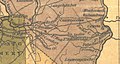 Fort Decatur (located in the center) as portrayed in Henry Schenck Tanner's 1830 The Traveler's Pocket Map of Alabama.
 -
 1889 photograph of John Sevier's original grave at Fort Decatur prior to disinterment. Tennessee governor Robert Love Taylor is leaning on the left corner of the fence and Alabama governor Thomas Seay is leaning on the right corner.
 -
 2017 LiDAR hillshade of Fort Decatur (in the lower right) and Fort Burrows (upper left), with the Tallapoosa River in the center of the image.


References
[edit | edit source]- ^ Harris 1977, pp. 40.
- ^ a b Bunn & Williams 2008, pp. 59.
- ^ Waselkov & Christopher 2012, pp. 208.
- ^ Owsley 2008, pp. 60.
- ^ a b Lua error in Module:Citation/CS1/Configuration at line 2172: attempt to index field '?' (a nil value).
- ^ Jones 2006, pp. 113.
- ^ Hannings 2012, pp. 205.
- ^ Brown 1900, pp. 122.
- ^ Pinckney 1926, pp. 501.
- ^ Jackson 1927, pp. 26.
- ^ Williams 1924, pp. 284.
- ^ Lua error in Module:Citation/CS1/Configuration at line 2172: attempt to index field '?' (a nil value).
- ^ Lua error in Module:Citation/CS1/Configuration at line 2172: attempt to index field '?' (a nil value).
- ^ Lua error in Module:Citation/CS1/Configuration at line 2172: attempt to index field '?' (a nil value).
Sources
[edit | edit source]- Lua error in Module:Citation/CS1/Configuration at line 2172: attempt to index field '?' (a nil value).
- Lua error in Module:Citation/CS1/Configuration at line 2172: attempt to index field '?' (a nil value).
- Lua error in Module:Citation/CS1/Configuration at line 2172: attempt to index field '?' (a nil value).
- Lua error in Module:Citation/CS1/Configuration at line 2172: attempt to index field '?' (a nil value).
- Lua error in Module:Citation/CS1/Configuration at line 2172: attempt to index field '?' (a nil value).
- Lua error in Module:Citation/CS1/Configuration at line 2172: attempt to index field '?' (a nil value).
- Lua error in Module:Citation/CS1/Configuration at line 2172: attempt to index field '?' (a nil value).
- Lua error in Module:Citation/CS1/Configuration at line 2172: attempt to index field '?' (a nil value).
- Lua error in Module:Citation/CS1/Configuration at line 2172: attempt to index field '?' (a nil value).
- Lua error in Module:Citation/CS1/Configuration at line 2172: attempt to index field '?' (a nil value).