Fabra Observatory
 | |||||
| Alternative names | Lua error in Module:Wikidata at line 937: attempt to index field 'wikibase' (a nil value).Lua error in Module:EditAtWikidata at line 29: attempt to index field 'wikibase' (a nil value). | ||||
|---|---|---|---|---|---|
| Organization | Reial Acadèmia de Ciències i Arts de Barcelona | ||||
| Observatory code | 006 | ||||
| Location | Barcelona, Catalonia, Spain, EU | ||||
| Coordinates | Lua error: callParserFunction: function "#coordinates" was not found. | ||||
| Established | 1904 | ||||
| Website | fabra | ||||
| Telescopes | |||||
| |||||
| Lua error in Module:Infobox_mapframe at line 197: attempt to index field 'wikibase' (a nil value). | |||||
| Error creating thumbnail: File missing Lua error in Module:Commons_link at line 62: attempt to index field 'wikibase' (a nil value). | |||||
The Fabra Observatory (Catalan: Observatori Fabra, IPA: [upsəɾβəˈtɔɾi ˈfaβɾə]; obs. code: 006) is an astronomical observatory located in Barcelona, Catalonia, Spain pointed towards the south at 415 metres above sea level (latitude: 41,4184° N; longitude: 2,1239° E).
It was established in 1904 and belongs to the Royal Academy of Science and Arts of Barcelona (Catalan: Reial Acadèmia de Ciències i Arts de Barcelona). Its main activity is the study of asteroids and comets. It is the fourth oldest observatory in the world that is still functioning.
It is where the comet 32P/Comas Solà was discovered by Josep Comas Solà.
Telescope
[edit | edit source]The double refractor was built by Mailhat, Paris, in 1904. The visual instrument (the lower of the two tubes) has an aperture of 38 cm and a focal length of 6 meters (f/15.8). The photographic instrument also has an aperture of 38 cm, but a shorter focal length of 4 meters (f/10.5).[1]
-
 Mailhat telescope
 -
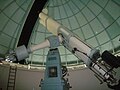 Mailhat refractor from 1904
 -
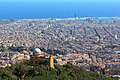 Fabra Observatory on the hill above the metropolis


See also
[edit | edit source]References
[edit | edit source]External links
[edit | edit source]- Fabra Observatory
- Official website of Fabra Observatory
- Official website of the robotic Fabra-Montsec Observatory where the Baker-Nunn camera will be installed
- Obsfabra Asteroid Archived 2007-09-09 at the Wayback Machine


 | This article about a specific observatory, telescope or astronomical instrument is a stub. You can help Wikipedia by expanding it. |
- Astronomical observatory stubs
- Astronomical observatories in Catalonia
- Meteorological observatories
- Sarrià-Sant Gervasi
- Buildings and structures in Barcelona
- Architecture of Barcelona
- Education in Barcelona
- Education in Catalonia
- Tourist attractions in Barcelona
- Great refractors
- Double telescopes
- Science and technology in Catalonia
- Tourism in Catalonia
- 1904 establishments in Catalonia