Eparchy of Buda
Eparchy of Buda Епархија будимска | |
|---|---|
| File:Görögkeleti püspöki székesegyház (Belgrád-templom) (7388. számú műemlék) 4.jpg | |
| Location | |
| Territory | Hungary |
| Headquarters | Szentendre (Serbian: Сентандреја) |
| Coordinates | Lua error in Module:Coordinates at line 489: attempt to index field 'wikibase' (a nil value). |
| Information | |
| Denomination | Eastern Orthodox |
| Sui iuris church | Serbian Orthodox Church Patriarchate of Peć (Serbia) |
| Established | 16th century |
| Cathedral | Virgin's Cathedral ("Belgrade Cathedral"), Szentendre |
| Language | Church Slavonic Serbian |
| Current leadership | |
| Governance | Szentendre (Serbian: Сентандреја) |
| Bishop | Lukijan Pantelić |
| Map | |
| File:Map of Eparchies of Serbian Orthodox Church (including Orthodox Ohrid Archbishopric)-en.svg | |
| Website | |
| www | |
The Eparchy of Buda (Serbian: Будимска епархија or Budimska eparhija) is a diocese or eparchy of the Serbian Orthodox Church, having jurisdiction over the territory of Hungary. The seat of the eparchy is in Szentendre (Serbian: Сентандреја or Sentandreja) near Budapest.[1]
Name
[edit | edit source]The term Buda (Serbian: Будим or Budim) in the name of the eparchy refers to the name of the former city of Buda, which merged with the city of Pest to form the modern city of Budapest in 1873. That change did not affect the eparchy and the original name has been kept to the present day.[2]
History
[edit | edit source]During the Middle Ages, authorities of the Kingdom of Hungary had an ambivalent attitude towards the presence of Eastern Orthodox Christians in various regions of the realm,[3] that was depending mainly on current relations with the Byzantine Empire, and medieval Serbia. By the end of the 15th century, Serbian presence in southern regions of the realm was gradually increased by continuous migrations that were caused by Ottoman invasion of Serbian lands.[4]
In the 16th century, following the Ottoman conquest of Hungary, Serbian Orthodox Eparchy of Buda was established, under the jurisdiction of the Serbian Patriarchate of Peć.[5] By the end of the 17th century, those regions of were liberated from the Ottoman rule and incorporated into the Habsburg monarchy. Since 1708, the eparchy belonged to the Serbian Orthodox Metropolitanate of Krušedol (Karlovci).[6] After 1918, the eparchy continued to function within political frames of the new Hungarian state, belonging in terms of ecclesiastical jurisdiction (since 1920) to the reunited Serbian Orthodox Church.[7]
Bishops
[edit | edit source]List of Serbian Orthodox Bishops of Buda:
- Archbishop Sava of Buda
- Metropolitan Sevastijan I
- Metropolitan Sevastijan II (†1662);
- Metropolitan Simeon (around 166?);
- Metropolitan Viktor (1660–1668 and 1680–1684);
- Bishop Kiril (1668–1680);
- Evtimije Popovic (1695–1700);
- Vikentije Popović-Hadžilavić (1708–1713);
- Mihailo Milosevic (bishop) (1716–1728);
- Vasilije Dimitrijevic (bishop) (1728–1748);
- Dionisije Novaković (1749–1767);
- Arsenije Radivojevic (1770–1774);
- Sofronije Kirilović (1774–1781);
- Stefan Stratimirović (1786–1790);
- Dionisije Popovic (metropolitan) (1791–1828);
- Stefan Stanković (1829–1834);
- Justin Jovanovic (bishop) (1834);
- Pantelejmon Zivkovic (1836–1839);
- Platon Atanacković (1839–1851);
- Arsenije Stojković (1852–1892);
- Lukijan Bogdanović (1897–1908);
- Georgije Zubkovic (1913–1951);
- Hrizostom Vojinović (1951–1952);
- German Đorić (1952–1956);
- Arsenije Bradvarevic (1960–1963);
- 1963–1988 various administrators;
- Danilo Krstić (1988–2002, admin. 1984–1988);
- Lukijan Pantelić (2002–present).
Monasteries
[edit | edit source]- Serbian Orthodox Monastery of Grabovac (Grábóc)
- Orthodox Monastery of Serbian Kovin (Ráckeve)
Gallery
[edit | edit source]-
 The Serbian Patriarch Arsenije III
 -
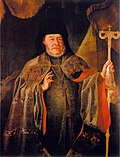 The Serbian Patriarch Arsenije IV
 -
 The mitre of Arsenije Stojković, Serbian Orthodox Bishop of Buda
 -
 The previous co-cathedral, the Church of Saint Demetrius in Buda


_(7388._sz%C3%A1m%C3%BA_m%C5%B1eml%C3%A9k)_4.jpg)
-en.svg)


See also
[edit | edit source]References
[edit | edit source]- ^ https://www.academia.edu/29778255/SERBIAN_MONKS_AS_DOCUMENTED_BY_THE_HANDWRITTEN_INSCRIPTIONS_IN_THE_EARLY_PRINTED_CYRILLIC_SLAVONIC_BOOKS_FROM_THE_TERRITORY_OF_THE_SERBIAN_ORTHODOX_EPARCHY_OF_BUDA_In_%D0%9D%D0%B8%D1%88_%D0%B8_%D0%92%D0%B8%D0%B7%D0%B0%D0%BD%D1%82%D0%B8%D1%98%D0%B0_%D0%B7%D0%B1%D0%BE%D1%80%D0%BD%D0%B8%D0%BA_%D1%80%D0%B0%D0%B4%D0%BE%D0%B2%D0%B0_14_%D1%83%D1%80%D0%B5%D0%B4%D0%BD%D0%B8%D0%BA_%D0%9C%D0%B8%D1%88%D0%B0_%D0%A0%D0%B0%D0%BA%D0%BE%D1%86%D0%B8%D1%98%D0%B0_%D0%9D%D0%B8%D1%88_2016_pp_603_616
- ^ Kašić 1966, pp. 10.
- ^ Baán 1999, p. 45–53.
- ^ Ćirković 2004, p. 115-117.
- ^ Sotirović 2011, p. 143–169.
- ^ Točanac-Radović 2018, p. 155–167.
- ^ Bataković 2005, p. 299-300.
Sources
[edit | edit source]- Lua error in Module:Citation/CS1/Configuration at line 2172: attempt to index field '?' (a nil value).
- Lua error in Module:Citation/CS1/Configuration at line 2172: attempt to index field '?' (a nil value).
- Lua error in Module:Citation/CS1/Configuration at line 2172: attempt to index field '?' (a nil value).
- Lua error in Module:Citation/CS1/Configuration at line 2172: attempt to index field '?' (a nil value).
- Lua error in Module:Citation/CS1/Configuration at line 2172: attempt to index field '?' (a nil value).
- Lua error in Module:Citation/CS1/Configuration at line 2172: attempt to index field '?' (a nil value).
- Lua error in Module:Citation/CS1/Configuration at line 2172: attempt to index field '?' (a nil value).
- Lua error in Module:Citation/CS1/Configuration at line 2172: attempt to index field '?' (a nil value).
- Lua error in Module:Citation/CS1/Configuration at line 2172: attempt to index field '?' (a nil value).
- Lua error in Module:Citation/CS1/Configuration at line 2172: attempt to index field '?' (a nil value).
External links
[edit | edit source]
- Lua error in Module:Official_website at line 94: attempt to index field 'wikibase' (a nil value). (in Hungarian)
Lua error in Module:Authority_control at line 153: attempt to index field 'wikibase' (a nil value).