Dykanka
Dykanka
Диканька | |
|---|---|
 Landscape with Holy Trinity Church | |
 Flag  Coat of arms | |
| Lua error in Module:Location_map at line 411: Malformed coordinates value. | |
| Coordinates: Lua error in Module:Coordinates at line 489: attempt to index field 'wikibase' (a nil value). | |
| Country |  Ukraine Ukraine |
| Oblast | Poltava Oblast |
| Raion | Poltava Raion |
| Hromada | Dykanka settlement hromada |
| Founded | 1658 |
| Area | |
• Total | 11.74 km2 (4.53 sq mi) |
| Elevation | 72 m (236 ft) |
| Population (2022) | |
• Total | 7,427 |
| Time zone | UTC+2 (EET) |
| • Summer (DST) | UTC+3 (EEST) |
| Postal code | 38502[1] |
| Area code | 5351 |
| Licence plate [2] | BI |
Dykanka (Ukrainian: Диканька) is a rural settlement in Poltava Raion of Poltava Oblast in central Ukraine. It hosts the administration of Dykanka settlement hromada, one of the hromadas of Ukraine.[3] Population: 7,427 (2022 estimate)[4]
The settlement is located 26 km (16 mi) away from Poltava-Kyivska railway station.
History
[edit | edit source]Ancient history
[edit | edit source]Dykanka was first mentioned in 1658 as a small village, though the area was populated for centuries before. Within the area of modern Dykanka, traces exist of Scythian settlement at various times. Also found were the remains of a settlement that had at one point been razed[citation needed] and the remains of two settlements from the 7th–6th centuries BC.
Medieval history
[edit | edit source]In 1430, the Dykanka area came under the ownership of Tatar Murza Leksada Mansurksanovych, the future Prince Alexander Glinski, and, according to Leo Padalka and other pre-revolutionary (before 1917) historians, Dykanka was among his ″settlements″.
Modern history
[edit | edit source]Dykanka has held the status of urban-type settlement since 1957.
Until 18 July 2020, Dykanka was the administrative center of Dykanka Raion. The raion was abolished in July 2020 as part of the administrative reform of Ukraine, which reduced the number of raions of Poltava Oblast to four. The area of Dykanka Raion was merged into Poltava Raion.[5][6] On 26 January 2024, a new law entered into force which abolished the urban-type settlement status, and Dykanka became a rural settlement.[7]
Culture
[edit | edit source]Dykanka is the location of the short story collection Evenings on a Farm Near Dikanka by Nikolai Gogol.[8] The tale of St John's Eve, concerning the family of the Church Sexton, inspired Mussorgsky's tone poem Night on the Bare Mountain.
Gallery
[edit | edit source]-
 The facade of the palace of the estate Kochubeys. The architect Giacomo Quarenghi. Picture the end of 19th century
 -
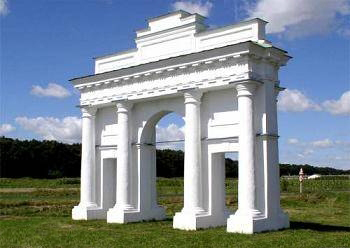 Triumphal Arch. The architect - the academician of architecture Luigi Rusca, 1820
 -
 Church of the Holy Trinity, 1780, late Baroque
 -
 Church of St. Nicholas. Architect N. A. Lvov, 1797
 -
 The bell tower of St. Nicholas Church. Architect Luigi Rusca, 1810–1827. Postcard late 19th century
 -
 Lilac Grove. The former estate of Prince Kochubey. Laid down in the early 19th century
 -
 Picture gallery of Marie Bashkirtseff

..jpg)


References
[edit | edit source]- ^ Ukrainian Zip Codes
- ^ Как расшифровываются новые номера
- ^ Lua error in Module:Citation/CS1/Configuration at line 2172: attempt to index field '?' (a nil value).
- ^ Lua error in Module:Citation/CS1/Configuration at line 2172: attempt to index field '?' (a nil value).
- ^ Lua error in Module:Citation/CS1/Configuration at line 2172: attempt to index field '?' (a nil value).
- ^ Lua error in Module:Citation/CS1/Configuration at line 2172: attempt to index field '?' (a nil value).
- ^ Lua error in Module:Citation/CS1/Configuration at line 2172: attempt to index field '?' (a nil value).
- ^ Lua error in Module:Citation/CS1/Configuration at line 2172: attempt to index field '?' (a nil value).
External links
[edit | edit source]- "Dikanka" (news of Dikanka, events, weather, all in English and Russian language)
Lua error in Module:Authority_control at line 153: attempt to index field 'wikibase' (a nil value).