Draft:DIALux
 | This article, Draft:DIALux, has recently been created via the Articles for creation process. Please check to see if the reviewer has accidentally left this template after accepting the draft and take appropriate action as necessary.
Reviewer tools: Preload talk Inform author |
| This article, Draft:DIALux, has recently been created via the Articles for creation process. Please check to see if the reviewer has accidentally left this template after accepting the draft and take appropriate action as necessary.
Reviewer tools: Preload talk Inform author |
| This article, Draft:DIALux, has recently been created via the Articles for creation process. Please check to see if the reviewer has accidentally left this template after accepting the draft and take appropriate action as necessary.
Reviewer tools: Preload talk Inform author |
| This article, Draft:DIALux, has recently been created via the Articles for creation process. Please check to see if the reviewer has accidentally left this template after accepting the draft and take appropriate action as necessary.
Reviewer tools: Preload talk Inform author |
| This article, Draft:DIALux, has recently been created via the Articles for creation process. Please check to see if the reviewer has accidentally left this template after accepting the draft and take appropriate action as necessary.
Reviewer tools: Preload talk Inform author |
| This article, Draft:DIALux, has recently been created via the Articles for creation process. Please check to see if the reviewer has accidentally left this template after accepting the draft and take appropriate action as necessary.
Reviewer tools: Preload talk Inform author |
 Comment: Be careful, some of this article sounds like an introduction for the software and not an encyclopedia article. ABG (Talk/Report any mistakes here) 07:52, 4 October 2024 (UTC)
| DIALux | |
|---|---|
 | |
| Developers | DIAL GmbH, Lüdenscheid, Germany |
| Stable release | DIALux evo 13.2, Patch 3 (5.13.2.3)(26. Aug 2025)
|
| Repository |
|
| Engine | |
| Operating system | Microsoft Windows |
| Available in | 26 languages |
| Type | 3D computer graphics |
| License | proprietary |
| Website | dialux.com |
DIALux is a 3D graphics software for lighting design developed by DIAL GmbH[1] in Lüdenscheid. It is mainly used by lighting planners, consultants, architects, lighting technicians and electricians to plan, calculate and visualize light for indoor and outdoor areas. The software is freely available through the manufacturer's website and this video tutorial[2] offers a quick overview.
A survey by Linköping University on the use of lighting simulation tools in Sweden found that over 70% of respondents identified DIALux as their primary tool for lighting simulations.[3] Many lamp and luminaire manufacturers offer plug-ins that integrate the beam characteristics of their products into the DIALux platform. As a result, more than 2 million luminaires are currently available for planning.
DIALux includes features for photometric calculations and supports the planning and simulation of various environments, including rooms, multi-story buildings, pathways, parking lots, streets, and landscapes. It also offers functionality for daylight simulation, obtrusive light calculations, the lighting design for sports venues and emergency lighting planning according to the DIN EN 1838 standard. Recent versions also enable energy assessments based on DIN V 18599 and EN 15193 standards, which are required for energy performance certificates. 3D models created with DIALux can be rendered with the raytracer POV-Ray.
-
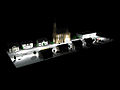 Lighting scenario created with DIALux (outside)
 -
 Lighting scenario created with DIALux (inside)
 -
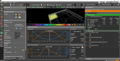 Energy assessment and saving using daylight
 -
 Visualization of daylight wih DIALux


History
[edit | edit source]DIAL was founded in 1989 as German Institute for Applied Lighting Technology. Since then, the company has been involved in software development, lighting technology, lighting design and building automation. DIAL has additional locations in Italy, the US, and Taiwan.
The first version of DIALux was released in 1994. The program was further developed over the next few years and many new functions were added until version DIALux 4.1 was finally created. DIALux evo was announced as the successor and released for use in 2012. The DIALux evo version that was then released is based on a completely new graphics engine, a new interface and new functions. As many designers were still very used to the previous version of the program, it could still be downloaded from the company's website for a while to make the transition from DIALux 4 to DIALux evo easier. DIALux evo has now established itself and has many more functions than the previous version. The latest version is available in 26 languages and has more than four hundred luminaire manufacturers in its database.
DIAL has completed joint research projects with the Fraunhofer Institute for Building Physics (IBP). The findings aim to enhance the energy-saving potential of lighting projects through the software.[4] [5]
Notable uses
[edit | edit source]The possible uses of DIALux evo are diverse and not limited to specific applications. The software has been applied in projects like the lighting design for the Alte Pinakothek[6] in Munich and the UNESCO World Heritage Site Imperial Palace of Goslar (Kaiserpfalz Goslar).[7]
DIALux has been used in case studies, such as an aircraft cabin lighting design[8], optimizing the lighting of the Jamkaran Mosque[9], for simulating lighting scenarios in historical gardens to evaluate light interactions with the surroundings[10] or in analysing and modeling the visual perception of exhibition rooms of the Abdürrahim Tuncak Atatürk House Museum. [11]
The program was also applied to specific tasks like optimizing the lighting of artworks in galleries[12] or as a simulation tool in studies on the design of LED tunnel lighting for motorway tunnels.[13]
The Project Showroom[14] in the DIALux Community shows further real projects and application possibilities.
-
 Planning entire floors and buildings. Visualization with the built-in ray tracer.
 -
 Outdoor scene in DIALux evo
 -
 Construction in DIALux evo using DWG plans
 -
 Lighting planning using the example of classrooms


Regional and international standards supported by DIALux evo
[edit | edit source]| Indoor areas | Outdoor areas | Street lighting |
|---|---|---|
|
EN 12462-1:2021 |
EN 12464-2:2014 |
EN 13201:2004 |
References
[edit | edit source]- ^ Lua error in Module:Citation/CS1/Configuration at line 2172: attempt to index field '?' (a nil value).
- ^ Lua error in Module:Citation/CS1/Configuration at line 2172: attempt to index field '?' (a nil value).
- ^ Lua error in Module:Citation/CS1/Configuration at line 2172: attempt to index field '?' (a nil value).
- ^ Lua error in Module:Citation/CS1/Configuration at line 2172: attempt to index field '?' (a nil value).
- ^ Lua error in Module:Citation/CS1/Configuration at line 2172: attempt to index field '?' (a nil value).
- ^ Lua error in Module:Citation/CS1/Configuration at line 2172: attempt to index field '?' (a nil value).
- ^ Lua error in Module:Citation/CS1/Configuration at line 2172: attempt to index field '?' (a nil value).
- ^ Lua error in Module:Citation/CS1/Configuration at line 2172: attempt to index field '?' (a nil value).
- ^ Lua error in Module:Citation/CS1/Configuration at line 2172: attempt to index field '?' (a nil value).
- ^ Lua error in Module:Citation/CS1/Configuration at line 2172: attempt to index field '?' (a nil value).
- ^ Lua error in Module:Citation/CS1/Configuration at line 2172: attempt to index field '?' (a nil value).
- ^ Lua error in Module:Citation/CS1/Configuration at line 2172: attempt to index field '?' (a nil value).
- ^ Lua error in Module:Citation/CS1/Configuration at line 2172: attempt to index field '?' (a nil value).
- ^ Lua error in Module:Citation/CS1/Configuration at line 2172: attempt to index field '?' (a nil value).
Literature
[edit | edit source]- Alyaá Tabbah: Master Thesis Evaluating digital twin data exchange between a virtual and physical environment regarding lighting quantity Jönköping University
- Anahita Davoodi: Doctoral Thesis Supporting evidence-based design using lighting simulations: A framework for lighting simulation of visual comfort in building design Jönköping University - School of Engineering
- Hu Guojian Hao Luoxi: Comparison and Analysis of Lighting Calculation Software Dialux & Agi32, in: China Illuminating Engineering Journal 2005-03
- Mulya Feri, Chairul Gagarin Irianto Lighting System Design Based on SNI 6197-2011 and Software-Based Design DIALux Evo 9.2 (Case study) Jurnal Teknik Elektro, Vol. 14 No. 2, October 2022, pp. 73 - 78 ISSN: 1858-1463 (print), 2580-6807 (online)
- R. Febriyursandi, A. Z. Azryenni, A. Hamzah Design Lighting Quality Based on DIALux Evo 8.1 Journal of science and applied engineering, Indonesia (JSAE)
- Sharma Ajay G, Deepa Karvat, PA Shah A Case Study on analysis of insufficient lighting in Substation in DIALux software in International Journal of Engineering Research & Technology (IJERT)
- Krzysztof Skarżyński (Warsaw University of Technology) A comparison of the calculations and measurements for a lighting design of the same room Article in Przegląd Elektrotechniczny, November 2020
- Nazmi Ekren (Marmara University, Istanbul), Bahtiyar Dursun (Gebze Institute of Technology, Kocaeli), Ercan Aykut Lighting Computer Programs in Lighting Technology G.U. Journal of Science 21(1): 15-20 (2007)
- Anahita Davoodi, Peter Johansson, Johanna Enger (Jönköping University) Comparison of lighting simulation tools with focus on lighting quality Conference paper: Improving Energy Efficiency in Commercial Building Conference (IEECB'14)
- Ali Hamada Fakra, Harry Boyer, Fawaz Maamari Experimental validation for software DIALUX: application in CIE test Cases for building daylighting simulation International Conference on Building Energy and Environment (COBEE 2008), Jul 2008, Dalian, China.
- João M.P.Q. Delgado Efficient and Suitable Construction Springer International Publishing, Dec 2020, ISBN: 978-3-030-62828-4
- Rogério Amoêda (Lusíada University, Portugal) Daylighting simulation on restoration projects of vernacular architecture: an application of DIALux ® evo 9.1 Conference: HERITAGE 2020 - 7th International Conference on Heritage and Sustainable Development
Category:3D graphics software Category:Simulation software Category:Light Category:Lighting Category:Windows software Category:Proprietary software