Dioscorea communis
| Black bryony | |
|---|---|
| File:Tamus communis.jpg | |
| Scientific classification Edit this classification | |
| Kingdom: | Plantae |
| Clade: | Tracheophytes |
| Clade: | Angiosperms |
| Clade: | Monocots |
| Order: | Dioscoreales |
| Family: | Dioscoreaceae |
| Genus: | Dioscorea |
| Species: | D. communis
|
| Binomial name | |
| Dioscorea communis (L.) Caddick & Wilkin
| |
| Synonyms[1] | |
| |
Dioscorea communis or Tamus communis is a species of flowering plant in the yam family Dioscoreaceae and is commonly known as black bryony, lady's-seal or black bindweed.[2]
Description
[edit | edit source]It is a climbing herbaceous plant growing to 2–4 m (6.6–13 ft) tall, with stems that twine anticlockwise.[3]: 102 The leaves are spirally arranged, heart-shaped, up to 10 cm (3.9 in) long and 8 cm (3.1 in) broad, with a petiole up to 5 cm (2.0 in) long. It is dioecious, with separate male and female plants. The flowers are individually inconspicuous, greenish-yellow, 3–6 mm diameter, with six petals; the male flowers produced in slender 5–10 cm racemes, the female flowers in shorter clusters. The fruit is a bright red berry, 1 cm diameter. Its fairly large tuber is, like the rest of the plant, poisonous.
Like most Dioscorea species that have been examined, D. communis possesses extrafloral nectaries at the petiole or leaf underside.[4]
Distribution
[edit | edit source]Dioscorea communis is native and widespread throughout southern and central Europe, northwest Africa and western Asia, from Ireland to the Canary Islands, east to Iran and Crimea.[1][5][6][7][8][9]
Habitat
[edit | edit source]Dioscorea communis is a typical plant of the forest understory, from the sea to the mountains, usually in dense woods, but it can also be found in meadows and hedges.
Uses
[edit | edit source]All components of the black bryony plant, including the tubers, are poisonous due to saponin content, so it is not typically used internally.[citation needed] An exception is only reported for young shoots, which are harvested when saponin content is still low and consumed as vegetable.[10] However, it has been used as a poultice for bruises and inflamed joints. It has been suggested[who?] that black bryony be used topically with caution, due to a tendency for the plant to cause painful blisters.
Studies have isolated calcium oxalate deposits and histamines in the berry juice and rhizomes, which may contribute to skin irritation and contact dermatitis associated with black bryony.[11]
Chemistry
[edit | edit source]The rhizome contains phenanthrenes (7-hydroxy-2,3,4,8-tetramethoxyphenanthrene, 2,3,4-trimethoxy-7,8-methylenedioxyphenanthrene, 3-hydroxy-2,4,-dimethoxy-7,8-methylenedioxyphenanthrene, 2-hydroxy-3,5,7-trimethoxyphenanthrene and 2-hydroxy-3,5,7-trimethoxy-9,10-dihydrophenanthrene).[12]
Gallery
[edit | edit source]-
Illustration from Flora von Deutschland, Österreich und der Schweiz 1885
-
Plant of Dioscorea communis
-
Close-up of fruits of Dioscorea communis
-
 Fruits and seeds
 -
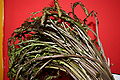 Young shoots - edible part of black bryony


References
[edit | edit source]

- ^ a b Kew World Checklist of Selected Plant Families.
- ^ Lua error in Module:Citation/CS1/Configuration at line 2172: attempt to index field '?' (a nil value).
- ^ Lua error in Module:Citation/CS1/Configuration at line 2172: attempt to index field '?' (a nil value).
- ^ Lua error in Module:Citation/CS1/Configuration at line 2172: attempt to index field '?' (a nil value).
- ^ Altervista Flora Italiana, Tamaro, Dioscorea communis (L.) Caddick & Wilkin includes photos plus European distribution map
- ^ Govaerts, R., Wilkin, P. & Saunders, R.M.K. (2007). World Checklist of Dioscoreales. Yams and their allies: 1-65. The Board of Trustees of the Royal Botanic Gardens, Kew.
- ^ Dobignard, D. & Chatelain, C. (2010). Index synonymique de la flore d'Afrique du nord 1: 1-455. Éditions des conservatoire et jardin botaniques, Genève.
- ^ Blamey, M. & Grey-Wilson, C. (1989). Flora of Britain and Northern Europe. Hodder & Stoughton. Lua error in Module:Citation/CS1/Configuration at line 2172: attempt to index field '?' (a nil value)..
- ^ Flora Europaea: Tamus communis distribution Royal Botanic Garden Edinburgh, Inverleith Row, Edinburgh, EH3 5LR, United Kingdom(2008).
- ^ Lua error in Module:Citation/CS1/Configuration at line 2172: attempt to index field '?' (a nil value).
- ^ Lua error in Module:Citation/CS1/Configuration at line 2172: attempt to index field '?' (a nil value).
- ^ Lua error in Module:Citation/CS1/Configuration at line 2172: attempt to index field '?' (a nil value).
Lua error in Module:Taxonbar at line 165: attempt to index field 'wikibase' (a nil value).