Dili Municipality
 | You can help expand this article with text translated from the corresponding article in Deutsch. (July 2011) Click [show] for important translation instructions.
|
Dili | |
|---|---|
| |
 Cathedral of Dili | |
| {{#property:P242}} | |
| Lua error in Module:Infobox_mapframe at line 197: attempt to index field 'wikibase' (a nil value). | |
| Coordinates: Lua error in Module:Coordinates at line 489: attempt to index field 'wikibase' (a nil value). | |
| Country | Error creating thumbnail: Timor-Leste |
| Capital | Dili |
| Administrative posts | |
| Area | |
• Total | [convert: invalid number] |
| • Rank | 13th |
| Population (Error: Invalid time. lua error in module:wikidata at line 880: attempt to index field 'wikibase' (a nil value).) | |
• Total | Lua error in Module:Wikidata at line 448: attempt to index field 'wikibase' (a nil value). Template:TL wikidata/deprecated parameter |
| • Rank | 1st |
| • Rank | 1st |
| Households (Error: Invalid time. lua error in module:wikidata at line 880: attempt to index field 'wikibase' (a nil value).) | |
| • Total | Lua error in Module:Wikidata at line 448: attempt to index field 'wikibase' (a nil value). Template:TL wikidata/deprecated parameter |
| • Rank | 1st |
| Time zone | UTC+09:00 (TLT) |
| ISO 3166 code | TL-DI |
| HDI (2017) | 0.733[1] high · 1st |
| Website | Dili Municipality |
Dili Municipality (Portuguese: Município Díli, Tetum: Munisípiu Dili) is one of the 14 municipalities, formerly districts, of Timor-Leste, and includes the national capital Dili. The municipality had a population of 277,279 as of 2015[update],[2] most of whom live in the capital city.
Toponymy
[edit | edit source]Several explanations have been proffered for the origin of the municipality's name. It is often explained, including by the municipality's own website, as being derived from the Tetum word ai-dila, which means pawpaw.[3][4] According to Australian linguist, ethnologist and historian Geoffrey Hull, however, that explanation is phonologically and historically implausible, as the language spoken in the area now known as Dili before the Portuguese established their seat of administration there in 1769 was Mambai, not Tetum. Hull describes such explanations as "folk etymology".[3]
In Hull's view, the word Dili appears to be cognate with the Bunak word zili (transl. 'cliff'), a reference to the escarpment behind the city; he comments that a Papuan language, of which Bunak is an example, was spoken in the area before the spread of the Austronesian-based Mambai and Tetum languages.[3]
Another "folk etymology" explanation suggested by the municipality is that its name is derived from the Portuguese word Dali, which, in turn, is an approximation of the Tetum expression tali akar (transl. 'hemp rope'). According to the municipality, there were lots of hemp trees in what is now the suco of Caicoli at the centre of the then Reino Motaain, which covered present day Dili. Every year, the local community held a traditional dance ceremony and also offered sacrifices for the hemp tree. The local people believed that the Portuguese word Dali meant 'sacred eye', and so they adopted it as the area's name.[4]
Geography
[edit | edit source]Since 1 January 2022, Dili has been the second smallest municipality in Timor-Leste by area, at 224.0 km2 (86.5 sq mi). It also has the highest population.[5] It lies on the north coast of the island of Timor facing Ombai Strait,[6]: ES I-4, 2-13 and borders the municipalities of Manatuto to the east, Aileu to the south, and Liquiçá to the west.
Atauro Island, to the north of the municipality opposite the capital, was one of Dili's administrative posts until the end of 2021, when it became a separate municipality.[7][8]
Dili is the economic and political centre of the country.
Administrative posts
[edit | edit source]The municipality's administrative posts (formerly sub-districts) are:[9]
The administrative posts are divided into 31 sucos ("villages") in total.
-
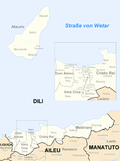 Subdivisions of the municipality
 -
 Cities in the municipality of Dili


References
[edit | edit source]Notes
[edit | edit source]- ^ Lua error in Module:Citation/CS1/Configuration at line 2172: attempt to index field '?' (a nil value).
- ^ Lua error in Module:Citation/CS1/Configuration at line 2172: attempt to index field '?' (a nil value).
- ^ a b c Lua error in Module:Citation/CS1/Configuration at line 2172: attempt to index field '?' (a nil value).
- ^ a b Lua error in Module:Citation/CS1/Configuration at line 2172: attempt to index field '?' (a nil value).
- ^ Lua error in Module:Citation/CS1/Configuration at line 2172: attempt to index field '?' (a nil value).
- ^ Lua error in Module:Citation/CS1/Configuration at line 2172: attempt to index field '?' (a nil value).
- ^ Lua error in Module:Citation/CS1/Configuration at line 2172: attempt to index field '?' (a nil value).
- ^ Lua error in Module:Citation/CS1/Configuration at line 2172: attempt to index field '?' (a nil value).
- ^ Lua error in Module:Citation/CS1/Configuration at line 2172: attempt to index field '?' (a nil value).
Bibliography
[edit | edit source]- Lua error in Module:Citation/CS1/Configuration at line 2172: attempt to index field '?' (a nil value).
- Lua error in Module:Citation/CS1/Configuration at line 2172: attempt to index field '?' (a nil value).
- Lua error in Module:Citation/CS1/Configuration at line 2172: attempt to index field '?' (a nil value).
- Lua error in Module:Citation/CS1/Configuration at line 2172: attempt to index field '?' (a nil value).
External links
[edit | edit source]Error creating thumbnail: File missing Media related to Lua error in Module:Commons_link at line 62: attempt to index field 'wikibase' (a nil value). at Wikimedia Commons

- Dili Municipality – official site (in Tetum with some content in English)
- Dili Municipality – information page on Ministry of State Administration site (in Portuguese and Tetum)
Lua error in mw.title.lua at line 392: bad argument #2 to 'title.new' (unrecognized namespace name 'Portal').
Lua error in Module:Authority_control at line 153: attempt to index field 'wikibase' (a nil value).