Chawk Mosque, Dhaka
 | This article needs additional citations for verification. (March 2022) |
| Chawkbazar Shahi Mosque | |
|---|---|
চকবাজার শাহী মসজিদ | |
| Error creating thumbnail: The mosque in 2020 | |
| Religion | |
| Affiliation | Islam |
| Ecclesiastical or organisational status | Mosque |
| Status | Active |
| Location | |
| Location | Chowk Bazaar, Dhaka |
| Country | Bangladesh |
| Lua error in Module:Location_map at line 411: Malformed coordinates value. | |
| Coordinates | Lua error in Module:Coordinates at line 489: attempt to index field 'wikibase' (a nil value). |
| Architecture | |
| Style | Mughal |
| Groundbreaking | 1664 CE |
| Completed | 1086 AH (1675/1676 CE) |
| Specifications | |
| Capacity | c. 10,000 worshipers |
| Dome | Three |
| Minaret | Ten |
The Chawkbazar Shahi Mosque (Bengali: চকবাজার শাহী মসজিদ) also known as Chawk Mosque is a mosque located in the Chowk Bazaar area in the old city of Dhaka, Bangladesh.[1]
History
[edit | edit source]The mosque was constructed in 1664 by Shaista Khan, the Subahdar of Mughal Bengal.[2] The mosque is known as the Shahi Mosque because it was founded by the Mughal governor or Subahdar. The mosque is built above a raised platform. The three domed mosque above the platform, now transformed into a multi-storied structure was originally a copy of Shaista Khan's another three domed mosque at the Mitford Hospital compound near the Buriganga River. There are some square-shaped rooms built for the Imam and for students of the madrasa. Today the original building design has lost much of its original form through multiple renovations and extensions. The mosque is noted for having a rainbow minaret.
Architecture
[edit | edit source]The promenade around the three domed prayer chamber, since there was no separate structure for study purpose, might have been used for open-air classes and the vaulted room with book-shelves on their walls underneath the platform may have been designed to provide residential accommodation for those who used to teach and study here. In that context Chawk Mosque may be regarded as the first known example of Residential Madrasa Mosque.
It is an ingenious[peacock prose] way of accommodating two structures-a madrasa and a mosque in a single building which not only saved space but also a considerable amount of money.[2]
The construction has been dated from 1664 CE, as noted by an inscription in Persian over a doorway. The inscription attributes the project to Subahdar Shaista Khan. So far known this is the earliest dated mosque in the History of Muslim Architecture in Bengal built on a high vaulted platform. Its architectural design was perhaps influenced by Tughlaq Architectures; such as Khirki Masjid or Kalan Mosque of Delhi. Influenced by this structure some other mosques were built in Dhaka and Murshidabad.
It has been suggested that Shaista Khan himself had composed the versified inscription, as his poetic nom de plume was "Talib". The inscription reads:[3]
"The rightly guided Amīr al-Umarā Shaista Khan - built this mosque for the sake of God / To the seeker (t̤ālib) enquiring its date - I said, "God's bidding is accomplished" / Year 1086 Hijri (1675-76 CE)."
Gallery
[edit | edit source]-
 The central Mihrab
 -
 The three domes
 -
 The interior of the mosque in May 2019
 -
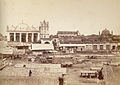 The mosque (on the upper-left), photographed by Johnston and Hoffmann in 1885
 -
The inscription


See also
[edit | edit source]References
[edit | edit source]- ^ MA Bari, Chawk Mosque (Dhaka), Banglapedia: The National Encyclopedia of Bangladesh, Asiatic Society of Bangladesh, Dhaka, Retrieved: 2012-09-18
- ^ a b *Husain, A. B. (2007). Architecture – A History Through Ages. Dhaka: Asiatic Society of Bangladesh (page 287).
- ^ *Karim, Abdul. (1992) Corpus of the Arabic and Persian Inscriptions of Bengal. Dhaka: Asiatic Society of Bangladesh (page 469).
Further reading
[edit | edit source]- Mamoon, M. (1993). Dhaka-Smriti Bismritir Nogori. Dhaka: Anannya (page 78)
- Husain, A. B. (2007). Architecture – A History Through Ages. Dhaka: Asiatic Society of Bangladesh (page 287)
- Karim, Abdul. (1992) Corpus of the Arabic and Persian Inscriptions of Bengal. Dhaka: Asiatic Society of Bangladesh (page 469)


