Beypore or Beypur (Malayalam:[beːpːuːr], formerly Beypoor) is an ancient port town and locality town in Kozhikode district in the state of Kerala, India. It is located opposite to Chaliyam, the estuary where the river Chaliyar empties into the Arabian Sea. Beypore is part of Kozhikode Municipal Corporation. The town was formerly known as Vaypura or Vadaparappanad and also as Beydary. Tipu Sultan, ruler of Mysore, named the town Sultan Pattanam. There is a marina and a beach, while Beypore port is one of the oldest ports in Kerala, which historically traded with the Middle East. Beypore is noted for building wooden ships, known as dhows or urus in the Malayalam language. These ships were usually bought by Arab merchants for trading and fishing but are now used as tourist ships. According to Captain Iwata, founder member of the Association of Sumerian Ships in Japan, Sumerian ships might have been built in Beypore. There is evidence to prove that Beypore had direct trade links with Mesopotamia and was a prominent link on the maritime silk route. The first railway line of Kerala was laid in 1861 from Tirur to Beypore (Chaliyam), passing through Tanur, Parappanangadi, Vallikkunnu, and Kadalundi.
Beypore is located 10 km (6.2 mi) away from Kozhikode city.
In the medieval period, Beypore was ruled by four Kovilakams - Karippa Puthiyakovilakam, Manayat Kovilakam, Nediyaal Kovilakam and Panagad Kovilakam - all belonging to the Beypore branch of the Parappanad family. The Parappanad royal family is related to the more famous Travancore royal family. Marthanda Varma, the founder of Travancore, belongs to Parappanad royal family. They also had branches at Parappanangadi, Vallikkunnu and Beypore.[15]
Beypore was visited first by Romans and afterwards by Chinese, Syrians, Arabs and in recent centuries by Europeans for trade. Beypore has a long history of being a centre for shipbuilding since the first century AD, and it was further expanded under the East India Company during the early nineteenth century. The Indian Ocean trade started from ancient times and strengthened during the medieval times. While in the old days Malabar directly traded with the Greeks and Romans, it concentrated on exchanges with the Middle Eastern ports in the medieval times. This exchange of goods resulted also in transfer of people from their abodes. While it is mentioned that Malabaris were found along African ports and even Egypt's, it was mostly Arabs who migrated to the Malabar coasts, mainly to administer, control and conduct the trade with their brethren in Yemen, Basra and Egyptian ports. Beypore was virtually a free port with only an export import duty imposed by the ruling Zamorins. The intermediaries between the Arabs and the Nairs were the Moplahs (themselves a community started by the intermingling Arab men and local women from ancient times). Also the south east Malay ports sent ships to Malabar for the cloth from Kerala, until British cloth took its place later in the 19th century. It was also a stop over for Hajj pilgrims from south east Asia. The Arab settlers in Malabar even had African slaves during that period.
File:Uru.jpgBeypore is world-famous for the ancient design boats called Urus
Beypore port is a sub-port of Kozhikode port, located approximately 10 km (6.2 mi) south of Kozhikode. The land for the port was acquired from Beypore Karippa Puthiyakovilakam in 1963 and 1964. It is an estuarine port, where Beypore river discharges into the Arabian Sea. Beypore is 180 km (110 mi) North of Cochin and 391 km (243 mi) away from Trivandrum. Beypore port is the second biggest port in Kerala after Cochin and currently handles about 100,000 tonnes of cargo and 7500 passengers per annum. The nearest ports are Kochi and Mangalore. The port has a depth of about 5 metres (16 ft) alongside wharf and approach channel. Beypore port is one of the oldest ports in Kerala from where trading was done to the Middle East.
The uru, or "Fat Boat", is a generic name for large dhow-type wooden ships made in Beypore.[citation needed] This type of boat has been used by the Arabs since ancient times as trading vessels, and to this day, urus are being manufactured and exported to Arab nations from Beypore.[16] These boats used to be built of several types of wood, the main one being teak. The teak was taken from Nilambur forests in earlier times, but now imported Malaysian teak is used.[17]
As of 2001[update] India census,[19] Beypore had a population of 66,883. Males constitute 49% of the population and females 51%. Beypore has an average literacy rate of 81%, higher than the national average of 59.5%; with 50% of the males and 50% of females literate. 13% of the population is under 6 years of age.
Pulimuttu- Pulimuttu is the local name of the 1-kilometre-long (0.62 mi) bridge made of stone stretching in to sea. It is made by piling stones like a pathway to sea. File:StonePier Beypore.jpgStonePier Beypore
Beypore Beach
Beypore light house is situated at the south bank of chaliyar.
Error creating thumbnail: File missing Media related to Lua error in Module:Commons_link at line 62: attempt to index field 'wikibase' (a nil value). at Wikimedia Commons
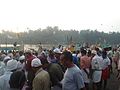 Fishing in Beypore


![[icon]](/index.php/File:Wiki_letter_w_cropped.svg)


