Baccharis sarothroides
| Baccharis sarothroides | |
|---|---|
| File:Baccharissarothroides.JPG | |
| Scientific classification Edit this classification | |
| Kingdom: | Plantae |
| Clade: | Tracheophytes |
| Clade: | Angiosperms |
| Clade: | Eudicots |
| Clade: | Asterids |
| Order: | Asterales |
| Family: | Asteraceae |
| Genus: | Baccharis |
| Species: | B. sarothroides
|
| Binomial name | |
| Baccharis sarothroides | |


Baccharis sarothroides is a North American species of flowering shrub known by the common names broom baccharis, desertbroom,[1][2] greasewood,[1] rosin-bush[1] and groundsel[1] in English and "escoba amarga" or "romerillo" in Spanish. This is a spreading, woody shrub usually sticky with glandular secretions along the primarily leafless green stems. The small, thick leaves are a few centimeters long and are absent much of the year, giving the shrub a spindly, twiggy appearance. It flowers abundantly with tiny green blooms on separate male and female plants.[1]
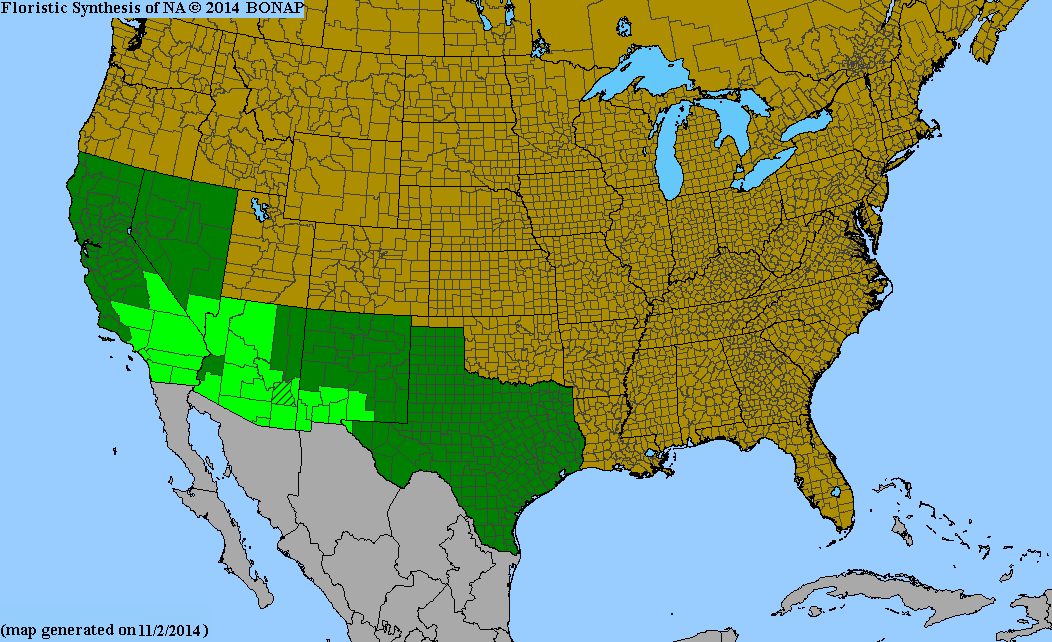
Native to the Sonoran Desert of northwestern Mexico (Baja California, Baja California Sur, Sinaloa, Sonora) and the Southwestern United States (southern California, Arizona, New Mexico, western Texas), it is common in gravelly dry soils and disturbed areas.[3][1]
Uses
[edit | edit source]The Seri refer to desert broom as cascol caaco, and make a decoction by cooking the twigs. This drink is used to treat colds, sinus headache, and general sore achey ailments. The same tea is also used as a rub for sore muscles.[4]
Studies done on plant extracts show that desert broom is rich in leutolin, a flavonoid that has demonstrated anti-inflammatory, antioxidant, and cholesterol lowering capabilities. Desert broom also has quercetin, a proven antioxidant, and apigenin a chemical which binds to the same brain receptor sites that Valium does.[5][6] However many members of the Sunflower family also contain compounds that cause negative side effects, thus caution is advised until this plant is more extensively tested.
Planting and care
[edit | edit source]Most people try to get rid of this plant, but it will grow in heavy clay or saline soils. The tall, bushy shrub has green stems and twigs and highly reduced leaves. It will accept shearing and can be trained into a decent, short-lived privacy hedge, useful while the longer-lived, taller, but slower growing Arizona rosewood gets established. Plants may be purchased at nurseries and planted in place. Avoid overwatering in heavy soils as desert broom will drown.[7]
References
[edit | edit source]- ^ a b c d e f Lua error in Module:Citation/CS1/Configuration at line 2172: attempt to index field '?' (a nil value).
- ^ Calflora taxon report, Baccharis sarothroides A. Gray, broom baccharis, desertbroom baccharis
- ^ Biota of North America Program 2014 county distribution map
- ^ Felger, R. S. and M. B. Moser, 1985, People of the Desert and Sea. University of Arizona Press, Tucson, AZ.
- ^ Lua error in Module:Citation/CS1/Configuration at line 2172: attempt to index field '?' (a nil value).
- ^ Karch, S. B. 1999. The Consumer's Guide to Herbal Medicine. Advanced Research Press, New York, NY.
- ^ Soule, J. 2011. Father Kino's Herbs: Growing and Using Them Today. Tierra del Sol Press.
External links
[edit | edit source]- Error creating thumbnail: File missing Media related to Lua error in Module:Commons_link at line 62: attempt to index field 'wikibase' (a nil value). at Wikimedia Commons
- Jepson Manual Treatment of Baccharis sarothroides
- Baccharis sarothroides — Calphotos Photos gallery, University of California

Lua error in Module:Taxonbar at line 165: attempt to index field 'wikibase' (a nil value).