3402 Wisdom
| Discovery[1] | |
|---|---|
| Discovered by | E. Bowell |
| Discovery site | Anderson Mesa Stn. |
| Discovery date | 5 August 1981 |
| Designations | |
| (3402) Wisdom | |
Named after | Jack Wisdom[2] (American planetary scientist) |
| 1981 PB | |
| Mars-crosser[1][3][4] | |
| Orbital characteristics[1] | |
| Epoch 23 March 2018 (JD 2458200.5) | |
| Uncertainty parameter 0 | |
| Observation arc | 41.20 yr (15,047 d) |
| Aphelion | 2.7283 AU |
| Perihelion | 1.5352 AU |
| 2.1317 AU | |
| Eccentricity | 0.2798 |
| 3.11 yr (1,137 d) | |
| 285.37° | |
| 0° 19m 0.12s / day | |
| Inclination | 4.8531° |
| 357.87° | |
| 303.69° | |
| Earth MOID | 0.5266 AU (205 LD) |
| Physical characteristics | |
| 2.05±0.49 km[5] 2.50±0.50 km[6] 2.59 km (derived)[4] | |
| 4.9949±0.0001 h[7] 4.9951±0.0001 h[a] | |
| 0.20 (assumed)[4] 0.283±0.113[6] 0.32±0.16[5] | |
| S (assumed)[4] | |
| 14.85±0.11 (R)[a] 15.00[1][6] 15.13±0.26[8] 15.34[4][9] 15.44[5] | |
3402 Wisdom, provisional designation 1981 PB, is a stony asteroid and Mars-crosser on an eccentric orbit from the inner regions of the asteroid belt, approximately 2.5 kilometers (1.6 miles) in diameter. It was discovered on 5 August 1981, by American astronomer Edward Bowell at Lowell's Anderson Mesa Station near Flagstaff, Arizona, in the United States.[3] The presumed bright S-type asteroid has a rotation period of 4.99 hours.[4] It was named after American planetary scientist Jack Wisdom.[2]
Orbit and classification
[edit | edit source]Wisdom is a Mars-crossing asteroid, a member of a dynamically unstable group, located between the main belt and the near-Earth populations, and crossing the orbit of Mars at 1.666 AU. It orbits the Sun at a distance of 1.5–2.7 AU once every 3 years and 1 month (1,137 days; semi-major axis of 2.13 AU). Its orbit has an eccentricity of 0.28 and an inclination of 5° with respect to the ecliptic.[1]
The body's observation arc begins with a precovery taken at Palomar Observatory in February 1977, more than 4 years prior to its official discovery observation at Anderson Mesa.[3]
Physical characteristics
[edit | edit source]Wisdom is an assumed stony S-type asteroid.[4]
Rotation period
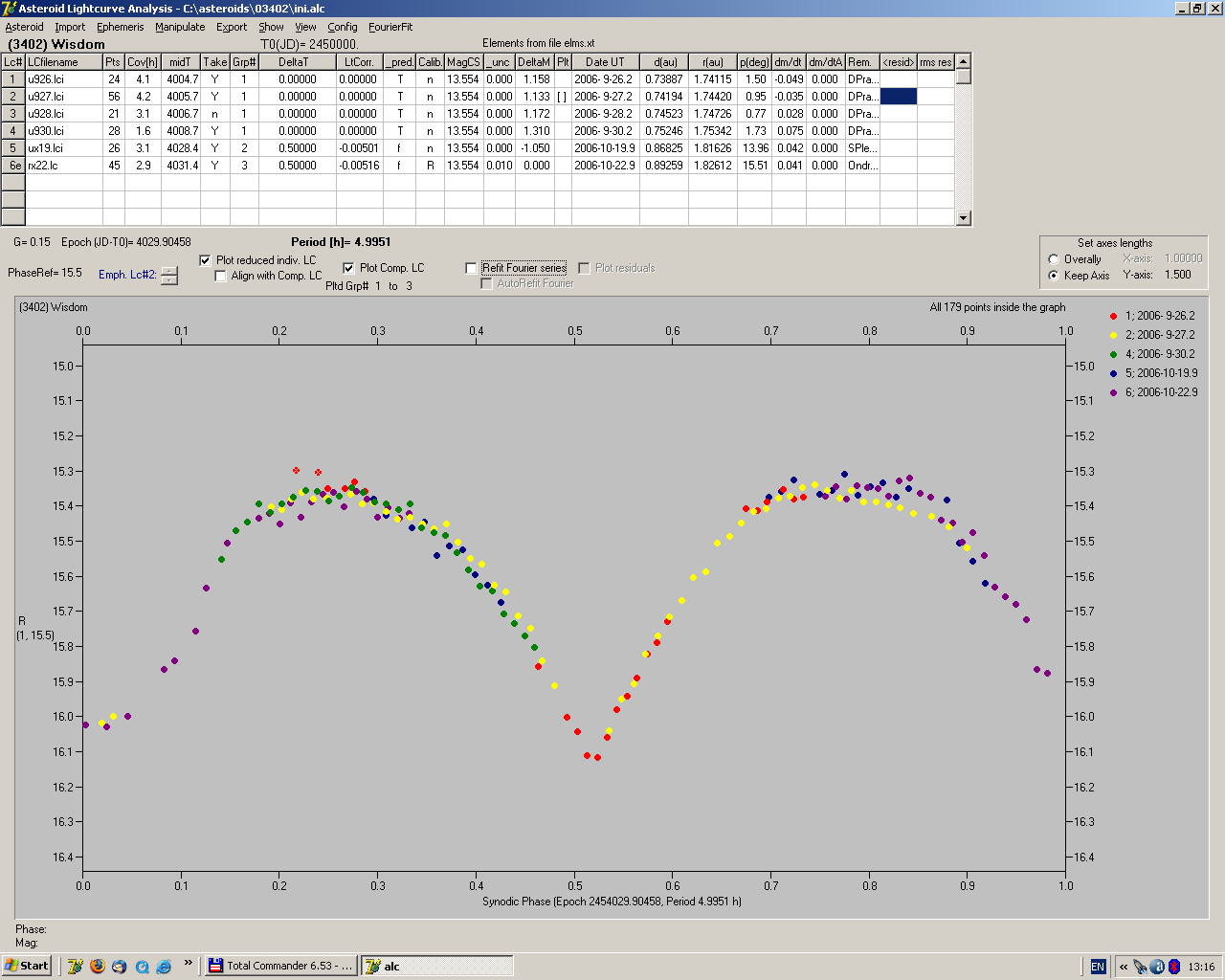
[edit | edit source]In October 2006, two rotational lightcurves of Wisdom were obtained from photometric observations at Ondřejov, Skalnaté pleso and Carbuncle Hill observatories (912;I00). Lightcurve analysis gave a well-defined rotation period of 4.9949 and 4.9951 hours with a high brightness variation of 0.75 and 0.74 magnitude, respectively (U=3/3).[7][a] A high brightness amplitude typically indicate that the body has an elongated rather than spherical shape.
Diameter and albedo
[edit | edit source]According to the survey carried out by the NEOWISE mission of NASA's Wide-field Infrared Survey Explorer, Wisdom measures 2.05 and 2.50 kilometers in diameter and its surface has an albedo of 0.32 and 0.283, respectively.[5][6] The Collaborative Asteroid Lightcurve Link assumes a standard albedo for stony asteroids of 0.20 and derives a diameter of 2.59 kilometers based on an absolute magnitude of 15.34.[4]
With a mean diameter of approximately 2.5 kilometers, Wisdom is one of the smaller mid-sized Mars-crossing asteroids. It is assumed that there are up to 10 thousand Mars-crossers larger than 1 kilometer.[10] The largest members of this dynamical group are 132 Aethra, 323 Brucia, 2204 Lyyli and 512 Taurinensis, which measure between 43 and 25 kilometers in diameter.
Naming
[edit | edit source]This minor planet was named after Jack Wisdom (born 1953), a dynamicist and professor of planetary sciences at MIT. Wisdom pioneered in the study of the dynamics and long-term stability of the Solar System, and demonstrated the dynamical mechanism for the clearing of asteroid in the Kirkwood gaps of the asteroid belt.[2] The official naming citation was published by the Minor Planet Center on 2 February 1988 (M.P.C. 12803).[11]
Notes
[edit | edit source]- ^ a b c Pravec October (2006) web: lightcurve plot of (3402) Wisdom, with a rotation period 4.9951±0.0001 hours with a brightness amplitude of 0.74±0.02 mag. Quality Code of 3. Observation in the R-band. Absolute magnitude of 14.85±0.11. Summary figures at LCDB and Ondrejov Asteroid Photometry Project (see data sheet)
References
[edit | edit source]- ^ a b c d e Lua error in Module:Citation/CS1/Configuration at line 2172: attempt to index field '?' (a nil value).
- ^ a b c Lua error in Module:Citation/CS1/Configuration at line 2172: attempt to index field '?' (a nil value).
- ^ a b c Lua error in Module:Citation/CS1/Configuration at line 2172: attempt to index field '?' (a nil value).
- ^ a b c d e f g h Lua error in Module:Citation/CS1/Configuration at line 2172: attempt to index field '?' (a nil value).
- ^ a b c d Lua error in Module:Citation/CS1/Configuration at line 2172: attempt to index field '?' (a nil value).
- ^ a b c d Lua error in Module:Citation/CS1/Configuration at line 2172: attempt to index field '?' (a nil value).
- ^ a b Lua error in Module:Citation/CS1/Configuration at line 2172: attempt to index field '?' (a nil value).
- ^ Lua error in Module:Citation/CS1/Configuration at line 2172: attempt to index field '?' (a nil value).
- ^ Lua error in Module:Citation/CS1/Configuration at line 2172: attempt to index field '?' (a nil value).
- ^ Lua error in Module:Citation/CS1/Configuration at line 2172: attempt to index field '?' (a nil value).
- ^ Lua error in Module:Citation/CS1/Configuration at line 2172: attempt to index field '?' (a nil value).
External links
[edit | edit source]- Asteroid Lightcurve Database (LCDB), query form (info Archived 16 December 2017 at the Wayback Machine)
- Dictionary of Minor Planet Names, Google books
- Discovery Circumstances: Numbered Minor Planets (1)-(5000) – Minor Planet Center
- 3402 Wisdom at AstDyS-2, Asteroids—Dynamic Site
- 3402 Wisdom at the JPL Small-Body DatabaseLua error in Module:EditAtWikidata at line 29: attempt to index field 'wikibase' (a nil value).
Lua error in Module:Authority_control at line 153: attempt to index field 'wikibase' (a nil value).