Classification of Fatou components
In mathematics, Fatou components are components of the Fatou set. They were named after Pierre Fatou.
Rational case
[edit | edit source]If f is a rational function
defined in the extended complex plane, and if it is a nonlinear function (degree > 1)
then for a periodic component of the Fatou set, exactly one of the following holds:
- contains an attracting periodic point
- is parabolic[1]
- is a Siegel disc: a simply connected Fatou component on which f(z) is analytically conjugate to a Euclidean rotation of the unit disc onto itself by an irrational rotation angle.
- is a Herman ring: a double connected Fatou component (an annulus) on which f(z) is analytically conjugate to a Euclidean rotation of a round annulus, again by an irrational rotation angle.
-
Julia set (white) and Fatou set (dark red/green/blue) for with in the complex plane.
-
Julia set with parabolic cycle
-
Julia set with Siegel disc (elliptic case)
-
Julia set with Herman ring
Attracting periodic point
[edit | edit source]The components of the map contain the attracting points that are the solutions to . This is because the map is the one to use for finding solutions to the equation by Newton–Raphson formula. The solutions must naturally be attracting fixed points.
-
Dynamic plane consist of Fatou 2 superattracting period 1 basins, each has only one component.
-
Level curves and rays in superattractive case
-
Julia set with superattracting cycles (hyperbolic) in the interior (period 2) and the exterior (period 1)
Herman ring
[edit | edit source]The map
and t = 0.6151732... will produce a Herman ring.[2] It is shown by Shishikura that the degree of such map must be at least 3, as in this example.
More than one type of component
[edit | edit source]If degree d is greater than 2 then there is more than one critical point and then can be more than one type of component
-
Herman+Parabolic
-
Period 3 and 105
-
attracting and parabolic
-
period 1 and period 1
-
period 4 and 4 (2 attracting basins)
-
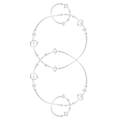 two period 2 basins
%3D1_over_(z3%2Ba*z%2B_b)_with_a_%3D_2.099609375_and_b_%3D_0.349609375.png)


%3D1_over_az5%2Bz3%2Bbz.png)
Transcendental case
[edit | edit source]Baker domain
[edit | edit source]In case of transcendental functions there is another type of periodic Fatou components, called Baker domain: these are "domains on which the iterates tend to an essential singularity (not possible for polynomials and rational functions)"[3][4] one example of such a function is:[5]
Wandering domain
[edit | edit source]Transcendental maps may have wandering domains: these are Fatou components that are not eventually periodic.
See also
[edit | edit source]References
[edit | edit source]- ^ wikibooks : parabolic Julia sets
- ^ Lua error in Module:Citation/CS1/Configuration at line 2172: attempt to index field '?' (a nil value).
- ^ An Introduction to Holomorphic Dynamics (with particular focus on transcendental functions)by L. Rempe
- ^ Siegel Discs in Complex Dynamics by Tarakanta Nayak
- ^ A transcendental family with Baker domains by Aimo Hinkkanen, Hartje Kriete and Bernd Krauskopf
- ^ JULIA AND JOHN REVISITED by NICOLAE MIHALACHE
Bibliography
[edit | edit source]- Lennart Carleson and Theodore W. Gamelin, Complex Dynamics, Springer 1993.
- Alan F. Beardon Iteration of Rational Functions, Springer 1991.