Diplazium esculentum
| Diplazium esculentum | |
|---|---|

| |
Scientific classification 
| |
| Kingdom: | Plantae |
| Clade: | Tracheophytes |
| Division: | Polypodiophyta |
| Class: | Polypodiopsida |
| Order: | Polypodiales |
| Suborder: | Aspleniineae |
| Family: | Athyriaceae |
| Genus: | Diplazium |
| Species: | D. esculentum
|
| Binomial name | |
| Diplazium esculentum | |
| Synonyms | |
|
Athyrium esculentum | |
Diplazium esculentum, the vegetable fern, is an edible fern found throughout Asia and Oceania. It is probably one of the most commonly consumed ferns.[1]
The genus Diplazium is in the family Athyriaceae, in the eupolypods II clade[2] of the order Polypodiales,[3] in the class Polypodiopsida.[4]
Description
[edit | edit source]This plant is a large perennial fern with an ascending rhizome of about 50 cm high and covered with short rufous scales of about 1 mm long. The plant is bipinnate with long brownish petioles, and the petiole base is black and covered with short scales. The frond can reach 1.5 m in length, and the pinnae is about 8 cm long and 2 cm wide.[5]
Uses
[edit | edit source]The young fronds are stir-fried and used in salads.[6][7]
They may have mild amounts of fern toxins but no major toxic effects are recorded.[8]
It is known as pakô ("wing") in the Philippines,[6] pucuk paku and paku tanjung in Malaysia, sayur paku or pakis in Indonesia, phak koot (Thai: ผักกูด) in Thailand, rau dớn in Vietnam, dhekia (Assamese: ঢেঁকীয়া) in Assamese, Dhenki Shaak (Bengali: ঢেঁকি শাক) in Bengali, paloi saag (Bengali: পালই শাগ) in Eastern Bengali, ningro in Nepali, dingkia in Boro and linguda in northern India, referring to the curled fronds.
It is known as pohole or hō'i'o in Hawaiian cuisine. The ferns grow in wet areas of shady valleys.[9][10] The fern species Diplazium esculentum is believed to have been introduced and naturalized in Hawaii and was first reported collected in 1910.[10] The fern also has medicinal uses.[11]
Pharmacological effects
[edit | edit source]The extract also had alpha-glucosidase inhibitory activity.[12]
Gallery
[edit | edit source]-
 Yam phak khut, a Thai salad of fern leaves and pork
 -
 Ensaladang pako (fern salad) with salted egg from the Philippines
 -
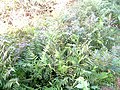 Habitat


See also
[edit | edit source]References
[edit | edit source]- ^ Lua error in Module:Citation/CS1/Configuration at line 2172: attempt to index field '?' (a nil value).
- ^ Lua error in Module:Citation/CS1/Configuration at line 2172: attempt to index field '?' (a nil value).
- ^ Lua error in Module:Citation/CS1/Configuration at line 2172: attempt to index field '?' (a nil value).
- ^ Lua error in Module:Citation/CS1/Configuration at line 2172: attempt to index field '?' (a nil value).
- ^ Lua error in Module:Citation/CS1/Configuration at line 2172: attempt to index field '?' (a nil value).
- ^ a b Lua error in Module:Citation/CS1/Configuration at line 2172: attempt to index field '?' (a nil value).
- ^ Ethnobotanical Leaflets
- ^ Lua error in Module:Citation/CS1/Configuration at line 2172: attempt to index field '?' (a nil value).
- ^ N_ Kua'_ina: Living Hawaiian Culture by Davianna McGrego pages 110, 133
- ^ a b [1] Hawai_i's Ferns and Fern Allies by Daniel Dooley Palmer page 125
- ^ CRC World Dictionary of Medicinal and Poisonous Plants: Common Names, Scientific Names, Eponyms, Synonyms, and Etymology (5 Volume Set) by Umberto Quattrocchi CRC Press, May 3, 2012 – Science – 3960 pages page 1439
- ^ Chai TT, Yeoh LY, Mohd Ismail NI, Ong HC, Abd Manan F, Wong FC (2015) Evaluation of glucosidase inhibitory and cytotoxic potential of five selected edible and medicinal ferns Archived 2016-10-18 at the Wayback Machine. Tropical Journal of Pharmaceutical Research 14 (3): 449-454.
Lua error in Module:Taxonbar at line 165: attempt to index field 'wikibase' (a nil value).