Sternothyroid muscle
| Sternothyroid muscle | |
|---|---|
| File:Sternothyroideus.png Sternothyroid visible center left | |
| File:Gray384.png Section of the neck at about the level of the sixth cervical vertebra. Showing the arrangement of the fascia coli. (Sternothyroideus labeled at right, third from top.) | |
| Details | |
| Origin | Manubrium |
| Insertion | Thyroid cartilage |
| Artery | Superior thyroid artery |
| Nerve | Ansa cervicalis |
| Actions | Depresses thyroid cartilage |
| Identifiers | |
| Latin | musculus sternothyroideus |
| TA98 | Lua error in Module:Wikidata at line 746: attempt to index field 'wikibase' (a nil value). |
| TH | {{#property:P1694}} |
| TE | {{#property:P1693}} |
| FMA | {{#property:P1402}} |
| Anatomical terms of muscle [[[d:Lua error in Module:Wikidata at line 865: attempt to index field 'wikibase' (a nil value).|edit on Wikidata]]] | |
The sternothyroid muscle (or sternothyroideus) is an infrahyoid muscle of the neck.[1] It acts to depress the hyoid bone.
Structure
[edit | edit source]The two muscles are in contact with each other proximally (close to their origin), but diverge distally (towards their insertions).[1]
Origin
[edit | edit source]The sternothyroid arises from the posterior surface of the manubrium of the sternum from the midline to the notch for the first rib (inferior to the origin of the sternohyoid muscle), and the posterior margin of the first costal cartilage.[1]
Insertion
[edit | edit source]It inserts onto the oblique line of the lamina of thyroid cartilage.[1]
Innervation
[edit | edit source]The sternothyroid muscle receives motor innervation from branches of the ansa cervicalis (ultimately derived from cervical spinal nerves C1-C3).[1]
Relations
[edit | edit source]The sternothyroid muscle is shorter and wider than the sternohyoid muscle and is situated deep to and partially medial to it.[1]
Variations
[edit | edit source]The muscle may be absent or doubled. It may issue accessory slips to the thyrohyoid muscle, inferior pharyngeal constrictor muscle, or the carotid sheath.
Actions/movements
[edit | edit source]The sternothyroid muscle indirectly depresses the hyoid bone by means of pulling the thyroid. When the hyoid bone is fixed, it instead elevates the larynx (producing an increased voice pitch).[1]
Clinical significance
[edit | edit source]The upward extension of a thyroid swelling (goitre) is prevented by the attachment of the sternothyroid to the thyroid cartilage. A goitre can therefore only grow to the front, back or middle but no higher.
Additional images
[edit | edit source]-
 Superficial dissection of the right side of the neck, showing the carotid and subclavian arteries.
 -
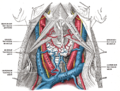 The fascia and middle thyroid veins.
 -
 Hypoglossal nerve, cervical plexus, and their branches.
 -
Side view of the larynx, showing muscular attachments.
-
Sternothyroid muscle


References
[edit | edit source]Public domain This article incorporates text in the public domain from the 20th edition of Gray's Anatomy (1918)

External links
[edit | edit source]- Photo of model at Waynesburg College musclehead/sternothyroid
- Anatomy photo:25:03-0105 at the SUNY Downstate Medical Center - "The Muscular triangle"
- PTCentral

Lua error in mw.title.lua at line 392: bad argument #2 to 'title.new' (unrecognized namespace name 'Portal'). Lua error in Module:Authority_control at line 153: attempt to index field 'wikibase' (a nil value).