Prunus mexicana
| Prunus mexicana | |
|---|---|

| |
Scientific classification 
| |
| Kingdom: | Plantae |
| Clade: | Tracheophytes |
| Clade: | Angiosperms |
| Clade: | Eudicots |
| Clade: | Rosids |
| Order: | Rosales |
| Family: | Rosaceae |
| Genus: | Prunus |
| Subgenus: | Prunus subg. Prunus |
| Section: | Prunus sect. Prunocerasus |
| Species: | P. mexicana
|
| Binomial name | |
| Prunus mexicana | |

| |
| Generalized natural range of Prunus mexicana | |
| Synonyms[2] | |
| |

Prunus mexicana, commonly known as the Mexican plum,[1] Inch plum, and Bigtree plum,[3] is a North American species of plum tree that can be found in the central United States and Northern Mexico.
Description
[edit | edit source]Prunus mexicana has a single trunk, an open crown, and reaches a height of 15–38 feet (4.6–11.6 m).[3] It has dark green, simple ovate leaves 2–4.5 inches (5.1–11.4 cm) long and 1.25–2 inches (3.2–5.1 cm) wide.[3] In the early spring it is covered with five-petaled fragrant white or pale pink flowers 0.75–1 inch (19–25 mm) wide.[3] Its dark gray bark is banded with horizontal lenticels.[4][verification needed] The dark red or purple fruit ripens late in the fall.[5][6]
Prunus mexicana is very similar to Prunus americana, and they intergrade along a broad contact zone centered around Arkansas and Missouri. These intermediate individuals may be impossible to assign to a specific species.[7]
Taxonomy
[edit | edit source]Prunus mexicana is included in the section Prunocerasus.[8]
Distribution and habitat
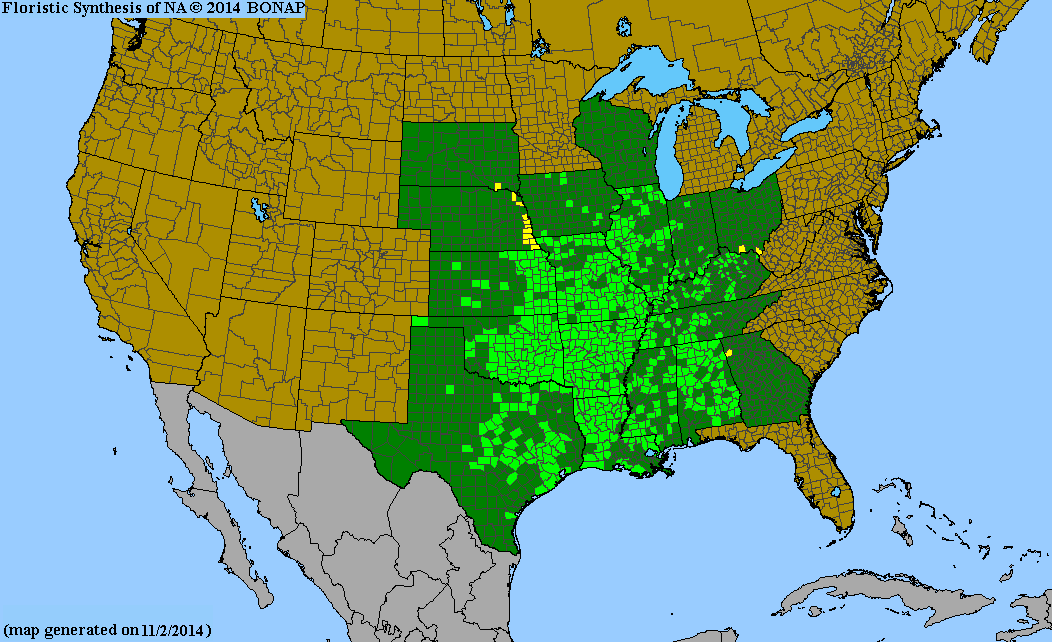
[edit | edit source]The native range of the species stretches from South Dakota east to Wisconsin, Ohio, Kentucky, and Georgia, and south to the Mexican states of Coahuila and San Luis Potosí.[1][9]
It is usually found on woodland edges or in open fields. It is adaptable to a wide range of soil pH and is drought-tolerant. The trees are hardy in U.S. Department of Agriculture zones 5 to 9.
Ecology
[edit | edit source]The fruit is eaten fresh by both mammals and birds.[3]
Uses
[edit | edit source]The fruit is made into preserves, and the tree can serve as a rootstock for grafting on other plum cultivars.[3]
Gallery
[edit | edit source]-
 Flowers of Prunus mexicana

References
[edit | edit source]- ^ a b c Lua error in Module:Citation/CS1/Configuration at line 2172: attempt to index field '?' (a nil value).
- ^ Lua error in Module:Citation/CS1/Configuration at line 2172: attempt to index field '?' (a nil value).
- ^ a b c d e f Lua error in Module:Citation/CS1/Configuration at line 2172: attempt to index field '?' (a nil value).
- ^ Lua error in Module:Citation/CS1/Configuration at line 2172: attempt to index field '?' (a nil value).
- ^ Lua error in Module:Citation/CS1/Configuration at line 2172: attempt to index field '?' (a nil value).
- ^ Flora of North America, Prunus mexicana S. Watson, 1882. Mexican or bigtree plum
- ^ Flora of North America, Prunus americana
- ^ Lua error in Module:Citation/CS1/Configuration at line 2172: attempt to index field '?' (a nil value).
- ^ Biota of North America Program 2014 county distribution map
External links
[edit | edit source]- Lua error in Module:Citation/CS1/Configuration at line 2172: attempt to index field '?' (a nil value).
- photo of herbarium specimen at Missouri Botanical Garden, collected in Nebraska in 2014
Lua error in Module:Taxonbar at line 165: attempt to index field 'wikibase' (a nil value).