Persicaria hydropiperoides
| Persicaria hydropiperoides | |
|---|---|

| |
Scientific classification 
| |
| Kingdom: | Plantae |
| Clade: | Tracheophytes |
| Clade: | Angiosperms |
| Clade: | Eudicots |
| Order: | Caryophyllales |
| Family: | Polygonaceae |
| Genus: | Persicaria |
| Species: | P. hydropiperoides
|
| Binomial name | |
| Persicaria hydropiperoides | |
| Synonyms[1][2] | |
| |
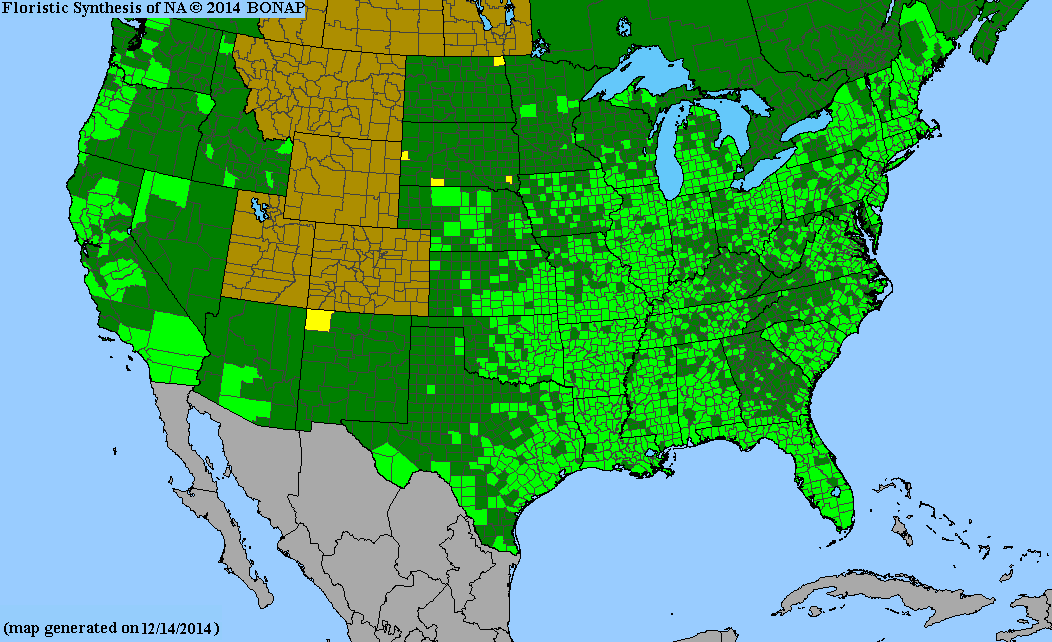
Persicaria hydropiperoides, commonly called swamp smartweed, mild waterpepper, false waterpepper,[3][4][5][6] or sometimes simply waterpepper,[7] is a species of flowering plant in the buckwheat family. It has a widespread distribution across much of North America and South America.[8][9][10][11][12] Its preferred habitat is in moist, saturated to inundated soils growing in full sun to partial shade; such as swamp forests, marshes, streams, shorelines, and ditches.[3][4][7] It is sometimes semi-aquatic.[citation needed]
Swamp smartweed is quite variable and is sometimes divided into several varieties, some of which may be better treated as species in their own right.[2]
In general, swamp smartweed is a rhizomatous perennial herb growing upright or erect and approaching a maximum height of one meter (40 inches). Roots may emerge from nodes on the lower stem. The bristly lance-shaped leaves are around 10 centimeters (4 inches) long. The leaves have sheathing stipules known as ochreae. The spike-like inflorescence produces many pinkish flowers each about 3 millimeters wide.[2]
Swamp smartweed is reported to be edible, as are all species in the genus Persicaria.[13] Although its close relatives Persicaria hydropiper and Persicaria punctata are known to possess a hot or pungent quality when consumed, swamp smartweed is said to lack the same pungency by at least one author.[13]
References
[edit | edit source]- ^ The Plant List, Persicaria hydropiperoides (Michx.) Small
- ^ a b c Flora of North America, (Michaux) Small, 1903. Swamp smartweed, renouée faux-poivre-d'eau
- ^ a b Lua error in Module:Citation/CS1/Configuration at line 2172: attempt to index field '?' (a nil value).
- ^ a b Lua error in Module:Citation/CS1/Configuration at line 2172: attempt to index field '?' (a nil value).
- ^ Lua error in Module:Citation/CS1/Configuration at line 2172: attempt to index field '?' (a nil value).
- ^ Lua error in Module:Citation/CS1/Configuration at line 2172: attempt to index field '?' (a nil value).
- ^ a b Lua error in Module:Citation/CS1/Configuration at line 2172: attempt to index field '?' (a nil value).
- ^ Biota of North America Program 2014 county distribution map
- ^ Jørgensen, P. M., M. H. Nee & S. G. Beck. (eds.) 2014. Catálogo de las plantas vasculares de Bolivia, Monographs in systematic botany from the Missouri Botanical Garden 127(1–2): i–viii, 1–1744
- ^ Marticorena, C. & M. Quezada. 1985. Catálogo de la Flora Vascular de Chile. Gayana, Botánica 42: 1–157.
- ^ Porter, D. M. 1983. Vascular plants of the Galapagos: Origins and dispersal. 33–54. In M. B. R. I. Bowman & A. E. Leviton Patterns of Evolution in Galapagos Organisms. Pacific Division, AAAS, San Francisco
- ^ Cowan, C. P. 1983. Flora de Tabasco. Listados Florísticos de México 1: 1–123.
- ^ a b Lua error in Module:Citation/CS1/Configuration at line 2172: attempt to index field '?' (a nil value).
External links
[edit | edit source]- Jepson Manual Treatment
- Missouri Plants Photo Profile
- Calphotos Photo gallery, University of California
- photo of herbarium specimen at Missouri Botanical Garden, collected in Peru in 2012
Lua error in Module:Taxonbar at line 165: attempt to index field 'wikibase' (a nil value).
 | This Polygonaceae article is a stub. You can help Wikipedia by expanding it. |